All Eyes on the Quartet: How the U.S. and Its Partners Could Push Toward Peace in Sudan
Sudan Events – Agencies
On September 12, the United States, Egypt, Saudi Arabia, and the United Arab Emirates announced a breakthrough roadmap to end Sudan’s catastrophic war. With the initiative already faltering, the four states must urgently press the country’s main warring parties to engage in peace talks.
Sudan’s brutal war—now in its third year—has shown extraordinary resistance to all peace efforts. After the split between the Sudanese army and the Rapid Support Forces (RSF) in early 2023, the country slid into a vortex of explosive conflict and state collapse. Both sides have traded military gains and losses, but the plight of Sudan’s people has only worsened. The fighting has created the world’s largest displacement crisis—about 12 million Sudanese have been forced from their homes—and driven parts of the country into famine. Each time one side seemed poised to tip the balance, outside backers stepped in with weapons, technology, and other forms of support. Diplomacy, meanwhile, has remained weak and fragmented—hampered by regional polarization, poor coordination, and U.S. reluctance to throw its full weight behind a serious peace effort.
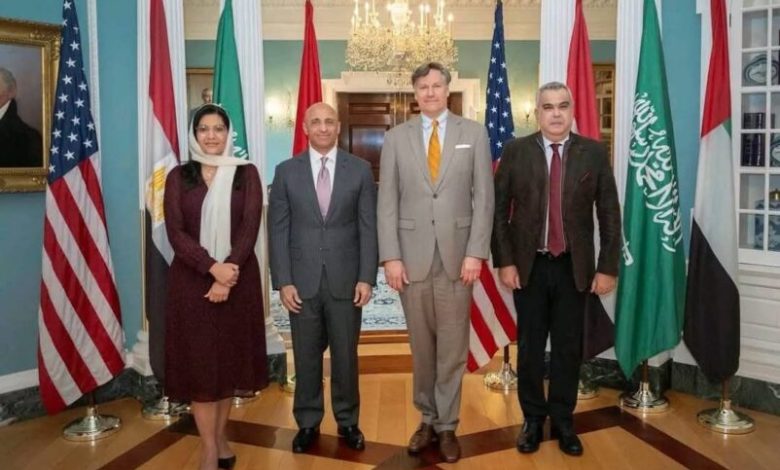
The question now: can that reality change? On September 12, after months of Washington-led negotiations, the U.S., Saudi Arabia, Egypt, and the UAE—collectively known as the Quartet—issued a roadmap for peace in Sudan, starting with a three-month humanitarian truce. The announcement itself would not end the war, but it marked a long-awaited achievement: a baseline agreement among Washington and three Arab powers closely linked to the warring parties on how the conflict should be resolved.
But how can that agreement be translated into real influence on the ground? Narrowing the divide among external players was a necessary condition to bring Sudan’s belligerents to the table, but domestic divisions remain deeply entrenched, and the Quartet does not appear to be doing much to resolve them. Within two weeks of the joint statement, conditions worsened: fighting escalated, army chief Gen. Abdel Fattah al-Burhan—long resistant to direct peace talks—publicly rejected the Quartet’s roadmap, while the RSF ignored it as it tried to cement its bloody grip on El-Fasher, the capital of North Darfur.
All eyes are now on the Quartet, which must push the warring parties to implement the September 12 agreement before it slips away. To prevent that, the Quartet needs more flexibility. Since a humanitarian truce is unlikely without direct talks, the focus should first be on launching those negotiations, with the roadmap serving as a guiding framework.
Two Years of Horror
Sudan’s civil war erupted in 2023, just four years after a popular uprising toppled longtime ruler Omar al-Bashir. The generals arrested Bashir but seized power for themselves. Burhan, the army chief, and RSF commander Mohamed Hamdan “Hemedti” Dagalo initially shared power with civilians, but ousted them in 2021. As Washington and others pushed for a return to civilian rule, tensions escalated—especially over integrating the RSF into the army. On April 15, 2023, the conflict exploded in Khartoum, splitting the country between the two forces.
Since then, the war’s trajectory has swung back and forth. The RSF stunned observers by seizing most of Khartoum, advancing into Sudan’s heartland, pushing the army from much of the west, and besieging El-Fasher. By late 2024, however, the army began regaining momentum. From its new base in Port Sudan on the Red Sea, and with support from Egypt, Turkey, Iran, and others, it forged alliances with multiple militias. By March 2025, it had expelled the RSF from Khartoum and pushed it back into its western strongholds.
But the momentum stalled. The RSF regrouped, launched counterattacks that halted the army’s advance in Kordofan west of Khartoum, carried out long-range drone strikes as far as Port Sudan, and seized the border triangle with Egypt and Libya. In August, it announced a rival government in Darfur—a move aimed at challenging Burhan’s legitimacy and deepening Sudan’s fragmentation.
Over two years of bloodshed, weapons and supplies have poured in on both sides. The army enjoys backing from Egypt, most Arab states, Iran, and Turkey. On the other side, the UAE has emerged as the RSF’s chief patron. Saudi Arabia has tried to remain neutral to facilitate mediation but has grown closer to the army, which is seen as the last official institution controlling eastern Sudan across the Red Sea from the kingdom.
A Late U.S. Push
Managing these dynamics has been difficult. Before the Quartet initiative, the U.S. failed to marshal the external pressure needed to stop the fighting. Its efforts included two negotiation rounds in Jeddah in 2023—excluding Egypt and the UAE—and an abortive attempt to convene talks in Switzerland in 2024.
Part of the problem was that U.S. diplomacy did not bring its “A team.” Whereas the George W. Bush and Barack Obama administrations treated peace in Sudan as a top priority, the Biden administration—on whose watch the war broke out—did the opposite: distancing the White House from the file and leaving it to the State Department’s Africa bureau, which has little sway with key Middle Eastern players. The appointment of a special envoy came late, and even then the envoy lacked sufficient authority.
When the Trump administration took office in January, it initially showed little interest in Sudan’s complex war. But by June, it began sending different signals. The State Department summoned the Saudi, Egyptian, and Emirati ambassadors to discuss plans for a high-level Quartet meeting and a framework for ending the war.
Two factors likely drove this shift. First was the engagement of Massad Boulos—President Trump’s son-in-law and adviser on African affairs—who sought quick breakthroughs to build political capital. After brokering a June 27 deal between the Democratic Republic of Congo and Rwanda, Boulos declared Sudan would be next, calling it a top priority—both out of recognition of the catastrophe and likely a desire for the administration to claim peacemaker status.
The second factor was pressure from Abu Dhabi, Cairo, and Riyadh on Washington to act—both to pull the U.S. into their respective Sudan strategies and to express growing frustration with the quagmire. An RSF drone strike on Port Sudan in May crossed a red line for Riyadh and Cairo. Meanwhile, Arab disputes over Sudan paralyzed regional forums and derailed a London conference in May.
The Joint Statement
Washington sought to cap its push for an immediate truce with a Quartet foreign ministers’ meeting in July. But consensus-building proved difficult. A late-July meeting was canceled, and talks dragged into September. On September 12, a roadmap was unveiled: push the parties into a three-month humanitarian truce, followed by a permanent ceasefire, then a nine-month political process to select a “civilian-led” transitional government not dominated by the warring factions. The statement also condemned “violent extremist groups within or linked to the Muslim Brotherhood”—a reference to the Sudanese Islamist movement allied with the army. It called for halting external support to the belligerents but did not include explicit pledges from Quartet states to end their own backing.
The negotiations exposed sharp divides. Cairo and Riyadh preferred gradual, non-disruptive steps suited to a scenario where the army still controlled the eastern capital, favoring a sequence of ceasefire first, then politics. Abu Dhabi, by contrast, pushed for shorter timelines and faster formation of a transitional authority. The compromise blended both: a phased sequence but with compressed deadlines.
Early signs underscored the scale of the challenge. The truce proposal looked stillborn: Burhan rejected it outright, while the RSF resisted a ceasefire, believing it was on the brink of victory in El-Fasher—the army’s last major Darfur stronghold. A planned follow-up statement at the UN General Assembly fell apart over disagreements on language urging the RSF to lift the siege.
In short, neither side appears ready to accept an unconditional truce, and it is unclear how serious any of the Quartet states are about pressing for one. Failure risks further escalation, particularly with the rainy season ending and both sides preparing for fresh offensives in Kordofan.
How to Make It Stick
If the Quartet wants to build on the opening created by its joint statement, it must act with determination and pragmatism. First, Washington should push its partners to uphold what they just signed. If an immediate ceasefire seems out of reach, the U.S. should coordinate a high-level push for direct talks between the parties, where a provisional truce could be crafted.
To make talks work, urgent shuttle diplomacy with both sides is needed—and persuading Burhan will be pivotal, given his camp’s refusal to negotiate with the RSF. Washington may also need a parallel track to engage Sudanese Islamists linked to Bashir’s regime to prevent them from sabotaging the process. Countries with influence over them—such as Qatar, Turkey, and Malaysia (which recently hosted Sudanese Islamist gatherings)—could help.
At the same time, leverage must be applied to create real pressure on both sides, including concrete steps to curb arms flows. Even opening a serious Quartet discussion on military supplies would be a useful start toward de-escalation. As diplomacy advances, the Quartet must first resolve its own internal divisions to present a united front to Sudan’s combatants.
A Crucial Test for Washington
The most significant aspect of the September 12 statement is that the Quartet finally showed unified commitment to harnessing its influence to end the war. Whether the roadmap is implemented literally matters less than whether the parties see serious pressure being applied. Credibility is key to securing support from other influential capitals. If commitment fades, the likely outcome is further escalation with unpredictable consequences.
The question remains: is the U.S. prepared to embark on a grueling process that demands both incentives and penalties for Quartet partners and Sudanese actors alike? Massad Boulos—already juggling multiple files—will remain central, while Secretary of State Marco Rubio and his deputy Christopher Landau appear more distracted.
Conclusion
The September 12 statement opened a narrow window for peace after two years of drift. That window is already closing. Seizing it requires the four states to push firmly in the same direction before it is too late. For Sudanese, the stakes could hardly be higher; for Sudan’s neighbors, the country’s collapse and the struggle over its future will reverberate across Africa, the Middle East, and beyond for years to come.