El-Fasher: Sudan’s Miniature War
Sudan Events – Agencies
For 17 months, since May 2024, El-Fasher, the capital of North Darfur, has been trapped in one of the longest urban sieges of modern wars—a grinding battle of attrition that recalls the devastation of Stalingrad and the starvation of Leningrad, combining both cruelties in a single city.
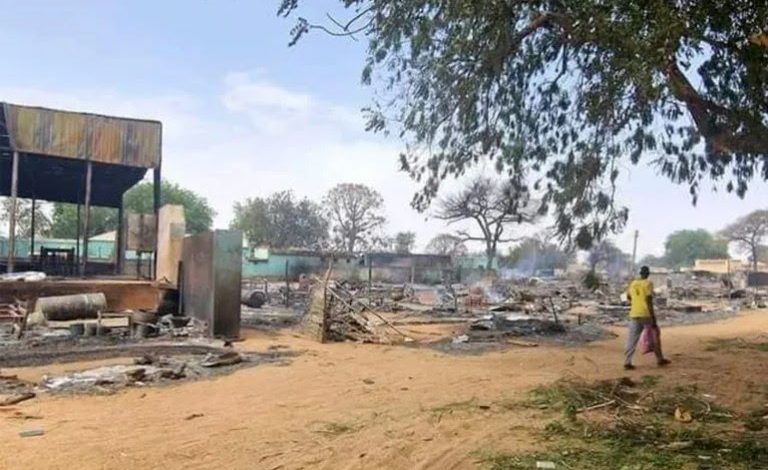
The siege, tightened step by step by the Rapid Support Forces (RSF), has transformed the city’s very fabric. Trenches cut across neighborhoods. Civilians move from building to building in search of safety, while self-defense groups fight alongside entrenched army garrisons.
Over these long months, El-Fasher has become Sudan’s war in miniature—a microcosm where the ancient tactics of starvation and siege collide with modern arsenals. Drones and advanced weaponry have turned the city into a proving ground for the wars of the future. El-Fasher embodies Sudan’s war at its most brutal: at once a laboratory and a purgatory.
By early October 2024, as RSF forces pushed deeper into the city, residents dug trenches in the neighborhoods they were forced to flee into. Trenches cut through streets, beside homes, and around makeshift gathering points sheltering displaced families. When the rains come, these shoulder-deep trenches flood, forming the new architecture of survival in the city.
Since the Sudanese Armed Forces (SAF) retook Khartoum in April 2025, the RSF has intensified its shelling of El-Fasher. “From three or four in the morning, often until late,” says one resident. “We know the schedule now. We prepare for it with every dawn.” Families descend into the dark trenches before sunrise as routine, sometimes sleeping there until the bombardment resumes. Roaming, long-range shelling has become the RSF’s signature tactic, growing heavier each month.
The bloodiest moments often come in the frantic dash between houses and trenches. Ibrahim recalls how two neighbors were killed when they paused to greet each other on their way to shelters—just holes carved into the earth. Amal describes dragging her grandfather’s body after an artillery strike, holding on to it and hiding beside it for hours until the shelling eased enough to bury him.
Mohamed remembers a young man left wounded in a flooded trench for two weeks, his leg rotting away, before he finally died.
These scenes echo across countless accounts: frantic descents, long hours underground, hesitant returns above; terror carefully choreographed. “The fear never changes,” says Hila, a young woman who fled the city. “If you go out, something will happen to you.” Sometimes, she adds, “when I saw someone in the street between bombardments, I just wanted to say: I’m glad we survived—let’s walk together.”
Since last October, drones have brought a new layer of fear. Residents say they now circle unpredictably above El-Fasher, marking one of the first uses of drone warfare in Darfur. For those on the ground, every buzz carries the same terror: surveillance or a kamikaze strike.
For 17 months, El-Fasher has been strangled by the oldest methods of war: attrition and starvation. As the RSF tightened its grip, it built earthen fortifications to the north, east, and south—choke points that sealed off almost every road in or out. The city became an island. Only one route remains for civilians: westward toward Tawila, some 60 kilometers away.
That escape is fraught with checkpoints, ambushes, and disappearances. For men and boys of fighting age, fleeing is nearly impossible: either stay and fight, or risk extortion or death on the road. The journey to Tawila—two days on foot or a day by donkey—winds through a chain of RSF checkpoints, each demanding ransom. “A donkey cart from El-Fasher costs more than a new car now,” says Leila, who recently escaped.
One elderly man reached the buffer zone in Tawila after walking from El-Fasher in early September, joining over 400,000 newly displaced who had arrived before him. “He asked for water, drank, and then collapsed dead in front of us,” a volunteer recalls.
Inside El-Fasher, life is scarcely more survivable. After 500 days of siege, markets have collapsed, and the city teeters on famine. What little food remains is priced beyond reach: two kilograms of millet for $100, sugar or flour at $80 a kilo—while the average monthly salary, when salaries were still paid, was $70.
An estimated 260,000 civilians remain trapped, most relying on four communal kitchens run by volunteers and local networks. Under bombardment, with scarce water and dwindling supplies, they serve just one meal a day. Even these kitchens have been shelled, killing volunteers. The only alternative is El-Fasher’s last functioning market, in the Neivasha district, now reduced to a handful of stalls with staggering prices.
“I get by with one meal if I can,” says Omar. “But during shelling or street fighting, we’re trapped.” Hani, a former smuggler, says the city long relied on smugglers to bring food in. “Most have gone. Some still try at night, but most don’t come back. It’s suicide now—a deadly gamble.”
For many families, the only food left are peanut husks—usually fed to livestock. Wounded civilians are taken to a makeshift treatment center known as “the Block,” where volunteers work with nothing but salt and torn cloth.
No formal aid has reached El-Fasher since the siege began. At the Saudi Hospital, the last semi-functioning medical facility, volunteers often triage patients in the harshest sense—deciding “who will live and who will be left to die,” says Amira, one of the volunteers. Because of its proximity to the front line, the hospital has stopped admitting wounded fighters. SAF troops and allied Darfuri combatants are usually treated at separate facilities, one of which was bombed out of service in the past two weeks.
What remains of the city is now squeezed into the northwest corner, where civilians are crammed into three neighborhoods and part of an internally displaced persons camp—alongside SAF positions and their Darfuri allies. At night, the area falls into silence and darkness. Even solar lamps are extinguished for fear of drones. “You can’t even light a cigarette,” says Abdullah.
Self-defense groups have proliferated, armed men filling the streets as militarization consumes daily life. The unspoken reality is that every able-bodied man and boy is seen as a potential fighter. The blurring of civilian and combatant lines is not unique to El-Fasher, but nowhere is it felt more starkly.
The battle for El-Fasher has shifted from crude street fighting to a technologically advanced war with weapons unseen before in Darfur. The siege is no longer only military; it has become political, even existential.
The RSF’s stranglehold endures largely thanks to external support. Both public and private accounts point to military supplies and logistical backing from the United Arab Emirates that have propelled the RSF beyond its natural capacity. Yet El-Fasher remains Sudan’s toughest front—and, paradoxically, one of the last places where a solution may still be found.