UAE-Made Combat Armoured Vehicles to Be Built in East and Central Africa, Sparking Controversy
Sudan Events — Agencies
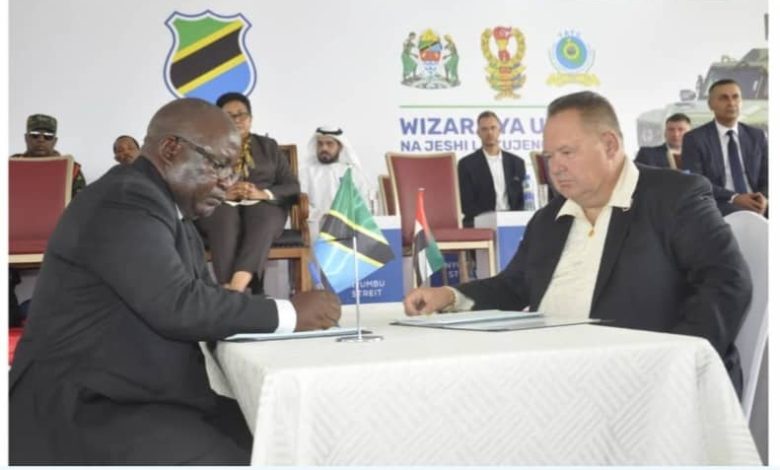
The chairman of Tanzania’s Automotive Technology Centre, Major General Wiyagonya Matthew Kisamba, and the CEO of UAE-based Street Group signed an agreement on Tuesday to manufacture, repair, and sell the armoured combat vehicles known as “Germain Gutorov” in Tanzania. The signing — attended by Tanzania’s Defence Minister Stergomina Lawrence Tax — marks the production of Canadian-origin military vehicles in Tanzania, a move that has provoked widespread debate across East Africa amid international accusations that both the UAE and Canada have contributed to fuelling conflicts in several African hotspots.
Official Narrative
In a press statement on Tuesday, Defence Minister Stergomina Lawrence Tax said the agreement, signed in the Kibaha suburb west of the commercial capital Dar es Salaam, “opens a new phase in defence manufacturing in our country.” She added: “We will start with military vehicles, but the scope will expand to include other vehicle types and then exports within the East African market.” The minister urged Tanzanians to seize the opportunity.
Tax said talks on the deal began in 2022 and involved technical experts from both sides before culminating in the formal signing. She forecast that the agreement would boost domestic technological capabilities, create jobs for engineers and technicians, and position Tanzania as a defence-manufacturing hub in Africa.
Retired Major General Wiyagonya Matthew Kisamba described the pact as a first-of-its-kind initiative in Africa, saying it would bolster industrial growth and national security. He argued the project would particularly benefit Tanzanian youth, especially technical institute graduates, by granting them direct access to advanced automotive technologies, skill transfer, and employment opportunities.
Lieutenant General Jacob John Mkonda, commander of the Tanzanian forces, called the project a strategic investment in national security that reflects Tanzania’s ambition for military and technological self-reliance. He said Street Group would transfer expertise to local engineers, delivering long-term benefits for the country.
Street Group’s CEO, Germain Gutorov, said Tanzania was chosen for its economic, political, and geographic advantages, making it an ideal base to distribute armoured vehicles across East and Central Africa. He described Street Group as a privately-owned global leader in armoured vehicle manufacture, operating five advanced production facilities and producing a wide range of vehicles—from armoured personnel carriers to bespoke luxury and security vehicles—designed to offer comprehensive protection in all conditions.
One of the Most Contentious Deals
A military expert speaking to the investigative site “Al-Muhaqiq” described the agreement as one of the most controversial ever signed by the Republic of Tanzania—not because defence manufacturing is inappropriate (every sovereign state has that right)—but because Street Group, founded in Canada in 1992 and among the world’s largest armoured vehicle makers, has faced accusations of serious breaches of arms export controls for nearly a decade.
The expert cited a 2016 UN panel of experts report alleging that Street exports to countries embroiled in armed conflict violated UN arms embargoes. He noted that the United States previously fined two Street subsidiaries $3.5 million and imposed a $250,000 fine on Gutorov personally for selling U.S.-made vehicles equipped with ballistic steel and bulletproof glass to Venezuela, Nigeria, Iraq, and Afghanistan without export licences.
Company Vehicles Found in Hands of Mercenaries
According to The Globe and Mail, Street Group—founded and led by Canadian businessman Germain Gutorov—has had its vehicles observed in combat alongside mercenaries and armed groups in multiple conflict-affected countries.
The introduction of such armoured vehicles into East African markets—where parts of the region are beset by violent conflicts—risks exacerbating violence and undermining peace in contested areas, critics warn. Observers say the company has not adhered to international controls on arms flows, and its plan to build a plant similar to its UAE facility raises alarms.
War in Sudan Covered by Tanzanian Press
The Tanzanian newspaper The Guardian ran a report on Tuesday implicating the UAE in Sudan’s war. According to the paper, Sudan has lodged formal complaints with the UN Security Council accusing the UAE of recruiting, financing, and deploying mercenaries. The allegations include claims that Rapid Support Forces units used UAE-made armoured vehicles such as the “Nimr Ajban” APCs fitted with French Galix systems. The report also references fresh images and videos purporting to show Canadian-made armoured vehicles in the arsenal of a paramilitary force in Sudan accused of committing atrocities and, in some accounts, genocide.
The Guardian quoted independent arms experts who identified the vehicles as Street Group models and cited The Globe and Mail’s reporting that Street sold dozens of armoured vehicles to Libya, Sudan, and South Sudan despite international restrictions on arms transfers to those countries.
Fears of Prolonged Conflicts
At a time when international efforts seek to resolve African conflicts and “silence the guns,” analysts monitoring outlaw groups warned that Tanzania’s decision to host a plant for a company seen as disregarding international norms could widen the scope of violence across southern and eastern Africa. Proximity to strategic mineral regions—many under the control of rebel or armed groups such as the March 23 Movement (M23) in the Democratic Republic of Congo and Al-Shabaab in Somalia—could enable continued supplies to militias via South Sudan, prolonging regional conflicts, critics say.