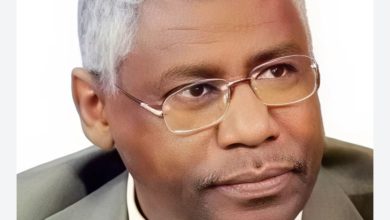
Dr. Muzammil Abu al-Qasim Debunks the “First Bullet” Myth — Releases the Most Dangerous Details
War is not waged with a single bullet; its preparation is not overnight or impromptu. Rebels and their political allies have tried to cement a naive and grave falsehood — namely, that elements of the army (belonging to the Islamic Movement) ignited the conflict by opening fire on Rapid Support Forces (RSF) units stationed at the Sports City and the Camps Ground on the morning of Saturday, 15 April 2023. To refute that slander, we note the following:
1/
There is no dispute that the army was not prepared for war; therefore it is practically impossible that it would initiate a war it had not readied itself for. Evidence of this is that readiness levels were ordinary — on 15 April they amounted to only 30%. Within the General Command buildings the forces present were confined to a single battalion comprised partly of officers responsible for administrative and financial affairs. By contrast, the rebels’ preparations and their accumulation of soldiers and military materiel did not begin in April of last year. Khartoum had in fact effectively fallen into Hemedti’s hands on the same day the Transitional Government fell — 11 April 2019 — when the RSF spread throughout the capital, deployed around and inside the General Command, entered the Republican Palace and parked its vehicles in the Palace yard (despite the presence of a full Republican Guard brigade), besieged the radio and television buildings and Khartoum Airport, and spread across all vital city areas. They took control of much of the Parachute Corps camp in Khartoum North, seized most headquarters of the National Congress Party including its main center opposite Khartoum Airport, and later occupied all camps of the former Operations Authority after it was dissolved (in Kafouri, south of the airport, Soba and Omdurman). They built eighteen camps inside and around the capital, the largest and most notorious being the Taybah, Jabal Sirkab and Qatina camps among others.
2/
The RSF commanders’ preparations for war in the lead-up were obvious to any observer: they amassed tens of thousands of soldiers inside the capital and, on 29 March 2023, concluded an agreement with Minister of Youth and Sports Hazhar Abdel Rasool to rent the Sports City buildings and the Camps Ground to be used as camps for thousands of troops. The minister initially denied the agreement, but an image of the contract leaked to the media and she was forced to acknowledge it later, stating publicly that an adviser to the Vice President of the Sovereignty Council had requested that a portion of the Sports City in Soba be allocated to the RSF; she insisted the site was officially under the ministry and used for sporting activities and hosting events, not as residential quarters for the RSF. Certainly it is not plausible to view the assembly of more than ten thousand soldiers inside a sports complex — in facilities designated for athletes — with innocent eyes, and not link that fact to what followed about two weeks later, when those camps and sports facilities became the RSF’s main hub for rebellion. They amassed hundreds of tactical vehicles (Tatra-type transports), vast quantities of ammunition, weapons, fuel, and personnel assignments inside the Sports City, exploiting its fortified buildings to avert air strikes.
3/
All this was preceded by a notorious insubordination by RSF deputy commander Abdel Rahim Dagalo, who publicly threatened the Army Commander and Chairman of the Sovereignty Council, Lieutenant General (Staff) Abdel Fattah al-Burhan, in a speech delivered at the Friendship Hall on 29 March 2023 before a large gathering of the Misseriya tribe. He said explicitly: “We have a message for our brothers in power… hand over power without beating around the bush.” Many regarded that public challenge by an officer from a state force to the country’s leadership and army as tantamount to an actual coup and an open rebellion, since officers are not authorized to criticize or threaten their superiors.
4/
If we put aside everything that occurred before April 2023 and focus only on events of that month, it becomes clear that on 12 April the RSF seized Merowe and El Obeid airports by moving a massive force — hundreds of Tatras — from Khartoum to Merowe first, without prior notice to or coordination with the army. They besieged El Obeid Airport the same day, parking Tatras on the runway to prevent use by Sudanese Air Force fighters, then attacked and captured both airports on the morning of 15 April, destroying three fighters stationed at El Obeid and four Egyptian planes plus three Sudanese aircraft at Merowe.
5/
On 8 April 2023 the RSF moved fifty-four armored vehicles from its base at Zurq in South Darfur toward Khartoum; those vehicles entered the capital in broad daylight (via the Fathihab Bridge) on 13 April and were seen by thousands. They immediately moved to south Khartoum, with some deployed at the Sports City and the Camps Ground, others at the Taybah camp and other Khartoum locations. Part of those armored units were used in the attack on the General Command buildings on the morning of 15 April after breaching the wall that separates the rebel commander’s residence from the army commander’s residence in Buklen — they had placed that vehicle inside Hemedti’s house days before the war began.
At dawn on 15 April RSF rebels captured hundreds of army officers en route to their posts in Khartoum, attacked the Intelligence School after breaking the connecting wall to the RSF headquarters south of Khartoum Airport (former Operations Authority HQ), detained the Intelligence School commander (a major-general) and dozens of officers, and captured the Army Inspector General (Lieutenant General Mubarak Kuti) from his home in the Airport neighborhood. Is it conceivable that the army would have initiated war against the RSF without informing its inspector general and senior officers, and without trying to secure them to prevent their easy capture by the rebels?
6/
On the morning of 15 April — specifically before dawn prayer (before 4 a.m.) — some youths posted a video documenting the start of RSF deployments in south Khartoum. The call to dawn prayer is clearly audible in the more-than-11-minute video, which shows more than a hundred Tatras loaded with soldiers and bristling with various weapons and military gear spreading across Khartoum at dawn. That video remains posted on YouTube to this day.
7/
RSF soldiers also published another video showing their forces’ control of central Khartoum in preparation for the attack on the General Command before sunrise on 15 April. In that footage the sun had not yet risen as hundreds of RSF Tatras moved through the streets of Al-Qasr, Al-Jumhuriya, Al-Baladya and along the Nile, readying to assault the General Command. Another video shows the rebel commander at dawn on 15 April after his forces had occupied the Republican Palace and betrayed the forces inside it.
8/
In the war’s early days RSF rebels released filmed material showing rebel figure Omar Jibril (one of the RSF’s chief media mouthpieces) alongside a number of army officers who identified themselves; among them was Brigadier (Staff) Mamoun Muhammad Ahmed, commander of the armored al-Baqir brigade, who stated plainly in the video that they had been captured on 14 April — meaning RSF rebels occupied the al-Baqir garrison and captured its commander and three officers a full day before the so-called first bullet.
9/
The RSF’s morning assault on 15 April 2023 did not target only the General Command; it coincided with a carefully coordinated series of attacks on Signal Corps, Engineers, Armored Corps, Wadi Sidna Air Base, Merowe and El Obeid airports, the Al-Hajana (El Obeid) garrison, El Fasher garrison, Zalengei garrison, Babinosa garrison, and multiple army camps in Kabkabiyah, Kutum, El Fula and many towns in Darfur. Simultaneously, RSF rebels occupied arms production facilities in al-Baqir, Kafouri and Qari. Could all of this have been a coincidence? Could it have resulted from a single bullet or an incidental clash near the Sports City?
10/
Three days before the war the European Union ambassador, accompanied by several EU ambassadors and Khalid Musa (director of the European Department at the Sudanese Foreign Ministry at the time), visited Hemedti at his home in the Airport neighborhood and urged him to lower tensions and avoid war with the army. He surprised them by saying: “I signed the framework agreement and I will not back down. If Burhan does not sign and implement it I will arrest him and put him in Kobar Prison next to Bashir.” He went from words to action: he attacked the army commander’s house and the homes of his associates and the General Command buildings in an attempt to capture or kill them, but the valor and bravery of the Republican Guard thwarted the vile scheme.
11/
In the months preceding the war the RSF bought and rented 480 houses across the three state capitals, focusing on large houses suitable for storing military vehicles (Tatras) and selecting houses with basements to hide Tatras, weapons, ammunition and fuel. The RSF also purchased dozens of farms around Khartoum — in Al-Salit project, east of the Nile, west of Omdurman and north and east of Kafouri — and stocked them with huge numbers of Tatras, weapons, ammunition and fuel. Clearly these moves were part of preparing for a planned armed takeover aimed at seizing power.
12/
Shortly before the war the RSF purchased large plots of land in key central Khartoum areas and built huge camps accommodating up to nine thousand soldiers within the city — one on a large plot south of the Republican Palace near the Registrar’s office, another adjacent to RSF headquarters in East Khartoum (the former Security Advisory building) west of the National Press Council building. These buildings and the former National Congress headquarters housed large numbers of Tatras and massive stockpiles of weapons, ammunition, fuel and personnel; from these sites the attack on the General Command and the occupation of the Republican Palace were launched.
13/
Before the war the RSF imported advanced wireless communications systems and equipped its forces to link and coordinate them at “zero hour”. They also acquired the notorious Pegasus electronic surveillance system to spy on the phones of army and other security leaders and the armed forces’ private communications, in addition to other modern jamming systems used effectively with the help of foreign experts brought in expressly for that mission.
14/
Shortly before the war RSF intelligence attempted to bribe some of the most skilled air force pilots with $200,000 each to refuse orders to strike RSF camps and forces if RSF leadership attacked the army. Those pilots reported the approach to army leadership and refused on patriotic grounds; RSF intelligence had also surveilled pilots’ homes across the capital and succeeded in arresting some of them on the war’s first day.
15/
The RSF established multiple specialized media rooms inside and outside Sudan and contracted foreign firms to run thousands of fake social media accounts, which they used effectively after the outbreak of fighting. They recruited prominent journalists and paid off influential activists to promote the rebels’ propaganda. New RSF spokespeople and advisers appeared who were unknown before the war and were deployed to defend the rebels on international networks — figures such as Imran Abdullah, Al-Basha Tabeeq and Sibawayh Yusuf — who performed the despicable task abysmally.
16/
Two days ago the rebel commander appeared in a recorded statement admitting they had hidden anti-aircraft guns and weapons near El Obeid Airport to target aircraft on takeoff, and he confessed to destroying four Su- (Sukhoi) army aircraft at El Obeid on the war’s first day — proof he had planned and prepared for war long before 15 April 2023. No reasonable person could imagine that these heavy weapons were moved to that concealment site only on 15 April.
17/
The militia leadership ensured the supply of vast quantities of foodstuffs (fava beans, lentils, rice, tahini, etc.), tens of thousands of packaged and canned meals (imported from the UAE), and stored them across all RSF camps in Khartoum. Some were labeled “Ramadan food baskets” for their troops but ordered by commanders to be stored intact and were subsequently used after the war began on 15 April.
18/
If the army had wished to initiate hostilities against the militia, it could have done so in Merowe initially, where militia forces were in exposed positions and could have been targeted and eliminated by the army’s aircraft based in Wadi Sidna, El Obeid and Merowe. The RSF’s spokesperson himself issued a famous statement that his forces had deployed to Merowe Airport without the Armed Forces’ permission or any coordination.
19/
Had the army intended to strike first it would have attacked and bombed the homes of the rebel commander and his brother to eliminate them immediately, instead of being compelled to defend the lives of its leaders in the guesthouse, their homes inside the General Command and in the Airport neighborhood. We all witnessed how the militia attacked these houses seeking to kill or capture Burhan and his companions — how the army leaders survived that heinous assault by God’s grace and by the courage of the Republican Guard, who paid the price with 35 martyrs in the war’s opening hours. They were buried inside the General Command, their graves becoming places of visitation for family, friends and comrades; these heroes deserve honor befitting the sacrifices that saved Sudan from being swallowed by a criminal project.
20/
Many saw footage of Yusuf Ezzat, the militia’s political adviser, roaming the Sudanese Radio buildings and attempting in vain to operate them to broadcast the coup statement on the first day of the war. That video is the clearest evidence that the events of the morning of 15 April were far greater than a single “first bullet” or an incidental clash between army and militia near the Sports City.
In conclusion, what happened in Sudan was not accidental and was not caused by a single bullet fired by whoever in south Khartoum on the morning of 15 April. Rather, it was a meticulously planned criminal scheme developed over years that required the accumulation of weapons, ammunition, artillery, and drones to be used in an infamous war aimed at hijacking the Sudanese state, seizing power, dismantling the army and replacing it with the RSF. Huge sums of money were employed to execute this evil plan, but God’s will prevailed over the machinations of the evildoers, and the valor and courage of the Armed Forces and other security services played a central role in foiling the diabolical scheme that sought to engulf Sudan, plunder its resources, displace its people and effect a sweeping demographic change. “They plan and God plans; and God is the best of planners.”