“War Is a Business”: Colombian Mercenaries Train Sudan’s Children to Fight — and “Go to Die”
Sudan Events — Agencies
A mercenary reveals lucrative contracts, the siege of El Fasher, and the training of children to fight to the death
Harriet Barber in Medellín and Santiago Rodríguez Álvarez in Bogotá — Wednesday, 8 October 2025
For the Colombian mercenaries, hardened by contracts in jungle wars, the conflict in Sudan at first felt slow.
“We sleep at night in Sudan — there isn’t even security or guards, because everyone goes to sleep. Colombians are different — we’re used to a different kind of war,” says “Carlos,” one of hundreds of Colombians hired to fight in the African country.
When Carlos and his companions reached the front, they advanced through the dark, penetrating deep into enemy territory. “Then the fighting escalated — and the number of dead started to rise,” he adds.
Carlos arrived in Sudan earlier this year, about two years after the brutal civil war broke out between the Sudanese army and the paramilitary Rapid Support Forces (RSF). The war has pushed Sudan into one of the worst humanitarian catastrophes in modern history, United Nations officials say: some 150,000 dead, abductions and rapes of women and girls, and nearly 13 million displaced — making it the world’s largest displacement crisis.
Around 260,000 civilians remain besieged in El Fasher, the capital of North Darfur and the last major stronghold of the army in the region, where the siege has lasted more than 500 days. No aid has entered the stricken city for about 18 months, and children have been forced to eat locusts and animal fodder.
There, Colombians were sent to fight on the side of the RSF. “War is a business,” Carlos said.
Revelations about mercenary involvement began last year when Colombian newspaper La Silla Vacía published an investigation showing that more than 300 former soldiers had been contracted, prompting an unprecedented apology from the Colombian foreign ministry.
But Colombians’ role went beyond the battlefield: fighters admitted to training recruited Sudanese children, and were filmed inside Zamzam camp, Sudan’s largest displacement camp. In April, RSF forces stormed the camp and killed between 300 and 1,500 people — an atrocity the United Nations described as among the worst of the war.
“We witnessed a double crime with our own eyes: the displacement of our people at the hands of the RSF militia, and now the occupation of the camp by foreign mercenaries,” Mohammed Khamis Doda, a camp spokesman, told the Sudan Tribune.
The UAE’s role and the mercenaries
The United Arab Emirates has long been accused of financing and arming the RSF, and is now also accused of facilitating the recruitment of mercenaries through private security firms. Abu Dhabi has consistently denied these allegations.
Unlike some Colombians who said they believed they were being sent to guard oil facilities in the UAE, Carlos knew he was going to war — he only didn’t know it would be in Africa.
His journey began with medical checks in Bogotá, where he signed a contract worth $2,600 a month. He was then flown through Europe to Ethiopia, to a UAE military base in Bosaso, Somalia, and later sent to Nyala in Sudan, which has become known as a hub for Colombian mercenaries.
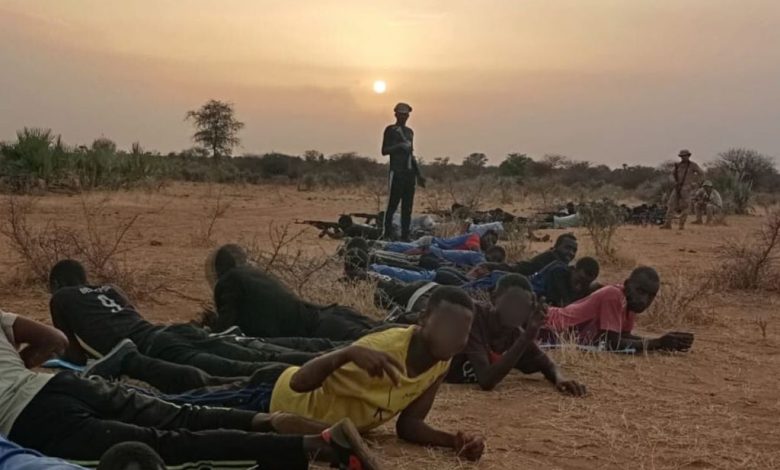
Carlos, who requested that his full name not be used, said his first assignment was to train Sudanese recruits, most of them children.
“There were thousands of recruits in the camps, some adults, but most were children — far too many children. These kids had never held a weapon. We taught them how to use rifles, machine guns and RPGs. Then they were sent to the front. We trained them to go and die,” he said.
He described it as “horrible and insane,” but added: “Unfortunately, this is war.”
El Fasher: the heart of the battle
Carlos was later sent to El Fasher, the country’s worst battleground. The RSF has built a 20-mile wall around the city, executing anyone who attempts to flee.
Video clips and photos shared by Carlos and his colleagues with La Silla Vacía and The Guardian showed Colombian mercenaries training Sudanese youths — many of them teenagers — and fighting in devastated neighborhoods.
In one clip, the mercenaries are heard speaking with heavy Colombian accents amid heavy gunfire as they try to pull a wounded man to safety.
Colombia: a source of mercenaries
Colombia’s long-running armed conflict has created a surplus of trained fighters, many of whom received U.S. training, turning the country into a major source of mercenaries.
“Colombia has more than half a century of active war history. Its soldiers are well trained and have fought hard battles, so they’re ready to fight,” says Elizabeth Dickinson, senior Colombia analyst at the International Crisis Group.
Sean McFate, an expert on mercenaries, says the use of Colombians rose over the past decade, first to guard oil facilities in the UAE and then in the Yemen war, where Abu Dhabi sent “many Colombian mercenaries to kill Houthis.” Since then, they have appeared regularly in several conflicts.
In July 2021, 18 Colombians were among the team that assassinated Haiti’s president, Jovenel Moïse. Others have fought in Iraq and Afghanistan, and now in Ukraine.
The trade in death
Colombian President Gustavo Petro described mercenarism as “a trade in men turned into commodities for killing,” and vowed to outlaw the practice. But low pension income and difficulties reintegrating fighters, together with financial temptations, make an end to the trade unlikely soon.
Analysts warn that private security companies are expanding recruitment to include active-duty soldiers, using offers via apps like WhatsApp with large salaries.
Carlos himself left the army after only five years of service and worked as a mercenary in Ukraine before moving to Sudan. Although he recently left Sudan over pay issues, flights are still bringing more fighters.
“Mercenaries nearly disappeared in the 20th century, but this trade is growing fast again. It’s the oldest profession in the world. We are returning to a medieval-like era where the wealthy can act like great powers,” McFate says.
Carlos sums it up: “It’s not honorable, nor legal. But you go for the money.”