Sudan Receives Hundreds of Thousands Returning from Egypt
Sudan Events – Agencies
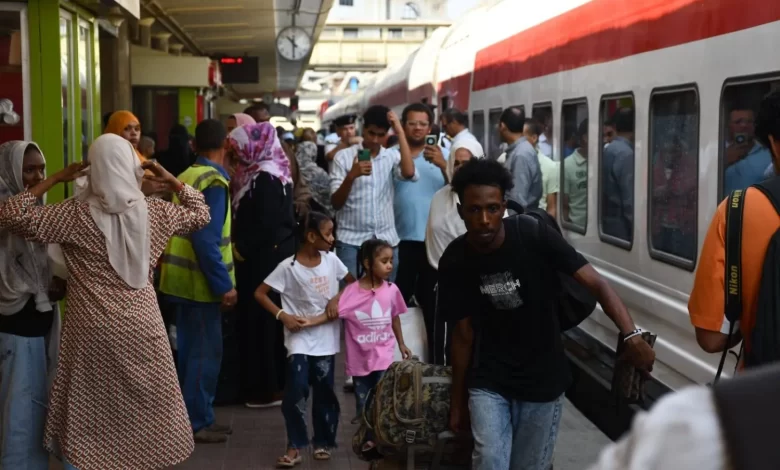
The number of Sudanese nationals returning from Egypt has risen to 410,000, accompanied by an increasing number of registrations in the voluntary return project, which facilitates travel by train from Cairo to Aswan in southern Egypt through three weekly trips.
Since the outbreak of war in Sudan about 30 months ago, more than 1.5 million Sudanese have crossed into Egypt—by air and through land crossings—along with tens of thousands who entered illegally. Before the conflict, Egypt already hosted over three million Sudanese residents.
The Sudanese Consul General in southern Egypt, Aswan, Ambassador Abdel Qader Abdullah, confirmed the continuation of the voluntary return initiative for Sudanese citizens, organized by the Defense Industries System in coordination with Egyptian authorities, who have mobilized their resources to facilitate the return of about 410,000 people via land crossings between the two countries.
Speaking to Al Jazeera Net, the consul said the voluntary return program began in early 2024 under difficult conditions, but the situation improved significantly since June, with greater facilitation through Abu Simbel, Ashkeet, and Arqin crossings, in addition to the organization of air transport services.
He added that civil society organizations have been providing buses, while the consulate coordinates the reception of about 30 buses per week, in addition to luggage trucks.
Free Transport Services
For her part, Umayma Abdullah, Director of the Voluntary Return Project, told Al Jazeera Net that the first phase of transport relied on buses before trains were introduced—initially one trip per week, later increased to two, and now three weekly trips.
She noted that the project initially faced numerous challenges, which were gradually overcome through coordination with Egyptian authorities, including the security services and the Ministry of Transport.
Returnees travel by train from Cairo to Aswan, then continue by bus to the Qustul/Ashkeet border crossing, where other buses transport them to their respective areas inside Sudan.
Abdullah explained that all transportation is free of charge, funded by the Defense Industries System, which also covers the cost of meals and official fees for the travelers. She revealed that registration for return trips is steadily increasing and that the returnees include various professional groups, particularly employees of state institutions.
Security and Economic Factors
Activist Khaled Abdullah, who works with the private sector on voluntary return initiatives, attributed the growing number of returnees to improved security conditions in the states of Gezira, Sennar, Khartoum, and White Nile, as well as the sharp depreciation of the Sudanese pound.
The falling currency, he said, has forced many Sudanese in Egypt—especially those dependent on remittances from home—to return.
He added that many families had been waiting for their children to finish school exams, and universities in Sudan have now announced the resumption of in-person classes in Khartoum State, replacing online learning.
Abdullah dismissed claims that outbreaks of dengue fever, malaria, and cholera in some regions have affected return rates. He noted that over 20 buses depart Cairo daily, some chartered by organizations and businessmen, in addition to those operated under the voluntary return project or privately funded travel.
Return Statistics
According to the International Organization for Migration (IOM), more than 2.2 million people have returned to their homes between November 2024 and August 2025, including over 815,000 who returned to Khartoum.
The IOM reported that 1.7 million of the total returnees were internally displaced persons (IDPs), while others came back from neighboring countries such as Egypt, South Sudan, Libya, and Chad, as well as from the Gulf states.
The organization expects the number of returnees to Khartoum to reach 2.9 million in the coming period, citing improved security, relative availability of basic services, and dwindling resources in displacement areas.
Source: Al Jazeera Net