Egypt Eases Work Permit Rules for Sudanese Workers
Sudan Events – Agencies
Egypt’s Ministry of Labor plans to introduce new measures to facilitate the issuance of work permits for Sudanese nationals, amid mounting complaints from Sudanese workers about difficulties they face in securing employment in Egypt.
Egyptian Minister of Labor Mohamed Gebran said on Sunday that his ministry is “keen to support and assist our Sudanese brothers in all labor- and vocational-related matters.” He noted that recent months have seen the launch of several initiatives aimed at regularizing the status of foreign workers — including Sudanese labor — through simplified procedures and reduced fees for obtaining official work permits.
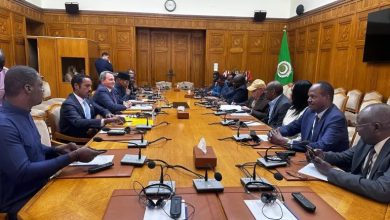
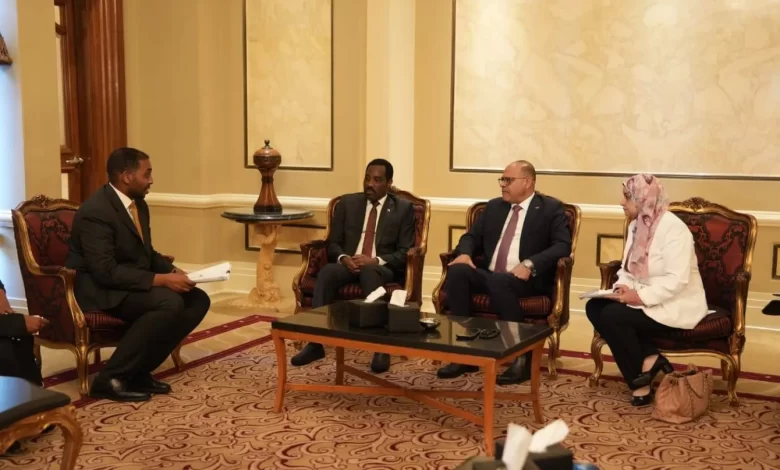
During a meeting with Sudan’s Minister of Human Resources and Social Welfare, Moatasem Ahmed Saleh, Gebran added that “the ministry is currently working to provide specialized vocational training programs for Sudanese workers residing in Egypt, to enhance their skills and qualifications in line with the needs of the Egyptian labor market.”
The internal conflict in Sudan has displaced millions of people both inside and outside the country. According to official estimates, around 1.5 million Sudanese have fled to Egypt since the war began, bringing the total number of Sudanese residents in Egypt to more than five million.
Work permit fees for foreign workers in Egypt range between EGP 5,000 and EGP 150,000 (approximately USD 1 = EGP 48), depending on the type of permit. The fee typically represents about 10 percent of the contract’s value, in accordance with Egyptian labor law, which also allows exemptions in certain cases based on labor market needs.
Egypt’s new Labor Law, which came into effect in early September, stipulates that foreigners may not engage in any employment unless they obtain a license from the competent ministry for entry and residence in the country for work purposes.
It further states that both the employer and the foreign worker found in violation of the law shall be fined no less than EGP 20,000 and no more than EGP 50,000, with penalties multiplied according to the number of workers involved or repeated offenses.
Mohamed Gabara, a member of the Sudanese-Egyptian Friendship Association, welcomed Egypt’s facilitative measures, noting that the new adjustments have brought work permit fees down to between EGP 2,500 and EGP 3,000, depending on the nature of the job and average Sudanese wages — a move he said “encourages legal employment within the framework of Egyptian labor law.”
In an interview with Asharq Al-Awsat, Gabara added that “most Sudanese workers in Egypt do not possess work permits. This is largely due to Egyptian and Sudanese employers who are responsible for coordinating with Egypt’s Ministry of Labor to regularize their workers’ status. Many Sudanese are also employed in informal sectors that fall outside the official economy.”
He explained that “workers often fall victim to Sudanese-owned companies established merely to obtain residency permits through questionable means. These companies later suspend their operations without regard for workers’ rights. Other firms simply avoid the financial burden of regularizing their employees’ residency and insurance status — whether social or health — and neglect to complete the necessary paperwork for official residence in Egypt.”
With the enforcement of the new labor law, Minister Gebran confirmed that Egypt has begun decisive measures to regulate the status of foreign workers, warning that the law imposes harsher penalties of up to EGP 200,000 for violations, addressing what he described as “the shortcomings of the previous law,” which had set fines at just EGP 1,000.
Gabara noted that many small business owners and shopkeepers continue to employ Sudanese workers without permits due to low wages, while most Sudanese migrants are simply in need of any job that helps them survive. “This remains common in working-class neighborhoods, where many workers also lack formal residency papers,” he said.
Until recently, Egypt allowed Sudanese nationals to work without permits under the “Four Freedoms Agreement” signed between the two countries in 2004. The agreement granted citizens of both nations the rights to reside, move, own property, and work in the other country — though its implementation has since been suspended.
According to Egypt’s Ministry of Labor, the number of foreign workers officially licensed in Egypt’s private and investment sectors rose to 22,900 in 2024, up from 17,300 in 2023, marking a 32 percent increase. However, this still represents less than 1 percent of Egypt’s total foreign labor force, estimated at 3.6 million workers.
Source: Asharq Al-Awsat