Has the “Quartet” Meeting in Washington Advanced Peace in Sudan?
Sudan Events – Agencies
The meetings of the Quartet on the Sudan crisis — comprising the United States, Saudi Arabia, Egypt, and the United Arab Emirates — concluded in Washington without any tangible progress toward implementing its proposed peace plan.
On September 12, the Quartet had unveiled, following consultations among the foreign ministers of its member states, a roadmap calling for a three-month humanitarian truce leading to a permanent ceasefire, followed by a nine-month inclusive and transparent political transition that would fulfill the Sudanese people’s aspirations for an independent civilian government.
Coinciding with the latest sub-ministerial Quartet meeting in Washington last Friday — aimed at discussing practical steps to operationalize the peace plan — two delegations, one representing the Sudanese government and the other the Rapid Support Forces (RSF), arrived in the United States at Washington’s invitation.
The government delegation included Foreign Minister Mohieddin Salem, the head of military intelligence Lt. Gen. Ahmed Ali Saber, and Maj. Gen. Abbas Bakhit, deputy director of the General Intelligence Service. The RSF delegation, meanwhile, was led by Qouni Hamdan Dagalo — the younger brother of RSF commander Mohamed Hamdan Dagalo “Hemedti” — along with chief negotiator Brig. Omar Hamdan and Mohamed Mokhtar Al-Nour.
Divergent Demands
Official Sudanese sources told Al Jazeera Net that Foreign Minister Salem and his delegation held talks with U.S. officials led by Presidential Advisor on African Affairs Mossad Bolous. According to the same sources — who requested anonymity — the delegation presented its views on Red Sea security, counterterrorism coordination, economic cooperation, and trade exchange, noting that positions were largely aligned on these issues.
The delegation reaffirmed its stance on the ceasefire, insisting on adherence to the roadmap submitted by the Sovereign Council to the UN Secretary-General last March and to the Jeddah Declaration signed in May 2023 as the foundation for any new agreement. It expressed readiness for a just and comprehensive peace that serves the Sudanese people while rejecting any political or military reintegration of the RSF.
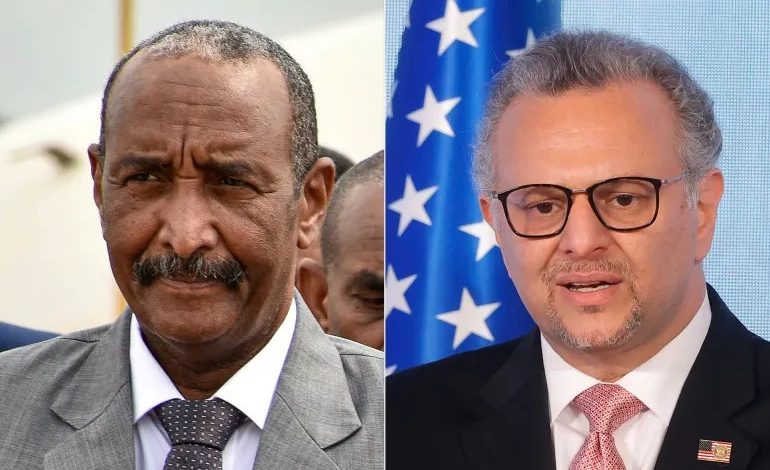
Sovereign Council Chairman Abdel Fattah al-Burhan briefed leaders of the Darfur peace movements in Port Sudan on Saturday evening about the nature of his government’s negotiations with the U.S. administration in Washington. He reiterated that there are no direct or indirect negotiations with the RSF, stressing that talks are limited to discussions with U.S. officials.
Conversely, media outlets close to the RSF reported that its delegation — consisting of four members — held separate meetings with U.S. officials and other Quartet representatives. The RSF reportedly demanded that the Manama Agreement, initialed in Bahrain in 2024 between Sovereign Council member Shams al-Din Kabashi and RSF deputy commander Abdul Rahim Dagalo, be recognized as the principal reference for negotiations.
According to those sources, the RSF also called for severing Sudan’s ties with Iran, dismantling the Islamic Movement’s influence in politics, handing over wanted figures to the International Criminal Court, and establishing a new, unified professional army on fresh foundations.
Coordination Mechanism
At the conclusion of the Quartet meetings, Mossad Bolous announced that the member states had agreed to form a joint committee to enhance coordination on urgent priorities in Sudan.
In a post on X (formerly Twitter), Bolous said the meeting broadly discussed ways to curb foreign interference in the Sudanese conflict, emphasizing the need to push for a political transition leading to an inclusive civilian government. He added that participants concurred on the importance of shielding the political process from regional and international influences that hinder peace efforts, and discussed mechanisms to support and strengthen civilian institutions in the next phase.
Former U.S. Assistant Secretary of State for African Affairs and current Middle East Institute fellow David Shinn told Al Jazeera Net that “it appears the Trump administration has delegated the task of ending the war in Sudan to Mossad Bolous.”
Shinn noted that neither the Sudanese army nor the RSF has shown serious willingness to end the conflict. If this initiative fails, he said, it remains unclear what steps the Quartet or Washington would take next, as neither has presented a contingency plan.
No Clear Roadmap
Bolous had earlier stated that “Sudan will be a priority in the coming period,” but challenges persist due to weak coordination within President Donald Trump’s administration, as well as conflicting regional agendas and Washington’s complex relationships with regional powers.
In a report by the Washington Institute for Near East Policy, researcher Areej Al-Haj argued that “the U.S.-led initiative is not designed to open direct negotiations between Sudan’s army and the RSF. Rather, it aims to establish a coordinated international platform capable of managing Sudan’s balance of power through strategic pressure and by creating the conditions for a successful political process.”
Similarly, Cameron Hudson, a senior fellow at the Center for Strategic and International Studies’ Africa Program, said: “There is no plan within the Trump administration to resolve Sudan’s crisis. It seems they believe that simply inviting people to Washington and relying on the State Department’s charm will make them agree.”
Speaking to Al Jazeera Net, Hudson added, “This meeting was hastily arranged, without an agenda or preparation. You cannot expect a breakthrough based on wishful thinking — that’s not a strategy.”
Bias and Interests
Commenting on the Washington talks, former presidential adviser Amin Hassan Omar, who served under ousted President Omar al-Bashir, criticized what he called the United States’ “biased approach” to Sudan’s crisis. He argued that Washington is unfit to broker peace, as it refuses to recognize legitimate authority or pursue solutions reflecting Sudan’s realities, instead promoting a narrative aligned with its geopolitical interests.
In a Facebook post, Omar accused the U.S. of seeking to dominate Sudan rather than support it, claiming it aims to distance Khartoum from China, Russia, and Turkey, monopolize the country’s rare mineral sector, and impose Red Sea arrangements serving Israeli security.
Political analyst Faisal Abdel Karim, however, believes the Quartet’s Washington round did not end in deadlock. He said the U.S. administration made progress in bridging differences among Quartet members and continues to play a pivotal role in the process.
Speaking to Al Jazeera Net, Abdel Karim noted that the Quartet remains the only serious effort to end Sudan’s war, warning that its failure would prolong the conflict and lead to bleak outcomes. He predicted that direct negotiations between the army and RSF could soon resume in Jeddah, Saudi Arabia, following a principles agreement mediated by Bolous’s outreach to both sides.
Source: Al Jazeera Net