Washington Negotiations: A U.S. Vision Awaiting Sudan’s Approval
Sudan Events – Agencies
Talks between the Sudanese and U.S. governments continued for the second consecutive day in Washington, focusing on bilateral relations, counterterrorism, and ways to end the ongoing war.
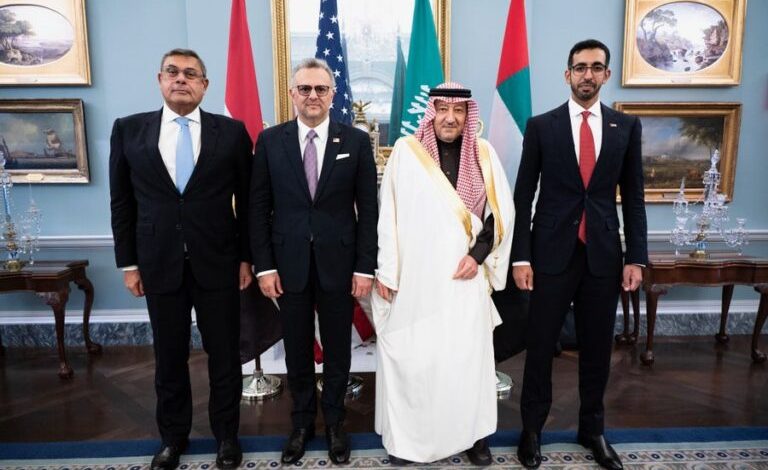
The discussions coincide with meetings of the Quartet taking place in Washington, which convened yesterday at a level below foreign ministers. According to the U.S. channel Alhurra, the talks covered issues including Red Sea security, the potential designation of the Rapid Support Forces (RSF) as a terrorist organization, and the formation of an independent technocratic government to lead Sudan in the coming phase.
No Negotiations with the Militia
Experts believe that the United States is reassessing its position on Sudan — a country of significant strategic importance — and is seeking through these talks to reshape the regional landscape and push Russia away from the Red Sea. Analysts note the absence of any mention or representation of the RSF in the talks, a point confirmed by Sudan’s Sovereign Council, which denied the existence of any direct or indirect negotiations with the rebel militia. The Sudanese Ministry of Foreign Affairs also stated that the discussions were confined mainly to the U.S. side.
Despite the flood of statements circulating in the media, experts emphasize that, so far, only representatives of the Sudanese government have been mentioned by name, with no credible information or leaks identifying any RSF political or negotiating figures participating in the talks.
Sudan’s Inclusion in the Quartet
Analysts suggest that Washington, under pressure to make progress, may have agreed to an Egyptian proposal to include Sudan’s government in the Quartet negotiations. This inclusion became evident through an invitation extended to Sudan’s Foreign Ministry to nominate its representatives, aligning with the Quartet’s ministerial-level structure.
The current picture, they argue, is that Sudan is participating through its Foreign Ministry alongside the four member states of the Quartet, while no verifiable evidence has surfaced to confirm RSF participation. This aligns with available reports and news coverage to date.
Observers note that this interpretation does not contradict the Sovereign Council’s statements denying negotiations with the RSF, though the Council has neither confirmed nor denied government participation in the Quartet meetings. The Sudanese Foreign Ministry stated that its top diplomat, Mohieldin Salem, had received an official U.S. invitation to discuss bilateral relations, counterterrorism, and peace efforts.
A Potential Deal
According to Alhurra, citing Sudanese sources, the Sudanese delegation reportedly presented several proposals to the U.S. side. Chief among them was revisiting the naval base agreement with Russia in exchange for tangible U.S. pressure on Abu Dhabi to halt its support for the RSF. The delegation also suggested dissolving the current government and forming a technocratic administration to oversee Sudan’s reconstruction phase.
Neither the Sudanese government nor the U.S. delegation has issued any statement confirming that such deals were discussed.
Consultation Outcomes
Talks between the Sudanese and U.S. sides are ongoing, with neither party making public statements about progress. However, the U.S. State Department said on Saturday that President Donald Trump remains highly interested in achieving peace in Sudan.
Meanwhile, in Washington, the Quartet concluded its Friday meeting by agreeing to form a joint committee to coordinate urgent priorities for Sudan.
According to Mossad Boulos, Trump’s adviser on African affairs, Friday’s meeting addressed the need for an immediate humanitarian truce, a permanent ceasefire, the cessation of external support for the warring parties, and advancing the transition toward civilian governance in Sudan.
The Quartet affirmed its commitment to alleviating the suffering of the Sudanese people and agreed to enhance coordination through a joint mechanism.
Dr. Al-Fadil Mohamed Mahjoub, a Sudanese political science professor, said the Quartet put forward four key points: a humanitarian truce, a permanent ceasefire, halting external (notably Emirati) support, and a genuine civilian transition. He predicted that the Sudanese delegation would likely reject these conditions, warning that they could replicate the Libyan scenario.
According to Mahjoub, the Sudanese government insists that the RSF must first surrender its weapons and regroup under army supervision before any ceasefire talks. He also criticized what he described as the “irony” of the Quartet’s demand to end foreign support for the RSF while one of its members continues to supply the militia with weapons, noting that “while agreeing to these points in Washington, its aircraft were simultaneously landing in Nyala loaded with arms and ammunition for the RSF.”
Nonetheless, Mahjoub expressed optimism about the separate direct talks between Sudan and the United States, which he believes are proceeding on a different track from the Quartet discussions and could ultimately form the basis for a bilateral framework independent of the Quartet’s influence.
A Defined Mission
The Sudanese Foreign Ministry stated that negotiations with the U.S. have not been suspended and that Minister Mohieldin Salem visited Washington at the invitation of the U.S. State Department.
Sources within the ministry revealed that the U.S. has presented its own vision for resolving the Sudanese conflict, which Sudan’s embassy officials in Washington have been discussing with the State Department. This prompted the foreign minister’s visit to hear the proposal firsthand. The sources stressed that the U.S. vision is not binding on Sudan but would be subject to review and discussion before any position is taken.
It appears that the Sudanese government has not closed the door on negotiations to end the war and resolve the crisis, having traveled to Washington with that intent. Yet, it remains firm on its own conditions and perspective — whether within the Quartet framework minus the UAE or through direct bilateral talks with Washington.
In a statement issued Thursday night, Sudan’s Sovereign Council reaffirmed that the government’s stance on any dialogue or settlement remains “firm and clear”: a national solution that preserves Sudan’s sovereignty, unity, stability, and the rights of its people.
Source: Asdaa Sudaneya