The Sudan Massacre: The Price of a New Colonial Race for Africa
Sudan Events – Agencies
A brutal war today serves the ambitions of Gulf powers and emerging nations competing for control over ports, gold, and regional influence.
There is a chilling pattern in how atrocities unfold.
It starts with warnings — often ignored — that something horrific is happening. Then come scattered reports describing horrors too extreme to believe. Over time, individual testimonies turn into an undeniable flood of evidence. Finally, come the images, satellite photos, and videos on social media — each confirming the unimaginable.
Such is the case in El Fasher, Sudan.
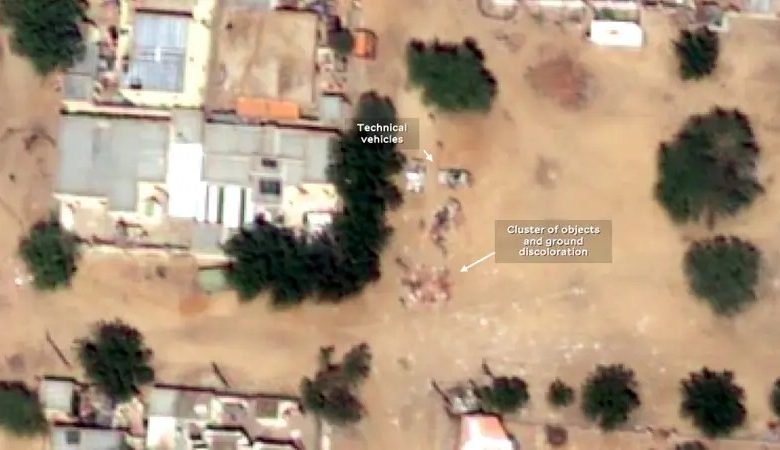
After the Rapid Support Forces (RSF) stormed the city on Sunday, communications with civilians were cut off. Observers were left only with satellite imagery and footage posted by the attackers themselves.
That alone was enough.
Satellite images show bloodstains and bodies scattered across the desert around the city, while videos depict armed men inside a looted hospital, its corridors filled with corpses. One clip shows a wounded man being shot at point-blank range before the camera pans to a courtyard strewn with bodies.
According to the World Health Organization, 460 patients and caregivers were killed at the Saudi Maternity Hospital in El Fasher. The Sudanese Doctors’ Union described the site as a “human slaughterhouse.”
“What happened in El Fasher is like Genghis Khan’s army storming a besieged city and slaughtering its people,”
said Will Brown, Africa analyst at the European Council on Foreign Relations.
The tragedy is even starker when recalling that El Fasher once hosted world leaders — Colin Powell, Kofi Annan, David Cameron, Jack Straw, and even George Clooney — who came to condemn the Janjaweed genocide two decades ago.
Those militias have since evolved into the RSF.
And this time, no one is coming to stop them.
A Repetition of Genocide — With Modern Tools
According to Ahmed Soliman of Chatham House, the El Fasher massacre reflects the broader pattern of the RSF–army conflict since 2023: a war without rules, with no protection for civilians or prisoners. It is, he said, a horrifying repetition of the Darfur genocide of 2003 — the same Janjaweed, the same victims, only a different context.
Sheena Lewis of Avaaz adds: “These are not isolated abuses. They are systematic policy.”
Witnesses to the Zamzam Camp massacre near El Fasher in April reported that RSF fighters openly declared they would “cleanse El Fasher of the Zaghawa.”
Not a Civil War — But a Proxy One
This is not a war of Africans against Africans. It is a proxy conflict involving Middle Eastern powers.
The Sudanese army is backed by Egypt, Iran, Turkey, and possibly Saudi Arabia and Qatar.
The RSF, meanwhile, enjoys support from the United Arab Emirates (UAE) — despite repeated denials.
The United Nations has described reports of Emirati backing as “credible.”
The Wall Street Journal, citing U.S. intelligence, said the UAE has supplied the RSF with Chinese-made drones and ammunition.
Supply routes through Libya, Chad, and Somalia appear to have been established ahead of a large-scale offensive that began in El Fasher.
A Sudanese analyst put it bluntly: “The UAE never explains its strategy — as if it’s doing it for sport.”
Yet its motives are clear:
To counter Islamist influence in Sudan
To secure gold and other natural resources
To ensure food security, viewing Sudan as a potential breadbasket for the Gulf
And to build a sphere of influence stretching from Libya to the Red Sea and Central Africa
The UAE is now one of Africa’s largest investors, with $110 billion in commitments.
DP World, its global ports operator, manages or develops terminals across the Red Sea and Indian Ocean.
The West’s Absence from the “New Scramble for Africa”
Today’s landscape resembles a new colonial scramble for Africa — but this time led by mid-level powers, not the traditional Western empires.
In the 1990s or early 2000s, a genocide of this scale would have sparked outrage and intervention from London and Washington.
Today, humanitarian intervention isn’t even part of the debate.
“It’s not even on the political agenda anymore,” says Brown.
Although the West still has leverage — such as halting arms sales to the UAE — attention is fixed elsewhere: Gaza, Ukraine, and China.
Until the world acts, the killing will go on.