Sudanese Foreign Ministry: The Government Does Not Reject a Truce but Has Concerns
Sudan Events – Agencies
The media advisor at Sudan’s Ministry of Foreign Affairs, Ammar Al-Arki, stated that “the Sudanese government does not object to a ceasefire on humanitarian grounds.” Speaking to Russia’s Sputnik Radio on Saturday, Al-Arki said that “the government has outlined through official state channels its openness to such a truce, provided that it respects national sovereignty and adheres to international laws and human rights principles.” He noted, however, that “the government has reservations about the possibility that the Rapid Support Forces’ (RSF) agreement to a truce might be an attempt to regroup and reorganize its military and political positions.” Al-Arki recalled that “the RSF had previously rejected all calls from the UN Security Council and government initiatives, yet now accepts a ceasefire only after seizing control of Darfur and committing crimes that have drawn global condemnation.” He added that Sudan’s leadership intends to pursue legal and diplomatic measures to hold perpetrators accountable for violations, in accordance with laws governing military, political, diplomatic, and legal engagement. Al-Arki described the conflict as having an international dimension, saying that “many actors have intervened, and some forces have succeeded in blurring international positions,” while emphasizing that “the African Union’s stance and that of several Arab parties have been positive.” He pointed to Egypt’s clear position within the Quad mechanism, which stresses “no compromise on Sudan’s sovereignty or its state institutions, including the national armed forces.” Al-Arki also noted Saudi Arabia’s continued sponsorship of the Jeddah platform, saying “the Kingdom still calls for a return to the Jeddah forum, which was a model framework that sought to address the crisis before it escalated across Darfur.”
On Thursday, the RSF announced its approval of a humanitarian ceasefire initiative proposed by the international Quartet—comprising the United States, Saudi Arabia, the United Arab Emirates, and Egypt. The initiative calls for a three-month cessation of hostilities and the launch of an inclusive Sudanese dialogue leading to the formation of an independent civilian government within nine months. However, a Sudanese military official stated the same day that while the army welcomes the Quartet’s proposal, it would not agree to a truce unless the RSF withdraws completely from civilian areas and surrenders its weapons, in line with previous peace proposals.
UN Special Envoy to Sudan, Ramtane Lamamra, described the proposed humanitarian ceasefire as “a rare opportunity to halt the fighting, protect civilians, and alleviate the suffering of the Sudanese people.” In a post on X, he affirmed the United Nations’ readiness to work with regional and international partners to turn the proposed truce into “a genuine bridge toward peace,” urging the warring parties to seize the opportunity. “A lasting ceasefire,” he said, “could open space for dialogue and a serious political process—the only path to a just and enduring peace.”
Meanwhile, the governor of Darfur, Minni Arko Minnawi, stated that acceptance of a humanitarian truce must be preceded by the RSF’s withdrawal from cities, residential areas, and hospitals, the release of detainees, and the safe return of displaced persons. “There can be no ceasefire without protecting civilians and holding perpetrators accountable,” he wrote on X, warning that any truce implemented without such conditions “would mean the division of Sudan.”
Sudan’s ambassador to Washington, Mohamed Abdullah Idris, reiterated his government’s commitment to the roadmap it submitted to the United Nations and called on the international community to support the efforts of the civilian government led by Prime Minister Kamil Idris.
Sudan has been mired in a power struggle between the national army and the RSF since April 2023, a conflict that has claimed more than 40,000 lives and displaced around 12 million people internally and externally, while plunging the country into a severe food crisis.
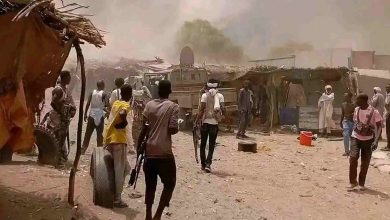
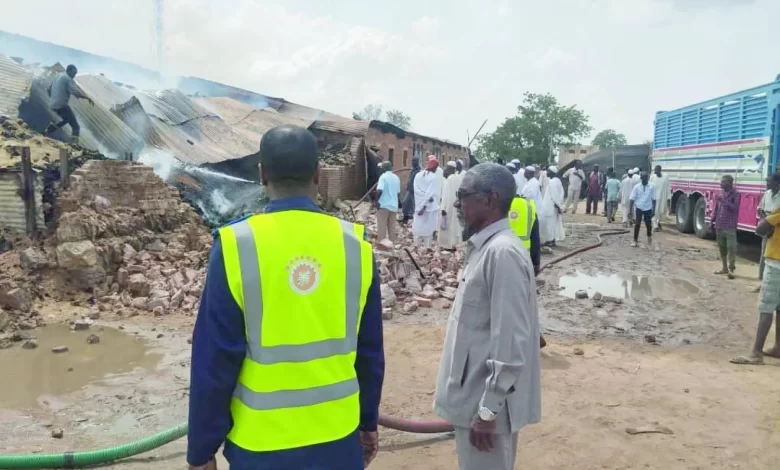
On the ground, local sources reported that on Saturday morning, the army shot down a drone flying over the city of El-Obeid, the largest city in Kordofan region, amid growing international and domestic concern over the ongoing military buildup by both the army and the RSF in preparation for major battles expected in the area. Eyewitnesses told Asharq Al-Awsat that air defense systems detected two high-altitude drones, and the sound of anti-aircraft fire was heard across the city. The army later released video footage showing the wreckage of a drone on the outskirts of El-Obeid. These developments followed the army’s interception a day earlier of a swarm of RSF drones targeting Omdurman—one of the three cities forming the capital, Khartoum—as well as strikes on Atbara in River Nile State, northern Sudan. Videos circulating on social media captured moments when army defenses intercepted the drones.
The RSF has intensified its use of drones against military and civilian targets in areas under army control, while the army’s air force carried out drone strikes on RSF positions in several cities across Darfur on Thursday, reportedly causing casualties among RSF fighters. Local sources told Asharq Al-Awsat that the RSF has massed large forces in preparation for an assault on the army’s 22nd Infantry Division in the city of Babnousa, western Kordofan, while other RSF units are maneuvering around towns near El-Obeid. Two weeks after seizing control of El-Fasher—the army’s last stronghold in Darfur—the RSF has threatened to expand its military operations into Kordofan State.
Source: Asharq Al-Awsat