UAE Begins a New Phase of Support for Militias and Conspiracy Against Sudan
Sudan Events – Agencies
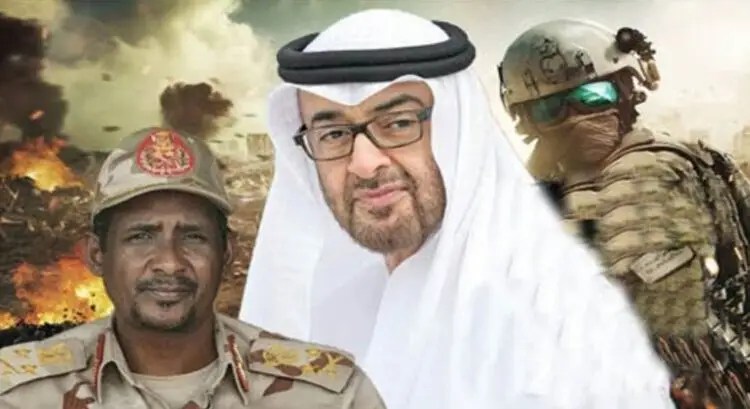
Following the fall of El Fasher and the intense criticism it faced both domestically and internationally, the United Arab Emirates appears to have activated all its available “mechanisms” to secure what it calls its interests in Sudan — a pattern similar to its actions in countries like Yemen and Libya under the pretext of combating the Muslim Brotherhood. This pretext allowed Abu Dhabi to co-opt certain civilian and military politicians opposed to Islamist movements, turning them into instruments for advancing its strategic goals in conflict-ridden states. In both Yemen and Libya, this policy ultimately led to the fragmentation of the state, a scenario Sudan now risks facing.
Networks of Loyalists
The UAE has established a network of loyalists — some aligned with it, others opposed — but ultimately, it seems unconcerned as long as its regional interests are secured and its status as an influential regional power is maintained. Through these proxy networks, Abu Dhabi ensures access to the wealth of these countries, offering financial and logistical support in exchange for political and moral cover. The UAE had hoped that the advance of the militias in Sudan would force what it calls the Port Sudan government to choose between accepting a settlement process or tolerating the emergence of two separate governments — one in El Fasher and another in Port Sudan.
However, this was rejected by the head of Sudan’s Sovereign Council, who instead opted for a military resolution after obtaining advanced technical and logistical capabilities. The Sudanese army reopened recruitment centers and mobilized large forces to decisively end the battles in Kordofan and then move toward Darfur to liberate its occupied cities.
In response, the UAE seems to have deployed new strategies, including mobilizing its loyal media figures to shape political discourse. Sky News Arabia anchor Tasabeh Khater was sent to Nyala and El Fasher, while Al Hadath TV’s Saad Al-Din Hassan appeared defending and advising the militias while attacking the Sudanese army. Additionally, a senior Emirati official reportedly called for enforcing the Quartet’s proposed ceasefire “by force.” Anwar Gargash urged international backing for the settlement plan despite being aware — as rights groups like Human Rights Watch have warned — that such a scenario could lead to ethnic massacres in El Fasher.
Nevertheless, Abu Dhabi has continued its material and political support for the militias, even as violence intensifies. With the Sudanese army rejecting the Quartet’s initiative and resuming operations, the UAE appears to be pushing toward a dangerous escalation aimed at entrenching the concept of two parallel governments: one in the east and another in the west, headquartered in El Fasher and financed through the sale of looted Sudanese resources.
A Triangular Supply Network
According to Dr. Osama Hanafi, a political science professor at Sudanese universities, the UAE recently summoned Chadian President Mahamat Idriss Déby and South Sudanese President Salva Kiir, suggesting coordination over a triangular supply route through South Sudan, southern Libya, and eastern Chad. Abu Dhabi reportedly pledged up to $35 billion to Chad under the guise of a “cooperation forum,” a move Dr. Hanafi describes as a front for funding war efforts in Sudan. The UAE also committed to financing infrastructure projects and supporting South Sudan’s struggling economy — steps that, he argues, ultimately serve to bolster militia operations and arms supplies.
He added that Sudan is witnessing “a new phase of Emirati support,” noting that two flights now land daily at Nyala Airport, while work is underway to prepare El Fasher Airport to receive cargo planes carrying weapons and evacuate wounded fighters for treatment in the UAE after initial transfers to hospitals in Chad and South Sudan. Those combatants are later treated in the UAE, Kenya, or other countries.
Upcoming Battles
Security expert Madani Al-Harith stated that the coming battles in Kordofan and Darfur will be fierce, as large numbers of mercenaries from South Sudan, Uganda, and other countries are arriving, accompanied by continuous arms shipments through well-known routes familiar to local populations. “We must rely on verified intelligence and keep it updated,” he said, warning that reaching El Fasher and Nyala will not be easy due to the sophisticated weaponry being moved into the region.
He acknowledged that some of these weapons have been destroyed by Sudanese airstrikes but urged caution and seriousness. “I believe the army’s leadership has the experience to overcome any obstacles in these battles,” he said, concluding that “the army that expelled the militias from Khartoum and Al-Jazira is capable of defeating them again in Kordofan and Darfur.”