Including the Designation of the Militia as a Terrorist Organization… Scenarios After the Burhan–Mohammed bin Salman Call
Sudan Events – Agencies
There are notable gaps and differences between the statements made by Mossad Bolus, advisor to the U.S. president and supporter of the Quartet Committee initiative, and those made by the U.S. Secretary of State. This is true, yet the Secretary of State’s tone was unmistakably clear regarding the issue, as he expressed Washington’s frustration with the militia’s failure to honor its commitments—not only its unwillingness to do so, but its structural inability, given its tribal composition, the heavy presence of foreign mercenaries, and its subordination to the agenda of the state funding its war against the Sudanese people.
Diverging Positions
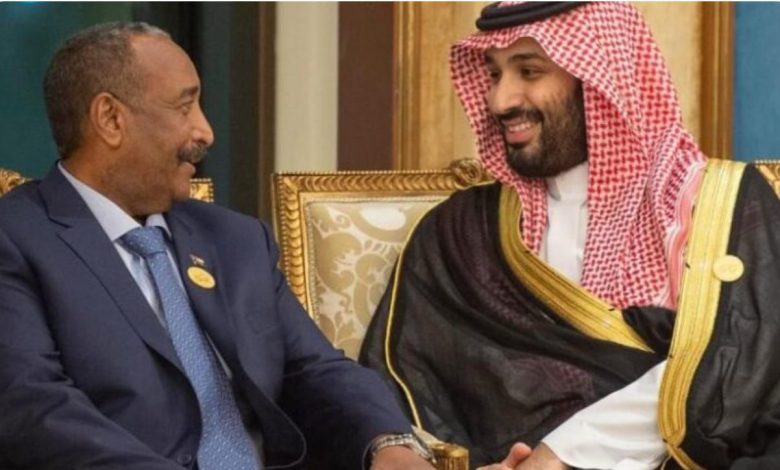
For the first time, he pointed explicitly—and with a tone not free of warning—to the UAE, and by extension to the countries that have allowed their territories to be used for transporting Emirati weapons into Sudan. It then became evident that the Saudi position—both within and outside the Quartet—has begun to shift. The recent phone call between the Chairman of Sudan’s Sovereignty Council, General Abdel Fattah al-Burhan, and Saudi Crown Prince Mohammed bin Salman appears to be a key turning point. Such communication between the two sides has been rare and seems linked to recent developments, possibly coming ahead of the Crown Prince’s visit to Washington this week, a visit expected to address the escalating situation in Sudan in addition to bilateral concerns relating to arms deals, economic issues, and Middle East regional arrangements.
According to Middle East Eye, a divergence between Saudi and Emirati positions has become increasingly visible—mirroring their differences in Yemen, where their approaches to regional influence and local alliances clash. While Saudi Arabia backs the internationally recognized government, the UAE supports southern separatists, complicating their relationship. A similar dynamic appears to be unfolding in Sudan: Saudi Arabia has leaned toward supporting the legitimate Sudanese government, whereas the UAE has thrown its weight behind the Rapid Support Forces (RSF), providing them with political and military backing.
Quartet Discrepancies
The shifting tensions between Saudi Arabia and the UAE serve as the first signal that the Quartet’s internal divergences are coming to light—particularly between countries such as Egypt and Saudi Arabia regarding the Sudan file. This is echoed by Dr. Saeed Salama, Director of the Vision Center for Strategic Studies in Ukraine, who noted that the Quartet lacks a unified vision and that each member is pressuring the others before even pressuring the warring parties. Therefore, he argues, current developments cannot be viewed as a decisive turning point in the conflict, but rather as a reflection of genuine international desire to halt the fighting and bloodshed. Yet ongoing disagreements among mediators and the warring parties’ unwillingness to commit seriously have rendered these initiatives little more than wandering diplomatic efforts struggling to break through the crisis.
This was evident when Mossad Bolus appealed to General al-Burhan to help him succeed in his mission—revealing a perspective that prioritizes the success of his initiative over the rights of victims. Dr. Salama argues that the situation has now gone beyond individual envoys and into the realm of broader state-led initiatives.
Halting Arms Shipments
Dr. Osama Hanafi, professor of political science at the University of Sudan, offers another view: he believes developments are heading toward forcibly halting Emirati support for the RSF by designating it a terrorist organization, thereby isolating the UAE from the Sudan file. This comes amid the firm stance of the Sovereignty Council chairman, who rejects any initiative involving the UAE. Hanafi added: “It seems the back channels are full of lessons. Countries concerned with Sudan’s stability—such as Egypt and Saudi Arabia—have previously urged the UAE to stop arming the RSF, but Abu Dhabi ignored the requests of Saudi Arabia, Egypt, and even the United States, whose Secretary of State openly warned states supplying weapons to the RSF.”
He continued: “I believe the U.S. is moving toward designating the RSF as a terrorist organization. Such a designation would subject its supporters to American sanctions and could significantly curb the UAE and stop the militia’s weapons shipments. The signals sent by the U.S. Secretary of State about Washington’s readiness to classify the militia as a terrorist entity—if such a step would help end the war—are closely tied to the measures the U.S. is preparing to stop Emirati support for the RSF.”
Political analyst Bashar Jarrar did not rule out the possibility that the United States—whose intensified diplomatic engagement indicates a desire to end the war—may go as far as providing some form of military support to the Sudanese army to enable it to reassert control and bring the fighting to an end.