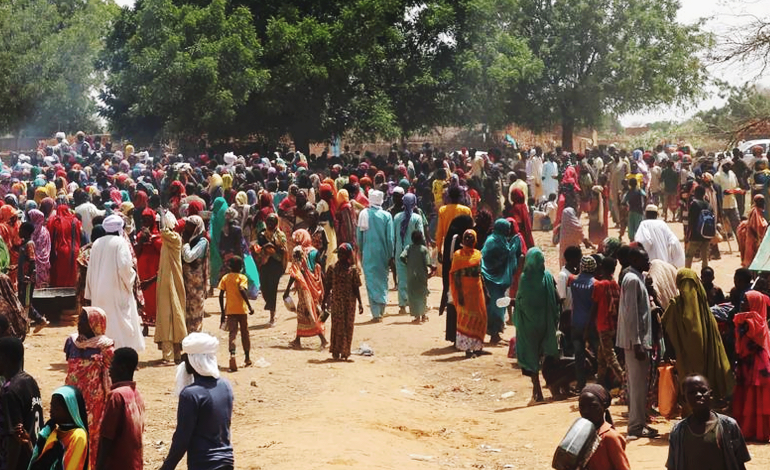
The French daily Le Monde reported that Chad is facing an increasingly fragile situation as the war in Darfur intensifies and its consequences spill across the border, given Chad’s role as an active player in the conflict. N’Djamena is accused of supporting armed groups aligned with its strategic interests while hosting more than one million Sudanese refugees.
According to the report by Cyril Bensimon, recent developments in Darfur—especially the fall of El-Fasher to RSF forces led by Mohamed Hamdan Dagalo (Hemedti)—have caused deep alarm within Chad, particularly as violence escalates against the Zaghawa, who have long formed the backbone of the Chadian military since the era of the late President Idriss Déby.
Chadians understand, the paper notes, that any ethnic spark in Darfur could easily spread across the border due to shared tribal ties.
Military sources say concern is growing inside the Chadian army, especially as the government has issued no condemnation of the massacres in El-Fasher—an omission that puts the authorities in a sensitive position amid anger among the Zaghawa.
A Chadian general told the newspaper, with clear unease: “It is no secret that the fall of El-Fasher angered the Zaghawa community. This is our biggest concern now—we must prevent the Darfur conflict from seeping into our country.”
As the conflict is increasingly viewed as a war between Zaghawa and Arab groups, a Zaghawa officer said: “We saw celebrations in some camps after El-Fasher fell, even as Hemedti commits massacres against the Zaghawa. It is only natural for people to think of revenge when their relatives are killed.”
Researchers cited by the paper argue that the situation is extremely awkward for N’Djamena, which has effectively aligned itself with the RSF. Multiple reports indicate that Chadian airports have been used to transfer weapons and treat wounded RSF fighters.
Political sources say the shift is driven by President Mahamat Idriss Déby’s calculations for staying in power, as he perceives the greatest threat to come from potential rebellions led by Zaghawa groups. He therefore sees RSF dominance in Darfur as a means of preventing such uprisings inside Chad.
But Le Monde warns that this strategy is fraught with risk: it threatens army cohesion, deepens ethnic divisions, and leaves Chad exposed to retaliation from Sudan’s military, which is well aware of Chad’s internal fragility. For decades, mutual support for insurgencies has defined Sudan-Chad relations.
The newspaper concludes that Chad’s announcement on November 28, 2024, ending its defense agreements with France has stripped it of French military backing—long a vital lifeline against rebel attacks—leaving no official French troops on its soil today.