Returned to the Country… Prime Minister Thanks Saudi Arabia and the United States, Drops Complaints Against Journalists
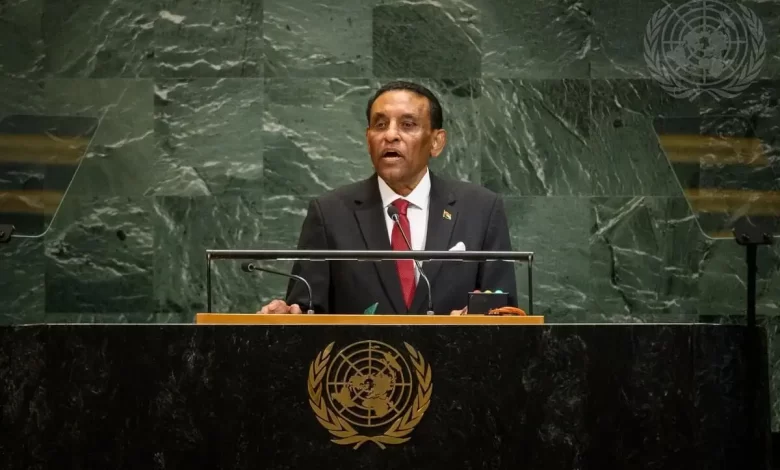
Prime Minister Dr. Kamil Idris has returned to the country after being absent from the scene for a period that sparked significant reactions, given the important files he left behind and the great hopes pinned on his government—hopes that have not been realized due to his repeated absences and slow movement on key issues.
His return was linked to a meeting said to have taken place on his way back with the president of the Journalists’ Union, Al-Sadiq Al-Rizayqi, during which he emphasized the role of journalists in defending their homeland and ordered the dismissal of recent complaints filed against some journalists who had sharply criticized him. The Prime Minister also welcomed the efforts of Riyadh and Washington to bring peace to Sudan, expressing in a statement yesterday his appreciation for the role of Saudi Arabia and the United States in seeking to end the war that has been imposed on Sudanese people.
The Prime Minister’s absence had stirred controversy between journalists, his office, and his advisor Mohamed Mohamed Khair, who had distributed accusations against journalists, describing them as “praise singers” — implying they only compliment those who give them favors — and vowed to wipe them out. This sparked wide debate and eventually led to complaints filed with the Cybercrime Prosecution and subsequent summons, which were closed yesterday by Kamil Idris after ordering all complaints to be dropped and pledging to allow the press to work freely.
Professor Fadl Al-Mawla Al-Na’eem, a political science expert, said: “I followed what was written and the developments. I believe many details are not important, but Kamil Idris must review his office and clearly define its management. It is illogical for the response to any criticism to be insulting journalists and labeling them with such descriptions. It is inappropriate for matters to reach this level and become personalized using state institutions—this is dangerous.”
He added: “It is good that the man has returned to his office to resume his duties despite the smear campaigns and rumors that targeted him and cast doubt on his position, even suggesting disagreements with the Sovereign Council that pushed him to resign.” He continued: “He must reconsider his approach because his performance during the past period does not match the critical phase Sudan is going through. It is unacceptable for the Prime Minister — the chief executive — to be absent without explanation. This casts a shadow over the Cabinet and the civil service in general. Sudanese people are living through a very difficult time, and we expect strong performance and major roles from the executive body. Work cannot be left to juniors and employees without oversight; the Prime Minister and his team must propose out-of-the-box solutions to the political, economic, and even social challenges currently facing the country. There are issues that need urgent plans and others that require long-term strategic approaches, and I believe the man is fully capable of addressing them.”
Ahead of him lies a long list of files that require work, starting with the political file, which saw increased involvement from the United States and Saudi Arabia this week. There is also the file of moving the capital back to Khartoum, which has become complicated and is now surrounded by conflicting statements. Additionally, the ongoing military battles in Kordofan require a strong governmental presence to provide services for citizens stranded in newly liberated areas.
Shawqi Al-Asam, who works in humanitarian and volunteer fields with the Red Crescent, said that displacement camps require daily work, government follow-up, and support. “Yes, organizations are working now and good-hearted people are helping, but the needs are huge. Just know that the Al-Dabba camp alone hosts about ten thousand people, and the number is increasing, straining the already limited resources. And these are only from El Fasher, and some from Bara.”
He added: “The presence of a government and a Prime Minister who assumes responsibility is essential. The President of the Sovereign Council has not been negligent—he has taken the matter seriously—but we are waiting for a role from the Prime Minister in providing the tools needed for the work, supporting the displaced, visiting these camps, and checking on the people’s conditions.”