Trump Enters the War Track… Optimism, Expected Moves, and Government Welcome for Saudi–U.S. Efforts
Report – Amir Abdelmajeed
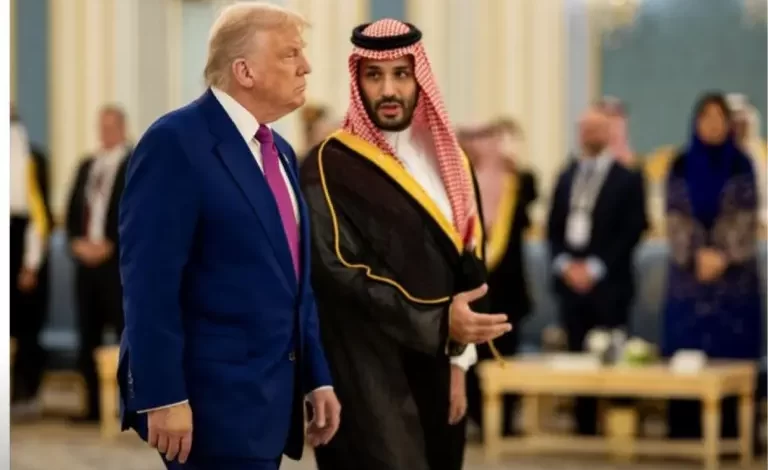
Statements by U.S. President Donald Trump regarding the war in Sudan have stirred wide controversy politically, militarily, and among the public. Trump expressed readiness to begin working on resolving the crisis, declaring that he would intervene to help end the war ravaging Sudan. Speaking at a Saudi investment conference held one day after his meeting with Saudi Crown Prince Mohammed bin Salman at the White House, Trump said the Crown Prince had asked him to intervene to resolve the conflict. He added, “We have already begun working,” noting that he started studying the matter “half an hour after the Crown Prince explained the importance of the issue.” He continued, “I ended eight wars before. Sudan wasn’t on my agenda, but the Crown Prince made me care about it. He wants me to do something about Sudan, and now I’m looking at ways to settle the conflict after he explained the matter in detail and how important it is to him. I have already begun working at his request, and he will have a strong role in ending what is happening in Sudan.”
Trump added: “Working with the Crown Prince was amazing. Yesterday, he mentioned Sudan and told me: ‘Mr. President, we talk about many wars, but there is a place on Earth called Sudan — what is happening there is terrible.’ I used to see the conflict as one between hired mercenaries with no government, but he explained Sudan’s culture and history to me. It was fascinating to hear these details. He told me that ending this conflict would be the greatest thing I could do — the greatest thing I’ve done so far. These were his exact words.”
Crown Prince Mohammed bin Salman had reportedly held a lengthy phone call with Sudan’s Sovereign Council Chairman, Gen. Abdel Fattah Al-Burhan, informing him that he intended to ask President Trump to intervene to halt the conflict and stop the flow of weapons to the militia — a key step toward ending the war and removing the threat facing Sudan and the region, in line with the aspirations of the Sudanese people.
This raises questions: Is the situation truly moving toward serious U.S. engagement? And what has U.S. adviser Massad Boulos been doing if the American President himself was unaware of developments in Sudan — especially given Trump’s suggestion that the conflict was not initially on his agenda and his misunderstanding of the situation as being merely “militias and mercenaries with no legitimate government”?
Senior U.S. adviser for Arab and African affairs, Massad Boulos, announced that under President Trump, the United States is committed to ending the “horrific conflict” in Sudan and stopping foreign support that fuels violence. The Sudanese government welcomed the efforts of Saudi Arabia and the United States to achieve a fair and just peace in Sudan and expressed readiness to engage seriously with them to achieve the peace the Sudanese people are awaiting.
American diplomat Cameron Hudson viewed the development as a shift in the trajectory of the war in Sudan, though he added, “We do not yet know whether this change is good or bad — but it is important.” He continued: “The U.S. is not an organization designed for quick crisis fixes. Solving Sudan’s crisis is a long-term goal that requires rebuilding the expertise lost within the U.S. State Department.” He noted that Secretary of State Marco Rubio is well-informed about the conflict but will need to manage it at the highest levels.
Hudson said: “Someone like Tom Barrack — who has experience and access to Trump — would be a better choice than Massad Boulos, whom some parties view as weak. There is also Chris Landau, the deputy secretary, who is a potential alternative to the weak Boulos.” He added: “Whoever handles the file must be decisive and send clear messages to all parties that matters are now being overseen by President Trump himself. Trump must also avoid being drawn into the broader Saudi–UAE rivalry. Since his involvement came at the request of the Saudi Crown Prince, he will constantly need to prove his neutrality. I believe this will restrain him from taking strict measures against the UAE — despite the urgent need to stop its support for the Rapid Support Forces.”
Hudson stressed the importance of distinguishing between two wars in Sudan and evaluating which one the U.S. can influence:
“Trump has leverage in the first, but Sudanese people need a solution to the second.”
He explained:
-
The first war is the current one between the army and the RSF. Trump can influence this by mediating to end the proxy war being waged against Sudan.
-
The second war is the cycle of military coups and the struggle for power. This, Hudson said, is something Trump does not have the tools to solve.
Dr. Al-Sadiq Khalafallah of the Hemeti Demti Institute attributed the renewed optimism about ending the war to the involvement of influential figures in the file. He said: “I have long said U.S. administrations were never serious about the Sudan file, which was historically handled by security and intelligence agencies while Congress and the White House stayed distant — contributing to the complexity. Any real solutions require elevating the file to a top priority in American foreign policy through senior figures like President Trump, Secretary of State Rubio, or the chairman of the House Foreign Affairs Committee, Brian Mast.”
Dr. Osama Hanafi, Professor of Political Science at the University of Sudan, said optimism about positive change is good and reasonable, but expectations must be tempered:
“What has happened so far is a step, but achieving what the Sudanese people hope for requires further steps — which will test the seriousness of the Americans and of Trump.”
He stressed that the first step must be to designate the RSF as a terrorist organization, saying:
“This is extremely important to halt the flow of weapons to the militia. Whoever leads the file must show a firm stance toward Abu Dhabi and its agents in Africa, whose actions have caused deep harm to Sudan and its people.”
Hanafi added:
“There are critical issues linked to the main file of ending the war. Any formula that brings back the RSF or its partners will not be accepted — not by the government nor by the citizens after what this militia has done to them. People will not accept a settlement that returns Hemedti or his militia to the political or military scene, nor the political groups that supported and stood with him. That will not be acceptable.”