31 Months of War: Displaced People and Displaced Markets
Sudan Events – Agencies
For more than two years, the war has uprooted both people and their markets across different parts of Sudan. The country’s social and economic map continues to shift each time the frontlines move, as each side gains or loses control of new areas.
The intensification of commercial and military activity along Sudan’s borders has also reshaped major crossings, following changes in territorial control since the conflict began in April 2023. In October 2024, the Rapid Support Forces (RSF) banned the movement of crops and goods from areas under their control to those held by the army. The decision caused goods to pile up on both sides and brought trade to a halt, driving prices to historic lows in production zones across Kordofan and Darfur. Small oil-producing factories in River Nile State and Port Sudan were similarly affected, with sesame and groundnuts no longer reaching them from western production areas.
This raises a fundamental question: How has the war reshaped Sudan’s geography, society, and economy?
New Markets to Replace Omdurman
Before the war, Omdurman Market in the capital Khartoum was the country’s primary hub for trade and goods movement. But a full year of battles in and around the market stripped it of this status, allowing new commercial centers to grow elsewhere.
Not far from Omdurman Market, Sabreen Market in Karari locality emerged as the sole hub for residents trapped between the lines of control in Khartoum State. Its commercial activity boomed thanks to simplified import procedures—authorities replaced the requirement for a commercial license with a 1% fee on the value of incoming goods, in addition to full customs charges.
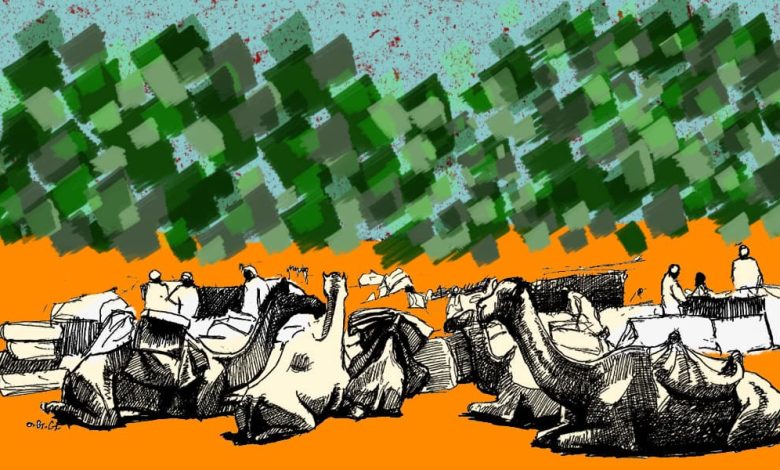
In Sudan’s Northern State, the town of Al-Dabbah became a major post-war commercial center. Its location on a bend of the Nile allowed it to link western and eastern states, and the market’s rise revived the historic Darb al-Arbaeen caravan route.
In Shendi (River Nile State), vehicle trading flourished as the war began, and the city’s car markets expanded rapidly. Three major markets emerged alongside dozens of relocated dealerships from Khartoum and Wad Madani, stretching along both sides of the railway.
After government forces and allied groups regained control of Khartoum State, reverse displacement began. In northern Khartoum Bahri, markets in Al-Siqayah and Al-Jili revived, and Kadaro Market reopened, supported by relative price stability. The main highway linking Bahri and Atbara now sees heavy truck movement, and shops—from groceries to bakeries and pharmacies—have resumed operations, along with outlets for major flour companies.
Tamboul and Eastern Al-Jazira
Following the October 20, 2024 defection of Abu Aqla Kekol from the RSF to the Sudanese army, the RSF launched attacks across eastern Al-Jazira State. By late November, an estimated 393,337 people had fled to 46 locations across eight states, with 42% seeking refuge in Gedaref State.
Several markets in eastern Al-Jazira were looted and destroyed, most notably in Tamboul—one of the region’s largest markets, home to a major livestock hub for camels and cattle. Tamboul supplies goods to the Butana Plain, eastern Al-Jazira, and major livestock markets in Halfa Al-Jadida and Al-Damer. During the war, Tamboul gained added importance for the RSF as a commercial gateway into central Al-Jazira. It also became a route for looted goods leaving the state, especially after seasonal rains closed key roads to Gedaref, fueling competition among traders aligned with the RSF.
Sennar, Blue Nile, and White Nile
The RSF’s capture of Jabal Moya in June 2024, followed by the fall of Sennajah and Al-Dinder, triggered the second-largest displacement wave in central Sudan since April 2023. Markets that had substituted for those in the devastated capital were emptied as traders evacuated their goods in anticipation of further attacks.
According to IOM’s displacement tracking teams, 725,965 people were displaced across Sennar State—37% originally from Sennar, and 63% previously displaced from elsewhere. This exodus caused markets to run out of goods, while prices soared in Blue Nile and White Nile states.
In August 2024, RSF forces overran the Blue Nile locality of Al-Tadamon, sending residents to shelters in Damazin. Large-scale farmers and agribusinesses fled with their machinery to South Sudan to escape RSF aggression.
Until early October 2024—when the army recaptured Jabal Moya—White Nile residents relied on a rugged dirt road running from Al-Duwaym westward to Um Seyala in North Kordofan, then north to Al-Dabbah, a journey of roughly 474 kilometers.
Between May and July 2023, the Tandalti Market on the border between White Nile and North Kordofan expanded dramatically. By October 2024, the market hosted 58 newly established oil presses, at least 23 shoe suppliers, and 16 clothing companies that had shifted part of their operations there, alongside relocated livestock export traders.
Kordofan: Checkpoints and Chokepoints
On May 1, 2024, the RSF announced its control over An-Nuhoud in West Kordofan—a key commercial hub and wartime replacement for North Kordofan’s besieged capital, El-Obeid. The city sheltered thousands fleeing Darfur and Kordofan, and lies on the main route connecting Khartoum to Darfur.
El-Obeid, already under siege, faced new waves of displacement and severe shortages after losing access to crops previously delivered from Darfur and Kordofan via An-Nuhoud. Capital financing agricultural production in An-Nuhoud was looted, along with harvests, property, and trucks.
Meanwhile, the expansive Dar al-Reeh region—stretching from west of the Nile in Dongola and Omdurman to eastern and northern North Kordofan, and southward toward White Nile State—became a major trade corridor due to its lack of direct fighting. But RSF checkpoints and tribal levies inflated transportation costs. Traders nonetheless continued using routes toward Mellit, Umm Keddada, Sarri, and east Darfur, or onward through the rugged routes toward Um Seyala, Al-Duwaym, Al-Mazroob, and Darfur.
From Darfur to Libya—And Back
By late 2024, displacement from Darfur had revived the so-called “Um Dawrwar” markets across North Darfur’s villages. Before the war, goods entered North Darfur via:
the Wadi Halfa–Omdurman–Barra–El-Obeid–An-Nuhoud corridor into Darfur, or
the Libyan route through Mellit, 65 km north of El-Fasher.
With Al-Dabbah’s wartime rise and the revival of the old road between it and North Darfur, new categories of goods appeared in Um Dawrwar markets—particularly after RSF forces cut the Mellit–Fasher road.
Al-Dabbah became a main supplier of consumer goods to North Darfur and to besieged El-Fasher, where drivers were forced to pay large sums for protection from armed groups, sharply raising transportation costs and prices.
On April 13, 2024, RSF forces seized the vast Zamzam displacement camp south of El-Fasher, forcing nearly 400,000 people to flee into the city, while others escaped westward to Tawila. As fighting and siege intensified, an additional 279,650 people fled north to Rokero (Jebel Marra).
Though Libya officially closed its borders with Sudan in April 2023, trade never completely ceased. It became riskier, shaped by smuggling networks and militia-controlled routes. Libya emerged as a primary outlet for smuggled Sudanese gold, transported through Darfur by networks tied to armed groups.
Before the RSF gained dominance over border crossings, caravans moved through traditional desert routes from Nyala and El-Fasher via Kabkabiya or Kutum through Al-Uwaynat to Kufra. Others passed through Tina into Chad before heading to Sabha. Today, Mellit has become a major commercial center, controlling the flow of goods along these desert routes.
In West Darfur, trade shifted to the route from El-Geneina through Bir Illeo into Chad, then onward to Sabha—fraught not only with armed clashes but also highway bandits.
According to displacement tracking teams, 75% of people displaced since October 26, 2025 were already internally displaced—first from camps like Zamzam and Abu Shouk or neighborhoods within El-Fasher, and then again after the city fell on October 26, 2025.
With each new battle, Sudanese civilians are forced to adapt—to new places, new markets, and unfamiliar ways of surviving. The recent decision by the Northern State governor to ban the transport of goods into RSF-controlled areas in Kordofan and Darfur marks yet another turning point—one that may push people toward new trade routes, new markets, and perhaps entirely new types of goods.
Source: Atar