Al-Burhan’s Remarks at the Memorial of Minnawi Movement Martyrs: Messages in Multiple Directions
Sudan Events – Agencies
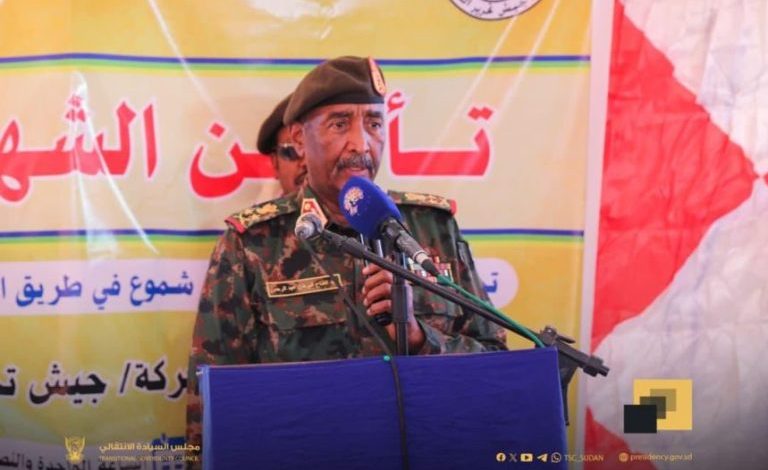
Chairman of the Sovereignty Council and Commander-in-Chief of the Army, General Abdel Fattah Al-Burhan, addressed on Monday the memorial ceremony for the martyrs of the Sudan Liberation Movement in Port Sudan, attended by the movement’s leader Minni Arko Minnawi alongside political and military figures.
Despite its brevity, Al-Burhan’s speech carried significant messages directed both internally and externally. Their importance stems from arriving at a moment requiring clarity after various tensions in recent days.
In a notable gesture, Al-Burhan extended explicit praise to the Sudan Shield Forces—one of the rare occasions in which he mentioned the group by name, as they were previously referenced only under the broader category of “supporting forces.”
The gesture came just days after tensions in Wad Madani, capital of Gezira State, involving a clash between a Sudan Shield member and Intelligence from the First Division. Although the incident was quickly contained without negative repercussions, observers say Al-Burhan sought to reassure the Sudan Shield Forces, especially after some leaders expressed mild dissatisfaction at not being mentioned in the army’s recent statement.
According to Sudanese political science professor Dr. Al-Fadil Mohamed Mahjoub, quoted by Asdaa Sudanese, Al-Burhan spoke “as a statesman for Sudan rather than as Chairman of the Sovereignty Council,” aiming to calm tensions. He emphasized welcoming any groups taking up arms against the militia—an indication, Mahjoub argues, that Al-Burhan seeks to revive popular support and reinforce internal cohesion amid ongoing challenges that some mistakenly believe have ended.
Al-Burhan extended similar praise to the Joint Forces, highlighting their resilience and courage in El-Fasher and other areas, stressing the importance of cooperation and unity in eliminating the militia threat.
According to Asdaa Sudanese, Al-Burhan also spoke of re-framing the Sudanese state and proposed returning to the old independence flag composed of three colors.
Experts say his call to “re-shape the state” aligns with the conditions of a nation emerging from a total war—one that requires deep, comprehensive changes in the state’s structure, institutions, mechanisms, and objectives to modernize and adapt to new challenges. They regard the flag suggestion as symbolic rather than central to the wider transformation.
They note that re-shaping the state extends far beyond surface-level adjustments, encompassing restructuring institutions and making radical changes across government bodies—such as the judiciary, parliament, and bureaucracy—to ensure efficiency and effectiveness. It also requires re-defining national priorities and overarching state goals in response to internal challenges (economic, social) or external pressures.
Ultimately, the aim is to build a new and different governance model that ensures effective public participation and better meets the population’s needs.
Al-Burhan’s call for re-structuring the state followed his remarks on solidarity and unity—tools that experts deem essential for strengthening the internal front and aligning it with the nation’s higher objectives. They stress the need for Sudaneses to maintain internal cohesion amid persistent and renewed challenges—not only war-related ones, but the fundamental challenge of state-building and uniting the nation around a shared national project that fosters unity rather than fragmentation.
The Sovereignty Council Chairman also spoke about the “Battle of Dignity” and the future of the Rapid Support Forces (RSF), vowing to end the war in favor of the Sudanese people’s will.
He unequivocally declared that the militia has no political future and closed the door on negotiations centered around it, insisting that any solution preserving the RSF in any form is unacceptable. Al-Burhan said he informed the Norwegian envoy, the UN envoy, and Trump’s envoy that “any solution that does not dismantle the militias is unacceptable,” adding: “We told them clearly: If your proposal doesn’t end the existence of militias, then you should find someone else to negotiate with.”
His remarks came less than two hours after Al Arabiya reported statements by Trump’s envoy, Massoud Bolos, calling for a ceasefire and suggesting that military restructuring would not be left solely to the army and the RSF.
Political scientist Dr. Mohamed Omar said Al-Burhan intentionally shut down such “provocative initiatives,” which effectively maintain the militias as they are. Al-Burhan’s message, Omar noted, was direct and unmistakable: no solution that preserves any privileges for the militia will be accepted.
Experts conclude that Al-Burhan spoke extensively within a short time, using every second to deliver a multitude of messages aimed at consolidating the internal front to confront unending challenges and conspiracies.