The Road to Ending the War: Neutralizing the Militia’s Weapons and Entering Through the U.S.–Saudi Initiative
Sudan Events – Agencies
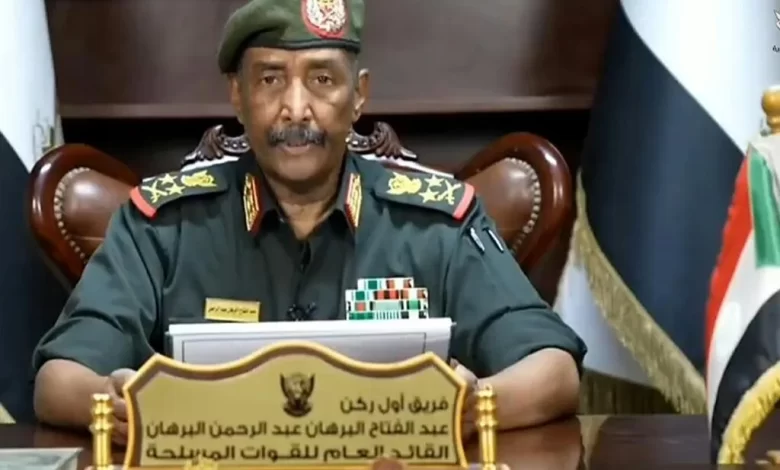
Once again, General Abdel Fattah al-Burhan has renewed his firm “No’s”: no return of the militia or normalization with it unless it lays down its weapons; no unilateral initiatives; and no ceasefire or political settlement while the militia remains armed. He added another “No” to the list: no return of the Muslim Brotherhood after they were overthrown by the people during the December Revolution. Although al-Burhan had previously expressed similar positions, his tone in a recent interview with Al Arabiya and Al Hadath channels appeared more resolute and clearer regarding the proposed initiatives, ceasefires, and the future of the Rapid Support Forces (RSF) militia.
The army chief stressed that the Sudanese Armed Forces will not sit at the negotiating table with the RSF unless it disarms and withdraws from the areas it has occupied. “These are essential conditions for any ceasefire or settlement,” he said. Al-Burhan added, “This war was imposed on us, and we will continue it until we restore state institutions from the hands of the rebel militia. The militia will not return, nor will we normalize with it unless it lays down its arms, because we will accept nothing but a single, unified army under the command of the Armed Forces.”
Regarding claims that the Muslim Brotherhood controls the army, he asserted: “There are no Muslim Brotherhood members in the army,” adding that “the Sudanese people toppled the Brotherhood in December 2018, and we will not allow them—or the RSF—to return under any circumstance.”
On the initiatives currently on the table, al-Burhan stated: “We welcome any genuine opportunity that brings real peace, and we value the initiative of Prince Mohammed bin Salman and U.S. President Donald Trump.” He continued: “The army is ready to engage positively with the joint U.S.–Saudi initiative,” while warning that “any unilateral initiative will not succeed.”
Sources close to decision-making circles have confirmed that intensive political and diplomatic efforts are currently underway to prepare for Trump’s initiative, parts of which have already been presented to involved parties and regional states as a precursor to its public unveiling. The initiative appears, for now, to be the most viable option, particularly because it has gained acceptance from the Chairman of the Sovereignty Council, who has consistently sent positive signals regarding it.
Dr. Bakri Mohamed Al-Sir, a lecturer at Sudanese universities and a specialist in political affairs, believes this initiative offers a significant opportunity to achieve a major breakthrough in the Sudanese crisis. He notes that this is perhaps the first time since the Jeddah talks that the Sovereignty Council chairman speaks positively about an initiative and repeatedly announces his readiness to engage with it. “I believe al-Burhan referred to it as the joint U.S.–Saudi initiative to indicate that the matter has gone beyond the Quad. We are now talking about a new initiative led by the United States and Saudi Arabia—a vital development in the search for solutions to halt Sudan’s bloodshed in the immediate term and to reach a political settlement that reflects the will of the people,” he said.
Dr. Al-Sir added that the public sentiment matches what al-Burhan articulated: ordinary citizens categorically reject any future role for the RSF. “People believe that the atrocities committed by the militia cannot be resolved through settlements but require accountability. This is exactly what al-Burhan has continued to state—and what the international community must understand: no one will accept the return of this militia.” He further added that al-Burhan’s recent statements have become clearer and more aligned with his actual views. “It is evident he has shed certain constraints that previously made many of his statements ambiguous, sparking lengthy debates about his intentions and positions.”
Abdel Nabi Musa, a researcher specializing in the history of conflicts in Sudan with an extensive archive of books, documents, and newspapers, suggests that al-Burhan’s references to the Muslim Brotherhood indicate that discussions on the matter have taken place between him and mediators. He believes some party—most likely the United States—requested clarifications. Musa also highlighted the significance of al-Burhan’s reference to a joint U.S.–Saudi initiative, describing it as a new development that suggests matters are now moving in a direction independent from the Quad, which the UAE had sought to frame as the sole path to resolving the crisis.
He concluded: “Al-Burhan has reaffirmed the parameters for any settlement, denied the presence of Brotherhood members in the army, and opened the door to the initiative of Prince Mohammed bin Salman and President Donald Trump.”