Darfur on a Hot Plate: The Road to Liberation Begins in Kordofan
Report – Sudan Events
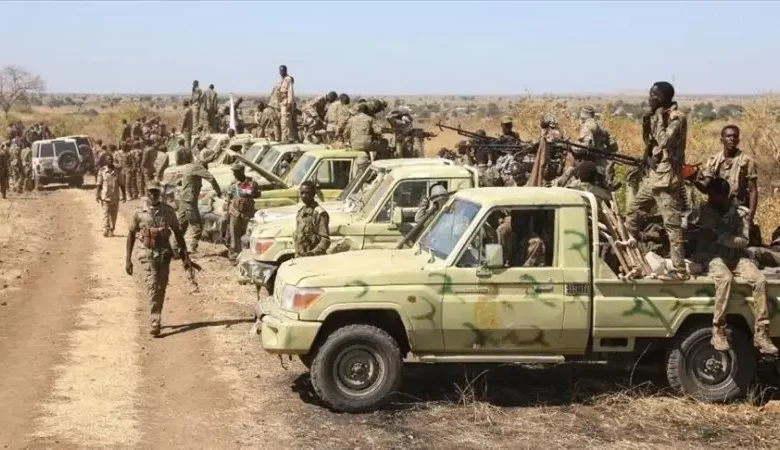
Several areas in Kordofan and Darfur have witnessed sudden drone attacks carried out by the Sudanese Armed Forces in recent weeks, targeting militia gatherings in both regions, as well as arms and fuel depots. These operations were accompanied by statements from army officials, state governors, and commanders of forces supporting the military. The attacks have inflicted heavy losses on the militia in both personnel and equipment, paving the way for the full liberation of Darfur.
The Governor of West Darfur, Bahr Al-Din Karama, warned all citizens in the state and its eight localities against approaching or being near Rapid Support Forces (RSF) militia positions, stressing that these locations are considered legitimate military targets for the air force and the army. He emphasized that any proximity to such sites puts civilian lives at risk due to anticipated military operations.
Karama reaffirmed the state government’s full commitment to rules of engagement and international targeting standards, ensuring all necessary precautions are taken to prevent harm to civilians or damage to civilian infrastructure. He stressed that the safety of citizens remains a non-negotiable priority.
He revealed that security agencies have documented the RSF militia’s use of civilians as human shields by converting homes, hospitals, schools, and service facilities into military positions—behavior he described as a “full-fledged war crime” and a deceitful attempt to conceal their presence within residential areas.
Karama did not rule out the possibility of the Sudanese Armed Forces—across all formations including joint forces, ground and air forces, special units, in addition to volunteer fighters and the popular resistance—launching large-scale operations to liberate the Darfur region, with West Darfur at the forefront, and to announce its complete cleansing from rebellion.
He asserted that the coming days will mark a decisive phase that will restore security, stability, and the authority of the state across Darfur.
Meanwhile, the Governor of Central Darfur, Commander Mustafa Tambour, announced following a meeting of the State Security Committee that a comprehensive review of the security situation and readiness for the next phase has been conducted, with all committee members present to discuss the latest developments on the ground.
Tambour told the Sudan News Agency (SUNA) that the meeting addressed the activities of what he described as the “rebellious RSF militia” inside the state, as well as the “flow of logistical support” reaching them through the borders with the Central African Republic and Chad—developments that prompted strengthened military and security arrangements for the upcoming period. He pointed to extensive violations committed by the militia, citing a technical report documenting damage inflicted on government institutions, including universities, ministries, hospitals, and the nine locality headquarters in the southern parts of the state.
Tambour affirmed that the Security Committee is operating “in full harmony and coordination,” adding that the key requirements for reclaiming the state have been established. He reassured citizens that matters are moving in the right direction and that the state’s recovery and the rescue of its population from security threats will happen soon.
The liberation of Darfur is now closer than ever, as confirmed by both the West and Central Darfur governors. Their statements signal a serious step toward the arrival of the armed forces and supporting units in the region. Air cover is expected to ease the progress of ground forces, while the drone strikes carried out in recent weeks against militia-held areas and equipment indicate that the attrition strategy is unfolding as planned—facilitating a ground offensive aimed at fully freeing Darfur and eliminating the militia entirely.