Mind-Consuming Feuds… From Amin’s Disputes and Al-Mahboub’s Opinions to the Crisis of Accusations of Treason in Sudanese Politics

By Abdelaziz Yaqoub
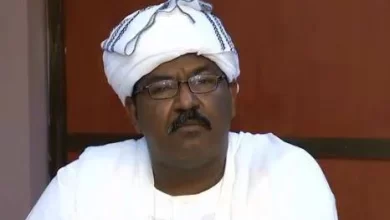
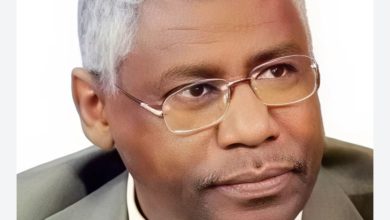
At the heart of political life, Sudanese parties face a constant test that reveals their ability to distinguish between genuine power and its illusion. Real power springs from original ideas, from initiatives that seek to address citizens’ concerns and improve their realities toward development and well-being, and from the capacity to bring together the diverse around a shared national project. Illusory power, on the other hand, is built on manufacturing accusations of treason, fostering fear, cultivating anxieties, and inventing an imaginary enemy toward whom the masses are steered. When this deceptive power prevails, politics descends into personal vendettas—just as seen in the exchanges between Dr. Amin Hassan Omar and Dr. Al-Mahboub Abdel-Salam. In such a climate, attacks replace serious dialogue, and words become blunt weapons instead of the gentle speech God commanded His prophets Moses and Aaron to use as a means of guidance.
Under the dominance of this approach, initiatives stall, ideas wither, and intellectual production becomes a mere echo of slogans that reproduce themselves without real impact. Instead of collaborative nation-building, the language of treason spreads as a tool for enforcing conformity, fear replaces critique, and rational debate is pushed aside in favor of the pursuit of adversaries. This creates an intellectual vacuum in which creativity retreats, noise overtakes action, and impulses eclipse wisdom.
The essence of politics, in its noble origin, is the crafting of the future through thought, dialogue, and innovation. A party that understands this essence opens its doors to every free voice, manages disagreement wisely, and treats diversity of views as a source of wealth rather than a threat. But once accusations of treason spread, natural differences turn into destructive conflict, healthy debate becomes personal hostility, and the political arena is reset to the equation of “you’re either with me or against me.” In such an environment, diversity loses its chance to evolve and becomes a burden to be contained or suppressed.
National-issue-based alliances offer the most effective path to building an active civil society, yet accusations of treason often destroy this path before it can even begin. When political forces unite around protecting freedoms, safeguarding citizens’ rights, expanding participation, and putting Sudan first, a new civic space emerges—one that strengthens citizenship and fosters awareness. But the discourse of treason and fear drags people back to old divisions and drowns public effort in side battles that achieve nothing amid an already troubled reality.
Major public issues—from environmental protection to improving pre-university education, public health, and reconstruction—could have served as shared arenas of cooperation between parties and societal actors. Instead, they become hostage to calculations of threat and treason, lost amid battles where partisan egos expand at the expense of the public good. Parties preoccupied with personal feuds gradually lose their appeal and their policy-making capacity, retreating into nihilistic slogans instead of coherent visions, and into intimidation rather than conscious mobilization.
No society can progress when accusations of treason replace dialogue. When an idea becomes a charge and an opinion a source of suspicion, people lose the courage to think even within their own parties. The public sphere narrows, and political arenas become battlegrounds governed by factional loyalties rather than reasoned argument. Advanced societies are those that allow criticism to function without fear, protect thought from guardianship, and derive decisions from public awareness rather than the threats of power struggles.
Politics built on feuding turns conflict into a tool of destruction. Politics built on causes turns competition into construction. A rising political party does not wait for an “enemy” to unite its ranks; it brings society together around clear goals. It is the party capable of transforming power from an end into a means, from a struggle into a project. Success in politics is not measured by the number of adversaries but by the depth of ideas and their ability to resonate with society.
Ultimately, in a society that acknowledges its pluralism and diversity, difference becomes a driver rather than a constraint. It becomes an asset invested in producing initiatives and policies that reflect the richness of human experience. Only then can justice be built, citizenship expanded, and a public sphere created that guarantees freedom, protects creativity, and enables every individual to contribute to a genuine renaissance—one rooted not in fear, but in awareness.