Fear and Money: Are the Militia’s Governing Equations Beginning to Collapse?
Report – Sudan Events
Sources in Nyala say that the liquidity crisis gripping the city may have pushed it beyond control, amid ongoing sporadic clashes whose objectives residents do not fully understand. The continuous sound of gunfire and explosions echoes across the city—an unfamiliar reality for a place long ruled by fear. In Nyala, even a mere comment can cost someone their life, or the lives of their entire family. There is no room for speech; silence has long been the only official voice of the population.
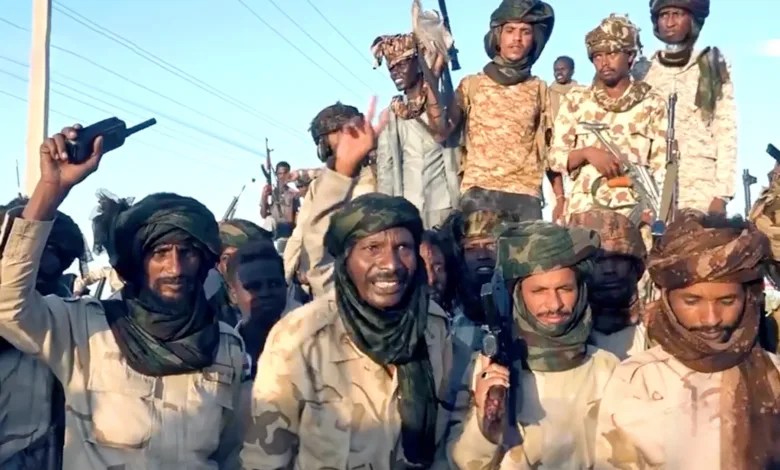
This remained the case until the recent outbreak of events. Even now, the only voices being heard are those of the warring parties themselves—members of the militia exchanging accusations. In a twist of bitter irony, the faction that once held power now labels the other as “rebels,” while the faction newly branded as such—already in rebellion against the Sudanese state—believes it has been stripped of its rights, neglected, and left to die, while aircraft transported members of the Mahariya tribe abroad for medical treatment.
Accusations have even reached Abdelrahim himself. These fighters widely believe that one of his close associates, a militia officer, received their salaries—allegedly delivered by plane from the United Arab Emirates—but failed to distribute them. They claim the officer embezzled the funds with Abdelrahim’s knowledge. The threats issued against both men, including vows to kill them, reveal the extent of confusion and disarray within the militia, as well as the growing loss of control it is experiencing.
That such accusations are now voiced openly in the streets, and that fighters are publicly denouncing their own commanders, points to a system on the verge of collapse. Distrust has reached the point where armed combatants threaten their leaders with death, accusing them of stealing salaries and abandoning the wounded without treatment. This is an extremely dangerous development—especially as it unfolds in Nyala, the city the militia chose as its capital.
The emergence of armed fighters confronting one another and openly declaring that salaries sent from the UAE were looted signals the erosion of the militia’s governing formula—one built on money and fear. The militia is known for liquidating dissenters, even from within its own ranks. Numerous incidents attest to this, including the pursuit of a defector into Chad, where he was killed in front of his family on his wedding day.
The militia has long pursued and executed escapees, entrenching fear within its ranks, while spreading terror among civilians through killing, public humiliation, looting, and rape. It also coerced tribal leaders, using fear and money to mobilize young men and push them into its fighting ranks. These two elements—fear and money—have been the pillars upon which the militia exercised control over its environment.
Many observers now believe this equation is beginning to unravel in Nyala, as fighters and wounded personnel openly challenge the militia’s authority and level direct accusations of stealing their money—charges to which the militia has so far offered no response. To date, it has not paid the salaries of thousands of its fighters, having previously disbursed wages to only a small fraction of them. This raises a critical question: is the militia’s governing formula collapsing?
Retired Colonel Siddiq Surkatti believes it is too early to pass judgment on the militia’s overall control and leadership based solely on what is happening in Nyala and a few other areas. He noted: “It is true that the militia rules through fear and money, and this equation cannot be relied upon indefinitely—it is limited. When people begin to rebel against it, it will not hold. However, the militia still possesses capabilities that should not be underestimated. These include tribal loyalties—there are tribes that cannot turn back halfway, as they now stand at the mouth of the cannon—as well as regional backing that provides mercenary fighters, and the continued flow of money from the UAE. The situation is not simple; it is extremely complex. But the concentration of military operations, finances, and leadership in the hands of one man is more dangerous to the militia than all the threats we have discussed. The militia is effectively under the command of Abdelrahim, who controls all its levers. This is extremely risky for it, and what we are saying now will become clearer later, when supply lines stretch apart, are severed, and ground-level communication becomes difficult.”
For his part, retired Major General Salah Mohamed Khaled said that the expected movement of the army this week will bring matters to a head, as the militia will be forced to redeploy its forces to combat zones, leaving its rear exposed—especially after the strikes that targeted its training centers and weapons depots. “This will compel the militia to cover long distances to supply its fighters,” he said, “exposing it to severe attrition, draining its resources, and opening existing gaps—then widening them.”
He added: “The strategic patience exercised toward the militia has created vulnerabilities. The time has come to exploit and penetrate them, because—as we have always said—time is not on its side.”