Killed During Militia Control of the Capital: Forensic Authorities Transfer 15,000 Bodies from Homes and Schools in Khartoum
Report – Sudan Events
During its presence in Khartoum, the militia prevented residents in some areas from leaving their homes. Some civilians were killed or arrested simply for attempting to go outside. The militia also banned burials in cemeteries and prohibited gatherings, driven by an intense fear of any form of assembly. Funeral prayers were stopped, and mosques were shut down and converted into living quarters for militia fighters, where numerous abuses were committed.
Under these restrictions, residents were forced to bury their dead inside their homes or directly outside them. This became starkly evident after the liberation of Khartoum, when a large number of graves were discovered inside houses and in front of them. Others buried their dead in or near available football fields in their neighborhoods. People carried out burials in secrecy and silence, fearing discovery, as the militia would reportedly kill anyone found burying a body and bury them alongside the deceased.
Even in Karari, an area where militia forces did not establish permanent control, burial was effectively impossible. The well-known Ahmed Sharfi Cemetery was inaccessible because it lay within the line of fire. Militia fighters were stationed in areas such as Hay Al-Omda and Wad Nubawi, making any presence near the cemetery extremely dangerous. The burial grounds formed a buffer zone between militia positions and army forces, meaning that any movement there—including attempting to bury a body—was tantamount to a death sentence.
The army itself warned civilians against trying to bury bodies in cemeteries, as militia snipers monitored the area and opened fire on any movement. As a result, families buried their loved ones inside homes, in streets, and in open spaces. Bodies accumulated daily due to ongoing battles and the near-total absence of medical care. With the exception of Al-Nao Hospital and a few facilities in northern rural areas, hospitals—including Omdurman Teaching Hospital and other major facilities—were closed. Gunfire, shelling, and death were everywhere.
Burials were often conducted by just two or three people, quickly and quietly, inside homes or on streets. This phenomenon sparked widespread debate among Khartoum residents, especially as cemeteries such as Ahmed Sharfi expanded over time and reached the edges of paved roads, and as thousands of bodies were buried in other designated cemetery areas throughout the years of war.
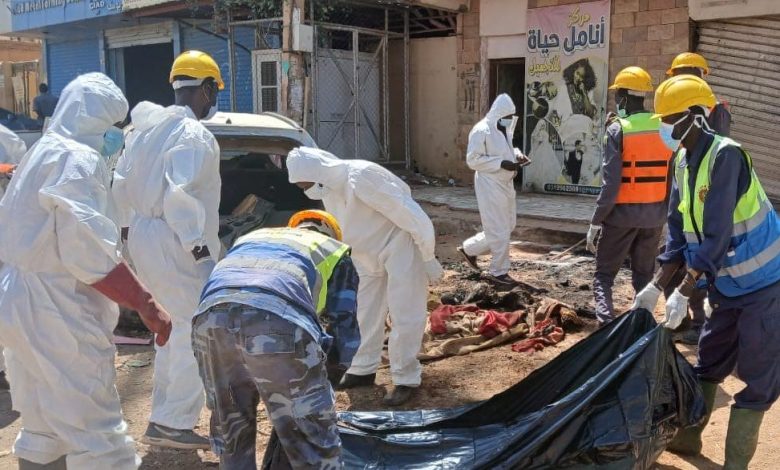
Recently, Khartoum State authorities have begun addressing this file. A source at the State Ministry of Health confirmed that the Forensic Medicine Authority has transferred approximately 15,000 bodies from residential neighborhoods and schools since April 2024. The source added that forensic authorities plan to declare Khartoum free of bodies buried in residential areas by 2026, noting that the remains will be relocated to designated burial sites.
The campaign was launched by the Higher Committee for Collecting the Remains of the “Battle of Dignity” and began last week in Khartoum. Dr. Abayazid Fath Al-Rahman, a medical field activist, described the effort as a positive and necessary step, warning that leaving the situation unaddressed and allowing people to act individually would lead to serious complications. He stressed that the involvement of the Ministry of Justice, forensic authorities, and relevant organizations is vital to ensure the legitimacy and effectiveness of such an initiative.
Dr. Abayazid added: “If the number of bodies transferred so far is fifteen thousand, then how many people were actually killed? Based on what I personally witnessed while moving around Khartoum, I believe we have not yet reached even a third of the total number of bodies. This gives a clear picture of the scale of death and brutality inflicted on Khartoum’s population.”
He continued: “Every one of these victims has a story and a reason for which they lost their life. What I hope for is that we do not merely bury the bodies, but that we document them, identify them by name, date of death, and cause of death. This is crucial for their families and for understanding what truly happened here. The issue goes beyond preventing burial in cemeteries—it is far deeper. Some victims were buried by their families, but others were buried by residents who found them killed in the streets.”
He concluded by emphasizing that the major task is not only transferring bodies, but also identifying them: “We must know who they were, how they died, and whether they were killed directly by the militia—by gunfire, shelling, beating, or other violence—or whether they died from hunger or lack of medical treatment. These details matter deeply to their families and are essential for understanding the suffering endured by Khartoum’s people during this period. There are bodies that have decomposed to the point where identification is only possible through forensic technology, as they were not found intact.”