Al-Burhan in Saudi Arabia: Will Riyadh’s Rains Extinguish the Fires of Sudan’s War?
Report – Sudan Events
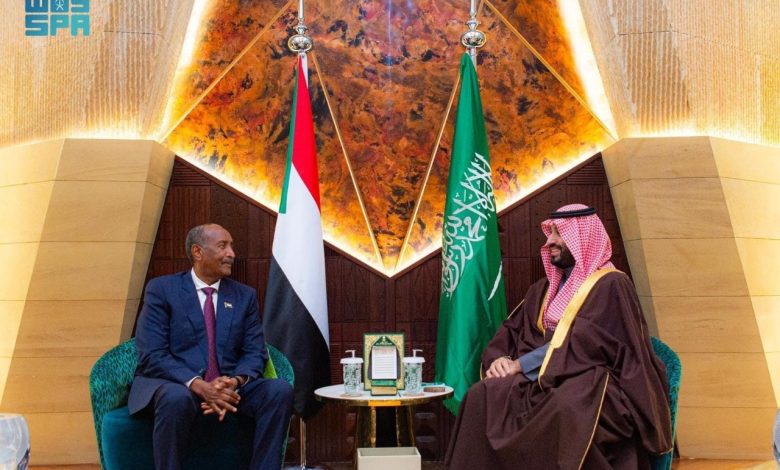
Amid a surge of popular marches that have taken place in several Sudanese cities in support of the Sudanese Armed Forces and their commander, and against the backdrop of extensive talk about behind-the-scenes contacts among Port Sudan, Cairo, Riyadh and Washington, Chairman of the Sovereignty Council and Commander-in-Chief of the Army, General Abdel Fattah al-Burhan, arrived in the Saudi capital Riyadh as rain fell over the city.
The visit comes shortly after Saudi Crown Prince Mohammed bin Salman’s recent trip to Washington and his meeting with U.S. President Donald Trump. Al-Burhan’s arrival also coincides with intense discussion about an undeclared truce, as well as international and regional pressure to adhere to a ceasefire previously proposed by the international quartet and rejected by the Sudanese army. It further comes amid talk of a new initiative mentioned by al-Burhan himself, which he described as a joint Saudi-American initiative, in addition to Turkey’s entry into the initiative track by offering to mediate an end to the war.
Following his meeting with Crown Prince Mohammed bin Salman, President Trump stated that the prince would play a major and important role in ending the war in Sudan—an indication of Washington’s confidence in Riyadh’s ability to bring the conflict to a close, and of Saudi Arabia’s move to pursue a settlement in coordination with the United States and Cairo. Egypt, for its part, has stepped up its efforts in recent days, with its prime minister meeting a number of Western officials as part of Cairo’s push to end the war. This raises pressing questions: Has Riyadh formulated a clear vision for resolving the crisis, or are matters still at the consultation stage? Does al-Burhan’s visit at this particular moment signal a shift in relations between Riyadh and Khartoum toward deeper understandings? And are there messages embedded in the visit?
Dr. Ezzeldin Al-Jumri believes the visit carries multiple messages: to the domestic audience, that the army is proceeding with full legitimacy and confidence in a people who have taken to the streets and entrusted it with managing the current phase; to regional actors still betting on the militia, that Sudan’s government possesses the legitimacy to govern and is moving forward with support and understandings with regional powers that have the financial and political clout to back the country’s liberation; and to the international community, that the Sudanese government is responsive to initiatives, not dismissive of them, and is engaged in efforts to end the war.
He added that the visit would certainly unsettle those wagering on the militia—particularly the United Arab Emirates—which, he said, now views Saudi moves with suspicion and recognizes that Crown Prince Mohammed bin Salman is no longer interested in old arrangements, as their success and the empowerment of the militia pose a strategic threat to the security of the Kingdom and Egypt, extending across the Red Sea region. “The UAE will be disturbed by the visit,” he said, “especially as it knows that Trump is closely following developments by phone and monitoring what the visit will yield.”
Al-Jumri went on to predict that what the U.S. administration has reached with Saudi Arabia and Egypt will be presented to al-Burhan during the visit. “I do not believe this is a routine bilateral visit,” he said, “but rather one linked to the Saudi-American-Egyptian initiative. Egypt is directly involved in what is unfolding in Riyadh and is fully aware of the details that will be put to al-Burhan.” He concluded: “We will see what follows this visit.”
Security expert Madani Al-Harith argues that developments on both the military and political fronts are positive, noting that just as the army is operating on military axes in Kordofan, it is also active on political tracks. He stressed that the army will not accept any option rejected by the public, nor the formation of a government lacking popular acceptance, as this would plunge the country into chaos that no one could bear. “No one will accept turning an initiative to end the war into a tool for creating disorder, scattering public opinion, and sowing discord,” he said.
For his part, Abdel Nabi Moussa, a researcher in the history of conflicts in Sudan, believes the timing of the visit is what gives it particular significance, as everyone is now anticipating a qualitative shift that the army would approve and the militia would implement. “No one knows what this shift will be or how it will occur,” he said, “but experience has taught us that nothing in Sudan is ever completed—neither war nor peace fully reaches an end.” He added that he expects the conflict, just as it began suddenly, to stop suddenly as well, producing a reality different from all previously drawn scenarios. “The war in Sudan has no parallel,” he noted, “except perhaps the Bosnian war in some of its details, its brutality, and the targeting of civilians.”
Moussa concluded that conditions on the ground suggest some form of halt to military operations may be imminent, as each side is currently seeking to expand and enter new areas. “The escalation of demands and the raising of ceilings,” he said, “are directly linked to what is happening behind the scenes.”