Al Jazeera Center for Studies Examines the Transformations and Repercussions of the War in Sudan
Sudan Events – Agencies
As the war in Sudan approaches its third year, the conflict that erupted on April 15, 2023, between the Rapid Support Forces (RSF) and the Sudanese Armed Forces has exacted a devastating toll. Sudanese civilians have borne the brunt of the violence through killings, rape, and widespread human rights violations, alongside mass displacement both inside and outside the country. Public and private assets have been destroyed, means of production looted, and daily life has effectively ground to a halt.
Against this bleak and blood-soaked backdrop—shaped by the actions of multiple actors—numerous questions arise regarding the war’s trajectory, transformations, and consequences.
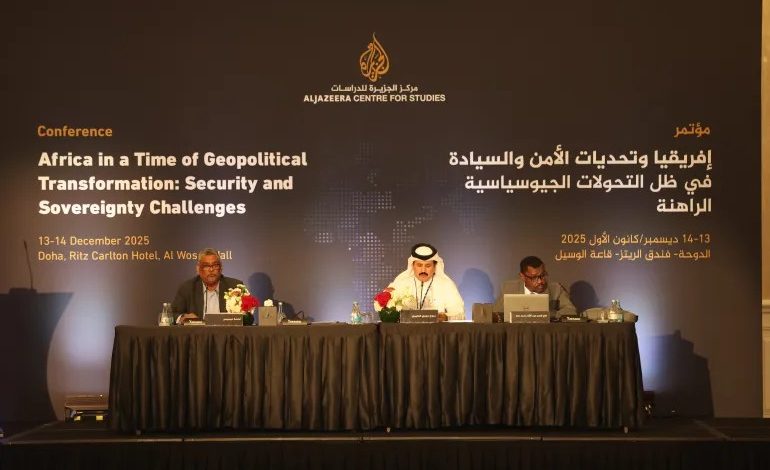
Seeking to address these questions, the Al Jazeera Center for Studies organized a conference titled “Africa and the Challenges of Security and Sovereignty amid Current Geopolitical Transformations.” As part of the conference, the Center held a special session on Sudan on Sunday under the title “The War in Sudan: Transformations and Repercussions.” The session was moderated by Dr. Madoukh Al-Otaibi, Professor of International Relations at the Joaan Bin Jassim Academy for Defense Studies in Qatar, and featured a group of specialists on Sudanese affairs.
Held on the second day of the conference, the session examined the current Sudanese landscape as a reflection of the collapse of the centralized state and shifting balances of power in the region. Discussions focused on the dynamics of internal conflict, the fragmentation of authority, and the rise of non-state actors.
Speakers also delved into the regional implications of the Sudanese crisis, which extend from the Sahel deep into the Red Sea basin and the Horn of Africa, where geography intersects with security and economic interests.
The session sought to explain how the war has reshaped networks of influence and resources within Sudan, transforming the economy into an arena of competition among domestic and external actors. It also aimed to unpack the logic of the Sudanese war as a complex crisis combining political, military, economic, and regional dimensions.
The first panel, titled “Sudan at the Crossroads of Conflict: Power Dynamics in Light of the Crisis,” was presented by Sudanese analyst Osama Edris, Professor of Strategic and Security Studies.
The second panel, “The Specter of Sudan’s Partition: The Disintegration of Central Authority and the Rise of Non-State Actors,” was delivered by Sudanese researcher and African affairs specialist Mohamed Torshin.
The third panel, “The Regional Repercussions of the War in Sudan: From the Sahel to the Red Sea and the Horn of Africa,” was presented by Eritrean researcher and journalist specializing in Horn of Africa affairs, Abdelkader Mohamed Ali.
The fourth panel, “The Economy in Times of War: Reshaping Networks of Influence and Resources in Sudan,” was delivered by Taj Al-Sir Abdullah Mohamed Omar, an expert in geopolitical and international relations issues in the Horn of Africa.
Roots of the Conflict: A Historical Perspective
Osama Edris offered a historical overview of the roots of the conflict, pointing to the elite class established during the colonial period to assist the administration, which later assumed power after independence in 1956. He noted that this elite quickly descended into internal divisions and power struggles, failing to establish principles and foundations for a peaceful and orderly transfer of power.
He added that this pattern persisted even among the elite that emerged after the December 2019 revolution that overthrew the Bashir regime, as the post-revolutionary leadership reverted to the same model in which armed forces shielded civilian rule. The Rapid Support Forces were granted expansive roles and heavily armed—particularly in the two years preceding the war—ultimately leading to the outbreak of conflict.
Regarding the current situation and possible scenarios, Edris explained that the Sudanese Armed Forces have largely retained their cohesion and striking power, maintaining full control over 19 military divisions. As for the RSF, he noted that it continues to receive sustained external support. However, atrocities committed recently in El Fasher and elsewhere have triggered a backlash, with influential regional and international voices rejecting the RSF’s conduct and calling for an end to any support. He cited U.S. sanctions on companies involved in recruiting mercenaries from Colombia, as well as British sanctions imposed on prominent RSF leaders.
Torshin: A Non-Traditional War
Mohamed Torshin addressed the fragmentation of central authority and the rise of non-state actors, stressing that the war in Sudan is not a conventional conflict but has evolved into an existential war that has significantly contributed to the collapse and disintegration of state institutions—particularly in areas controlled by the RSF. In these regions, nearly all aspects of life have come to a standstill, while the country’s economic capabilities—especially the gold and oil sectors—have been severely affected.
Torshin explained that the war has facilitated the rise of informal actors, particularly in RSF-controlled areas. He cited the growing power of tribal structures, which have assumed influential roles and demonstrated high levels of effectiveness. He also emphasized the importance of the external dimension of the conflict, pointing to the cross-border flow of weapons, fuel, and fighters.
A Marketplace for Fighters and a Training Ground
The session concluded with an intervention by Eritrean researcher and journalist Abdelkader Mohamed Ali, who focused on the regional repercussions of the Sudanese crisis, particularly in the Sahel and the Horn of Africa.
He noted that the war has created a labor market for fighters arriving from Sahel countries and has turned Sudan into a training ground for armed groups from neighboring states participating in the fighting.
Ali warned that Sudan’s transformation into an arms marketplace could further fuel conflicts in surrounding countries, many of which are already grappling with internal crises and lack the capacity to effectively monitor their borders. He cited Ethiopia, South Sudan, and Chad as examples.
The session concluded with remarks by Dr. Taj Al-Sir Abdullah, who discussed the fourth panel on “The Economy in Times of War: Reshaping Networks of Influence and Resources in Sudan.” He noted that the power of the Sudanese state has declined sharply due to the war, leaving it weakened, threatened, and increasingly incapable of addressing the challenges posed by the conflict.
Source: Al Jazeera Net