What Happened Within the Sudanese Congress Party: Internal Disputes or a Deep-Rooted Old Maneuver?
Report – Sudan Events
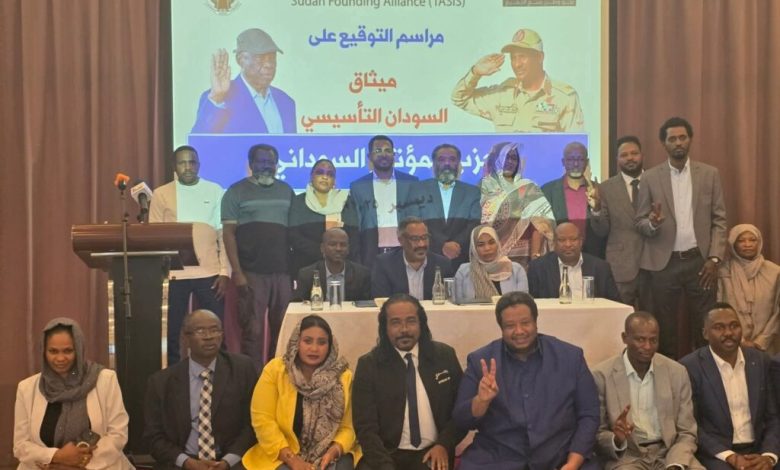
The Sudanese Congress Party (SCP), through well-known figures within its leadership, announced that it had signed the charter of the so-called “Founding Alliance.” Photos circulated widely showing SCP members signing the charter and celebrating alongside the militia-backed government. Many observers viewed this not as a new position, but merely a redefinition of the party’s long-standing stance—one already aligned with the militia. Since the outbreak of the war, the party has consistently adopted positions supportive of the militia, with its political leaders, most notably Khalid Omar Yousif, widely known as “Silik,” openly defending it. Yousif has persistently opposed the Sudanese Armed Forces and their allied units in what is referred to as the “War of Dignity,” while promoting the Janjaweed militia’s narrative.
More recently, following reports of the party’s signing of the charter with the militia, the Sudanese Congress Party issued a statement disavowing the members who signed the document and announcing their expulsion from the party. Those expelled include Abdullah Shams Al-Kawn, Mohamed Al-Wali, Abdullah Jali, Reham Sobhi, Ahmed Ibrahim Ishaq, and former governor Mohamed Hassan Arabi. Arabi, who expressed surprise at the decision, insisted that he had not signed the charter, but added, “I respect the party’s decision,” noting further, “I am no longer a member of the party, nor of Somoud, nor of Ta’sis.”
In its statement, the party asserted that those who signed the document do not represent it or its legitimate institutions. This stance has revived memories of the recent split within the National Umma Party, whose membership became divided between the “Somoud” and “Ta’sis” camps, while others remained within the framework of the state and its legitimacy. That configuration ensured the party’s presence under all circumstances. While the party’s leader moved toward “Ta’sis,” the remaining members of the executive bureau stayed within “Somoud.” The Sudanese Congress Party appears to be following a similar approach, maintaining members on two fronts—both hostile to the army and state institutions, and both, in one way or another, supportive of the militia. This pattern has become increasingly clear to the public, which has come to understand the party’s method of handling national issues, whether major or minor.
Mohamed Mudathir, who left the party at the outbreak of the war, believes the situation closely resembles what occurred within the Umma Party. “Some went toward what is called the Founding Government, while others went to Somoud,” he said, arguing that those who joined Ta’sis acted out of tribal zeal rather than a coherent political position. He added, “Even within the Umma Party, there is a strong belief that its historical base in Darfur is linked to Arab communities there, and therefore supports the militia. The same is happening now within the Sudanese Congress Party. Those individuals went to the militia driven by tribal loyalty, while others who share the same vision believe they can control the Founding Government and manage it, and thus oversee any future dialogue or negotiations between the militia and the armed forces.”
Mudathir continued, “The conflict within the Sudanese Congress Party is not far removed from the conflicts seen in all Sudanese parties. There is no unified vision—neither in direction nor in decision-making. A small group controls the process, taking whatever decisions it sees fit, while others are left with only two choices: follow or leave—without any discussion. There is no democracy or transparency, except in their rhetoric.” He went on to say, “We used to hear people describe the Sudanese Congress Party as a clique or a party of friends, and we thought it was merely political spite. Now we say it openly: they are a clique with a party that serves their interests—nothing more. However, I do not believe those who went to Ta’sis are in agreement with those who chose to remain in Somoud; otherwise, they would not have been expelled, and their membership would have merely been suspended.”
Professor Fadl Al-Mawla Al-Naeem, a political science academic, disagrees with Mudathir’s assessment, though he acknowledges that tribal zeal influences many politicians who have chosen to act against the nation by joining Ta’sis, such as Al-Ta’ayashi and others. He argues, however, that what occurred here indicates an agreement among the parties involved. “The evidence,” he said, “is that no one has attacked the other despite the supposed divergence in positions. In fact, their positions are unified—both support the militia, and that support may even be organic.”
He added, “What we are witnessing is not fragmented parties, but rather parties that, unfortunately, repeat the same mistakes, believing that what they are doing is a form of political cleverness. The National Umma Party is not truly divided, nor is the Sudanese Congress Party. What they are producing is a type of opportunism they believe to be successful—one that guarantees them a place in power regardless of its nature, whether through agreements with the military, a military coup, or by exploiting the dreams of the poor and climbing to power on their backs. These are the practices of Sudanese politicians that have crippled the country.”
He concluded, “Unfortunately, politicians in Sudan constantly repeat the notion that politics has nothing to do with ethics. They practice this belief within their own institutions and in their handling of national concerns.”