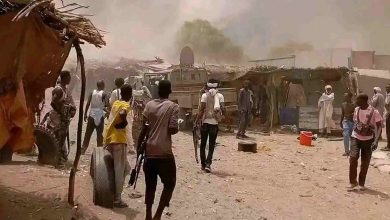
Supply Routes: Drones Strike Abu Qamra, Bir Saliba, and Karnoi
Report – Sudan Events
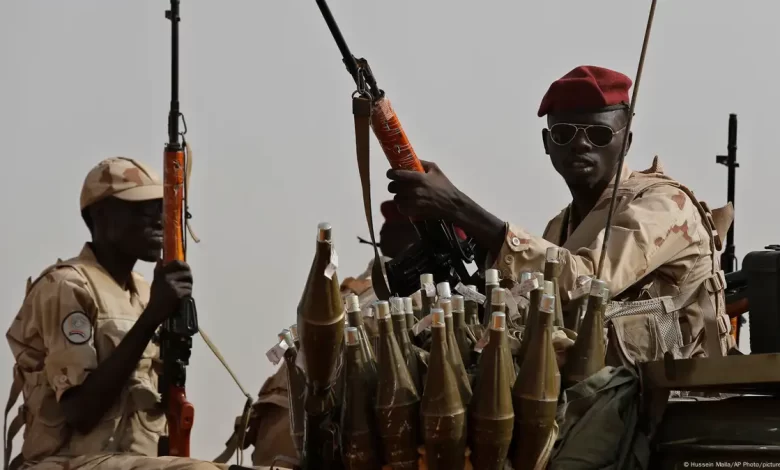
The militia has recently concentrated heavily on the localities of Abu Qamra and Bir Saliba, moving closer to Karnoi and Ambar. Why this push? Why is it deploying its vehicles and fighters to the area?
These localities are considered the last strongholds of the Joint Forces and the Sudanese Army in Darfur. They are also critical border gateways linking Darfur to Chad and Libya. Moreover, the region’s urban layout and terrain offer little natural protection—neither for the area itself nor for the forces stationed there.
Should the Janjaweed enter these areas, they would secure supply lines that have been disrupted in recent months. The army has succeeded in isolating sizeable militia formations and cutting off their supply routes. Large consignments that previously arrived from southern Libya—including food commodities, fuel, weapons, and mercenaries—have come under direct army fire, making those routes increasingly untenable.
As a result, the militia has begun searching for alternative supply corridors, routing shipments into Chad and then transiting through Chadian territory to Al-Tina and onward into Darfur. This is the line the militia is now seeking to secure through battles in Abu Qamra, Bir Saliba, Karnoi, Ambar, and other localities.
All of these areas are vital to the militia’s objective of ensuring the passage of arms, ammunition, fuel, and supplies from southern Libya into Darfur. This explains the intensity of fighting there. Simultaneously, the militia is waging battles in Kordofan to prevent the army from reaching Darfur and engaging it in its core strongholds and occupied cities.
This context prompted Minni Arko Minnawi to address residents of these areas, urging them to defend their land and not surrender it to the Janjaweed. He understands their strategic importance; having fought for years in these regions, he knows how decisive support flowing from them can be. He is also acutely aware of the dangers should the militia seize these localities and convert them into Janjaweed-dominated zones.
Minnawi therefore called on residents to fight, organize, and hold their ground—not only to block arms flows, but to prevent a deliberate demographic transformation, involving displacement or killing of local populations to make way for the resettlement of Arab diaspora groups from Mali, the Central African Republic, Chad, and elsewhere, turning the area into a Janjaweed-controlled enclave.
Earlier, Lt. Gen. Yasser Al-Atta, Assistant Commander-in-Chief of the Sudanese Army, revealed that extensive military preparations are underway. He indicated that large forces would carry out decisive operations in Kordofan and Darfur, supported by what he described as “specialized capabilities.”
Mohamed Ibrahim (“Barhouma”), who recently returned from operations in Kordofan after being wounded in the Umm Samima battles, said the nature of the fighting there is markedly different. It required the army to revise its operational doctrine, which partially slowed operations. He noted that the army also focused on regenerating combat power and control by introducing certain units and specialized weapons to enable advances aligned with the battlefield’s demands.
“There is now a qualitative engagement with the militia,” he said. “They deployed very large forces to the area and sought to ensure Al-Hilu’s advance on some axes to distract and stretch the army. But from what I saw, this strategy failed. The army has solid intelligence and, with recent adjustments, can now operate effectively across multiple axes—something the militia finds extremely difficult. Movement under the army’s combat aircraft and drones has become devastating for the militia, with catastrophic results.”
He added: “Operations in Kordofan will not last long. The army has surprises in store regarding Darfur—clear plans and methods that are complex and patient, but whose outcomes are assured.”
Military expert Maj. (Rtd.) Nader Mahmoud Sembari believes the battle is now taking new forms, with a significant shift in its pattern and geography—from open plains to mountainous and other challenging terrains requiring different approaches. “The army has changed many of its mechanisms—we won’t disclose them—but look at the drones and combat aircraft: their strikes are now extremely precise and effective. We’ve overcome many of the obstacles the militia set up, and the militia knows it no longer controls areas that offer protection. These are major developments,” he said.
He continued: “The localities mentioned are important because they are historic smuggling corridors from Chad. This is no secret to operations command. When supply lines are closed in one area, you must assume others are being prepared. What we are witnessing is a war in which neighboring countries are playing dirty roles, unfortunately. And it’s not limited to this corridor—there are others from the south, via Umm Dafuq, the Triangle, and beyond.”