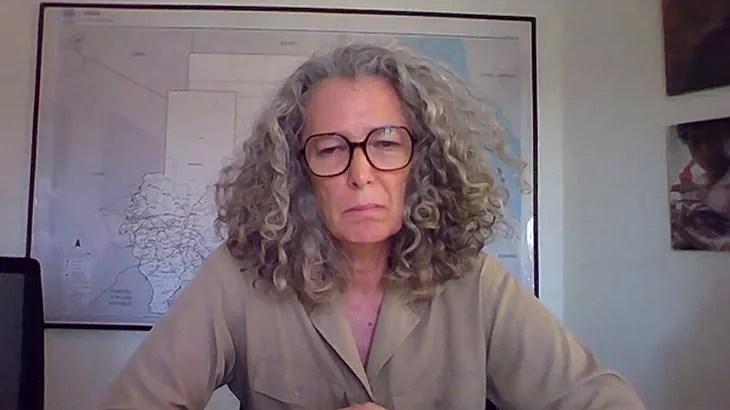
The UN Humanitarian Coordinator for Sudan, Denise Brown, has described the humanitarian situation in the country as “horrifying,” stressing that the international community should feel shame and disgrace for its failure to provide adequate assistance to millions of displaced people facing catastrophic conditions amid an ongoing war, massacres, and systematic sexual violence.
Speaking in an interview with Al Jazeera, Brown said her warning comes at the close of a year marked by staggering numbers of people killed, displaced, and forced into exile, while 60 percent of the required funding to meet basic humanitarian needs remains unavailable.
She revealed what she called a shocking and shameful gap between immense needs and what is actually being delivered on the ground, noting that people continue to flee their homes with no shelter, now relying on tents and makeshift plastic shelters. Children, she said, are in desperate need of access to education, while Sudan’s economy has completely collapsed.
Brown explained that organized sexual violence represents one of the most horrific aspects of Sudan’s humanitarian crisis, citing cases of mass rape and abuse amounting to sexual torture. Most women, girls, and children, she said, are enduring extremely harsh conditions amid a lack of protection and the absence of effective international assistance.
Addressing the severe funding crisis, Brown disclosed that humanitarian operations in Sudan remain short of 60 percent of the required funding as 2025 draws to a close.
She recounted a personally shocking experience at Tawila camp, about 50 kilometers from El Fasher, describing how women arrived alone with their children after traveling along dangerous routes in search of help—only to find that there was nothing to offer them.
Brown said she felt deep shame over the situation, adding that the international community should feel the same.
In assessing the international response, she argued that the core problem lies in the global community’s inability to focus on multiple crises simultaneously.
She emphasized that the massacres and atrocities committed in El Fasher in October should have been sufficient to mobilize international attention and spur action to deliver urgently needed aid.
While political solutions are being pursued in the hope of success, Brown stressed that the bare minimum required is the provision of assistance to millions of women and children trapped by the war.
She noted that civilians are risking everything—fleeing on donkey carts along perilous journeys—while the international community is not doing nearly enough to help them.
Calling for accountability, Brown expressed gratitude to donors who have contributed aid, but firmly insisted that the current funding gap is unjustifiable under any circumstances.
She urged the international community to show courage and take risks to deliver assistance to people who risk their lives every day, stressing that what is currently being provided is wholly insufficient and fails to meet the needs of millions of civilians caught in a cycle of violence and war.