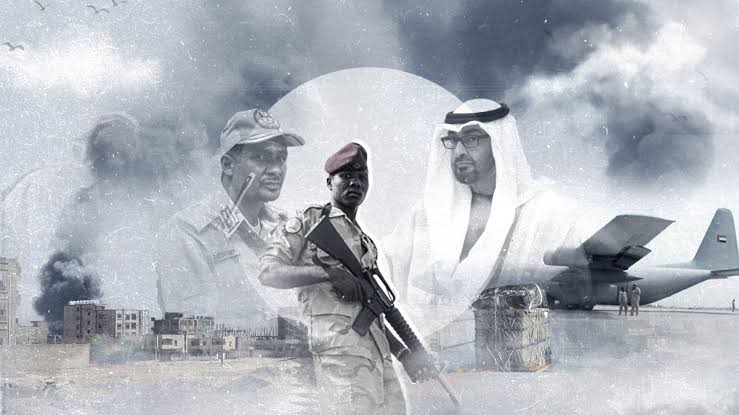
An analytical report by researcher Mark Owen Jones, published on December 31, 2025, has uncovered what he described as a “large-scale bot network,” likely linked to the United Arab Emirates, which sought to amplify pro-Rapid Support Forces (RSF) narratives following the events in El Fasher in late October 2025. The campaign utilized a coordinated wave of hashtags that trended in the UAE, Sudan, and other parts of the Middle East.
According to the report, the hashtags appeared in early November 2025—shortly after the El Fasher massacre on October 26—to promote a “remarkably consistent” narrative blaming Sudanese Army Commander Abdel Fattah al-Burhan and the armed forces for starvation, aid obstruction, and the continuation of the war, while portraying the RSF as “disciplined and humane,” ready for a ceasefire, and depicting El Fasher as a city “coming back to life” under their control. The report described this as an attempt to whitewash the massacre.
80,000 Tweets, Majority Automated
Owen Jones’ analysis examined around 80,000 tweets posted by approximately 21,000 accounts across six coordinated hashtags between November 5 and 19. Based on the metrics used, between 18,709 and 19,514 accounts exhibited strong indicators of automation—roughly 89% to 93% of all active accounts in the hashtags. He emphasized that his estimates were “intentionally conservative,” relying on the intersection of multiple indicators rather than a single measure of bot detection.
The report noted that the hashtags collectively generated over 91 million impressions. The mechanical recycling of hashtags, multilingual posting (including Arabic and French), and the use of visual materials such as videos and infographics, all pointed to an “organized effort” to produce and amplify content.
Technical and Behavioral Indicators: Mass Creation, Lack of Genuine Interaction
The report outlined several indicators supporting the automated amplification hypothesis, including:
Repeated bios, naming patterns, generic profile pictures, and numeric identifiers in usernames.
“Random and unusual” geographic locations (e.g., Spain, Switzerland), suggesting potential VPN use.
Short, concentrated bursts of activity, with similarly sized tweet series for each hashtag.
95% of accounts exhibited negligible engagement (very low interaction).
Mass account creation: 81.4% created within a five-month period in a “single surge.”
96% used the Twitter Web App—a common choice among automated networks.
Propaganda Framework and Regional Accusations, UAE Selectively Absent
The messages did not only glorify the RSF; they also accused specific regional states of prolonging the war or exhibiting “hypocrisy” and “obstruction,” including Egypt, Saudi Arabia, Qatar, Turkey, Iran, and Russia. The UAE, however, received rare but positive mentions as a “humanitarian” state providing assistance, with no blame attributed.
The report further noted that prior to focusing on El Fasher, the network had been critical of Saudi Arabia, later shifting to supporting South Yemen’s independence and praising the UAE as a “true ally,” which the author viewed as consistent with UAE foreign policy positions.
El Fasher Context: Siege, Starvation, and a “Closed” City
The report contextualized the campaign within the RSF’s control of El Fasher following a prolonged siege, described as possibly “the worst single atrocity” of the war. Satellite imagery analyzed by Yale University’s Humanitarian Research Lab revealed drastic changes in city life patterns and the emergence of new burial and incineration sites. El Fasher remained closed to journalists, humanitarian agencies, and UN investigators, while aid convoys were stalled outside due to a lack of security guarantees. International experts declared a state of famine.
Analytical Tools
Owen Jones cited the use of various data and network analysis tools—including NodeXL and Phantombuster—alongside manual visual inspections of account characteristics, creation dates, and activity patterns. Results were cross-verified across multiple samples and methods.
Report Conclusion
The author concluded that the campaign constituted a “propaganda effort” to flood social media with positive RSF content and negative portrayals of army-supporting parties, timed to limit criticism of the UAE amid accusations of backing the RSF.