Discovery of 19,000 UAE-Linked Bot Accounts Promoting the Rapid Support Forces After Atrocities in El Fasher
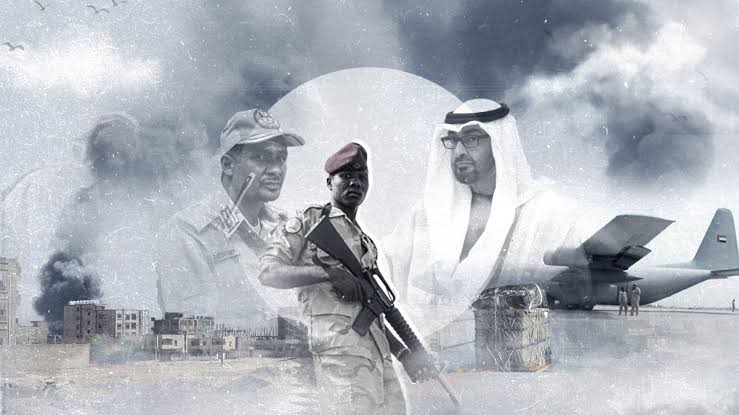
Report – Sudan Events
Inside a Large-Scale Bot Network Promoting RSF Narratives
In November 2025, very shortly after the El Fasher massacre, a cluster of Sudan-related hashtags surged to the top of trending lists on X in the United Arab Emirates, Sudan, and elsewhere across the Middle East. Together, these hashtags advanced a strikingly consistent narrative: responsibility for starvation, obstruction of humanitarian aid, and the continuation of the war was placed squarely on Abdel Fattah al-Burhan and the Sudanese Armed Forces (SAF).
The Rapid Support Forces (RSF), backed by the UAE, were instead portrayed as disciplined, humane, and willing to agree to a ceasefire. El Fasher in particular was depicted as a city where “life is returning” under RSF control. In short, the campaign amounted to an attempt to whitewash the massacre.
Responsibility for Sudan’s suffering was repeatedly shifted onto a familiar set of regional actors—Egypt, Saudi Arabia, Qatar, Turkey, Iran, and Russia—each accused of fueling the war, obstructing peace, or acting hypocritically. In contrast, the RSF were framed as a force seeking peace and normalization. Within this narrative, the United Arab Emirates appeared selectively as a humanitarian actor, conspicuously absent from blame.
The activity centered on six tightly interlinked hashtags (not listed here in full, but including tags such as #Life_Returns_to_El_Fasher).
This narrative appeared in both Arabic and French, repeated across multiple hashtags and resurfacing in sharp bursts of activity. An analysis of approximately 80,000 tweets posted by around 21,000 accounts across six coordinated hashtags indicates that this environment was driven largely by automated amplification. According to the metrics used, between 18,709 and 19,514 accounts showed strong indicators of being bots—roughly 89–93% of all active accounts using the hashtags. These estimates are deliberately conservative, reflecting convergence across multiple indicators rather than reliance on a single bot-detection measure.
The hashtags began trending around 4 November, shortly after the El Fasher massacre of 26 October. Collectively, they generated more than 91 million impressions. In addition, the coordinated repetition of hashtags, multilingual posting, and the use of bespoke videos and infographics point to an organized content-creation effort. Prior to El Fasher, the same network had focused particularly on criticizing Saudi Arabia; after shifting attention to El Fasher, it emphasized support for South Yemeni independence and praised the UAE as a “true ally.”
Not every participant was automated, but multiple independent indicators show that most of the amplification came from accounts displaying coordinated, inauthentic behavior.
Overall, the dataset reflects a propaganda effort to flood social media with positive information about the RSF and negative information about states (and the Muslim Brotherhood) seen as supporting the SAF. The timing also suggests an attempt to dilute and overwhelm criticism of the UAE over its backing of the RSF. The network’s broader activity aligns closely with Emirati foreign-policy priorities.
Context: The El Fasher Massacre
In late October 2025, Sudan’s Rapid Support Forces seized control of El Fasher, the capital of North Darfur, following a prolonged siege by starvation—an event human-rights experts now believe constitutes the single worst atrocity of the Sudanese civil war. Satellite imagery analyzed by Yale’s Humanitarian Research Lab shows a city emptied of life: once-crowded markets, roads, and neighborhoods fell silent within weeks, while new burial and burn sites indicate widespread killing and body disposal.
British parliamentarians were briefed that at least 60,000 people were killed, with up to 150,000 residents missing, with no evidence that they fled the city. El Fasher remains closed to journalists, humanitarian agencies, and UN investigators, despite RSF pledges to allow access. Aid convoys remain stranded outside due to a lack of security guarantees, and international experts have declared the city to be in famine.
Data Collection
The core analysis is based on a large dataset of roughly 80,000 tweets posted by around 21,000 accounts, collected through a set of Sudan-related hashtags between 5 and 19 November. Additional samples were taken from these hashtags to capture different metadata signals. The emphasis was on multi-layered verification—comparing results across samples, methods, and indicators. Consistency across these independent slices supports the findings. Samples of tweets from high-probability bot accounts were analyzed for narrative themes. Multiple tools were used (including NodeXL and Phantombuster).
(Time-series charts and visual examples of account patterns are referenced in the original report but are not reproduced here.)
Technical and Behavioral Indicators
Manual visual inspection: identical bios, creation dates, and tweeting patterns.
Usernames containing numbers; generic profile images.
Unusual, random locations (Spain, Switzerland, etc.), suggesting VPN use.
Distinct bot networks:
Type A: hashtag amplification with generic phrases.
Type B: political commentary.
Temporal patterns: short, tightly controlled bursts of activity; mechanical sequencing of hashtags (each roughly 13,000 tweets).
Network analysis: 95% of accounts showed no genuine interaction (degree 0–2).
Account creation: 81.4% created within a five-month window, with one large spike.
Tweeting application: 96% via Twitter Web App, commonly used by bots.
Narrative and Framing
SAF and al-Burhan: blamed for deliberate starvation, aid obstruction, and refusal of a ceasefire.
RSF: depicted as disciplined, humane, and protective of civilians.
“Life returns to El Fasher”: images of open markets and children playing—classic whitewashing.
Centrally produced infographics blaming the SAF and Islamists.
Geopolitics
Criticism of Egypt (military support), Saudi Arabia (financial backing), Qatar (media), and Turkey/Russia/Iran (arms).
UAE: mentioned infrequently, but almost exclusively in positive terms (aid, humanitarian statements).
Yemen and the Southern Transitional Council
The same network was also used in a large automated campaign supporting the UAE-aligned Southern Transitional Council, advocating for southern independence and opposing Saudi Arabia.
Mixed History
Some content appeared in French. Several accounts had previously promoted anti-immigrant or anti-Islam narratives in Europe.
—
This full report is translated from the original article published on Substack by Marc Owen Jones. It is based on detailed data analysis and multiple indicators pointing to the existence of a large-scale automated amplification campaign.