Cairo Pressures Khalifa Haftar to Halt Support for Sudanese Militias
Sudan Events – Agencies
Senior Egyptian sources familiar with the Libyan file told Al-Araby Al-Jadeed that relations between the Egyptian leadership and eastern Libya’s commander Khalifa Haftar have seen growing strain in recent weeks, against the backdrop of Haftar’s continued support for Sudan’s Rapid Support Forces (RSF). According to the sources, Cairo has sent messages to Haftar over the past weeks demanding an end to any form of support or logistical facilitation for the forces of Mohamed Hamdan Dagalo, known as “Hemedti,” via Libyan territory, stressing that such actions directly threaten Egypt’s national security. The sources added that Haftar has not shown sufficient commitment to these warnings.
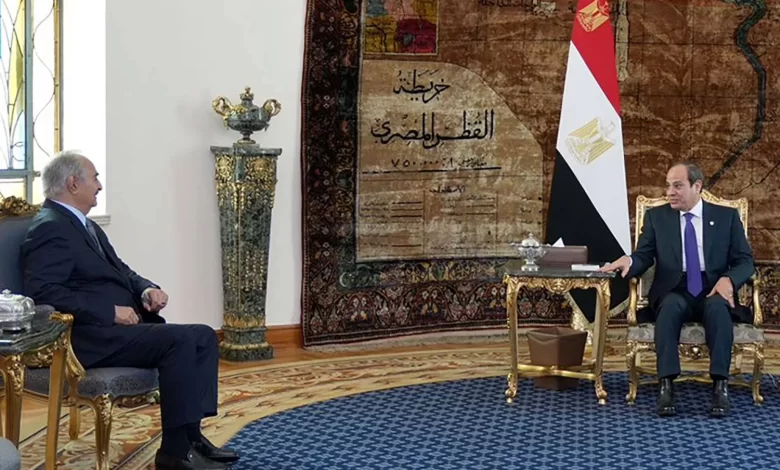
They also noted that Haftar’s visit to Cairo with his sons Khaled and Saddam in early December took place in a tense atmosphere and featured sharp Egyptian criticism of the approach pursued by the eastern Libyan commander—particularly his backing of the RSF and his failure to take earlier Egyptian warnings seriously.
Talks Between Haftar and Cairo
The sources said the meetings went beyond the exchange of diplomatic messages and included direct discussions about the repercussions of this conduct on the future of relations between Cairo and eastern Libya. During the visit, Haftar was clearly informed of the possibility of a negative shift in relations between Egypt and eastern Libya should he continue to disregard Egyptian concerns and cautions—whether related to the Libyan file, which represents a strategic security depth for Egypt along its western border, or the Sudanese file, which carries no less significance on the southern front.
According to the sources, Cairo reaffirmed that its approach to both files is based on preventing the emergence of cross-border threat hubs or armed alliances that could undermine regional stability.
In this context, the sources linked the heightened tension to the recent visit of a high-level Egyptian security delegation to western Libya, led by Major General Khaled Hussein, deputy head of Egypt’s General Intelligence Service, who met with Prime Minister of the Government of National Unity Abdul Hamid Dbeibeh on Monday. They viewed the visit as one of Cairo’s indirect political pressure tools, aimed at delivering a clear message to Haftar that he is not Egypt’s sole Libyan ally.
Egyptian Projects in Libya
The sources added that the visit was not limited to political considerations, but also came as part of efforts to follow up on Egyptian projects in western Libya and to reaffirm continued channels of communication with the Tripoli-based government. It also coincided with Hussein’s attempts to bridge the gap between eastern and western Libya, within a broader Egyptian vision focused on preserving Libya’s unity and preventing it from sliding into an open regional conflict.
The sources concluded that while Cairo remains keen to avoid a complete rupture with eastern Libya, it is now more prepared to deploy its political and security leverage to recalibrate Haftar’s behavior—particularly amid the growing entanglement of the Libyan and Sudanese files and Egypt’s rising concern over southern Libya becoming a platform for supporting armed forces hostile to its interests. In this light, Egypt’s recent moves appear to carry a dual message: a clear warning to Haftar, and a signal that Cairo has multiple alternatives and alliances within the Libyan arena.
Source: Al-Araby Al-Jadeed