As a Senior Saudi Official Arrives, a Settlement Edges Closer
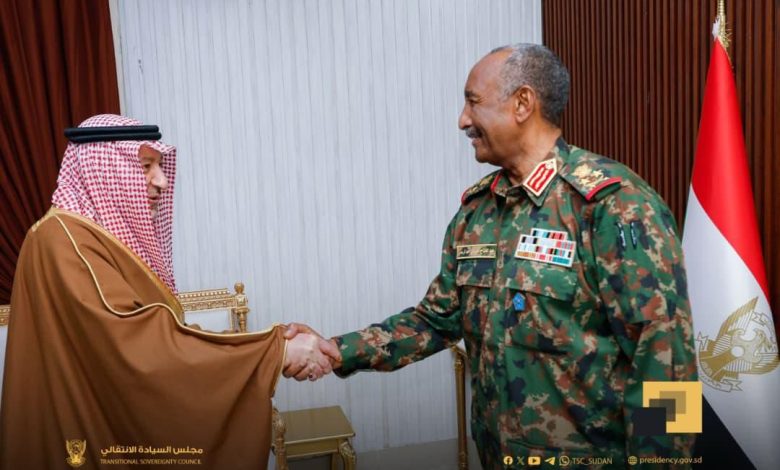
Following a meeting between the Chairman of the Sovereign Council and Commander of the Sudanese Armed Forces, General Abdel Fattah al-Burhan, and Saudi Deputy Foreign Minister Waleed Al-Khuraiji, renewed discussion has emerged around initiatives to halt the war in Sudan—both on the political and military fronts. This comes particularly in light of al-Burhan’s remarks during the meeting, in which he reiterated his welcome of the initiative jointly proposed by Saudi Crown Prince Mohammed bin Salman and U.S. President Donald Trump. Notably, however, he made no reference to the so-called “Quartet Initiative,” which U.S. envoy Massad Boulos has been working to place on the table—fully aware that the U.S. administration, and al-Burhan in particular, reject this initiative and oppose the inclusion of the United Arab Emirates in any framework to resolve the Sudanese crisis.
From the perspective of the Sudanese government and broad segments of the public, the UAE is viewed as a key player and principal backer of the Rapid Support Forces (RSF) militia, and as bearing full responsibility for the killings, mutilations, rape, and forced displacement suffered by Sudanese civilians. It is through this lens that officials and much of the population see who is driving the war against Sudan today.
A high-level meeting was recently held between senior officials from the United States and Saudi Arabia, including Massad Boulos, aimed at reaching a ceasefire in Sudan. The meeting brought together Saudi Defense Minister Prince Khalid bin Salman, Foreign Minister Prince Faisal bin Farhan, Deputy Foreign Minister Waleed Al-Khuraiji, and Political Advisor Prince Musab bin Mohammed Al-Farhan.
Leaks have since circulated regarding a Saudi-led approach to crafting a revised version of the Quartet Initiative that would be acceptable to Riyadh. Observers linked this to Al-Khuraiji’s visit to Sudan’s temporary administrative capital, Port Sudan, and his meeting with al-Burhan. It is widely expected that the Saudi official conveyed new proposals to the Chairman of the Sovereign Council concerning a truce and a cessation of hostilities—proposals designed to bypass Sudan’s rejection of the UAE’s inclusion in the Quartet, while seriously addressing the concerns of the Sudanese government.
According to these expectations, the Saudi approach seeks to reconcile the joint Saudi–U.S. initiative with elements of the Quartet Initiative, without entirely excluding the concerns of other countries—aside from the UAE—that have direct or indirect involvement in the Quartet framework. As is often the case, no official details have emerged from al-Burhan’s latest meeting with the U.S. deputy foreign minister.
Professor Fadl al-Mawla al-Naeem, a political science academic, says attempts to impose the Quartet Initiative on Sudan have so far failed—not only because the UAE is part of it, as some suggest, but because the initiative itself is “watered down” and would reintroduce the Janjaweed militia into both the military and political arenas. “This is unacceptable to most Sudanese, not just the government,” he said.
He added that recent Saudi moves demonstrate the Kingdom’s growing leadership role in the region. “The fact that Waleed Al-Khuraiji, the Saudi deputy foreign minister, visited Port Sudan to meet al-Burhan—rather than Massad Boulos—is significant and highly indicative. It confirms that al-Burhan’s welcome of Saudi Arabia’s role in resolving the Sudanese crisis is moving in the right direction.”
Al-Naeem noted that Saudi Arabia has acted effectively, pointing to visits by Saudi officials to Egypt and elsewhere, as well as the high-level Saudi–U.S. meeting, as evidence that a coherent vision has begun to take shape and is now under discussion. “This is an important development that shows the situation is evolving,” he said.
He further observed that the Sudanese perspective now appears to be taken into account. “Otherwise, negotiations would have been held with local political forces and regional actors that Sudan considers hostile. This, too, is a positive sign.” He concluded by saying he expects any proposed solution to be acceptable to the Sudanese government, its supporters, and the Sudanese public.
Dr. Saeed Salama, Director of Vision Center for Strategic Studies, believes that matters are now becoming clearer and that consultations have moved into the details. “It is evident that the Sudanese government remains firm that any solution must align with the initiative it presented to the United Nations through the prime minister,” he said. “That initiative contains the core elements of any viable settlement to the Sudanese crisis.”
He added that despite the intense pressure exerted on Sudanese government leaders, it has become clear that they will not retreat—at least not on certain key points they consider essential to any solution. “In reality,” Salama said, “it is extremely difficult for the Sudanese government to accept the option of preserving the Janjaweed militia after everything it has done on both the political and military fronts. This is unacceptable not only to the government, but also to a people who have suffered immensely from the militia’s existence in the past—and are paying an even heavier price today.”