Informal Settlements: When Life Suffocates
Report – Sudan Events
It is widely believed that areas with a high concentration of informal settlements played a central role in the destruction and looting of residents’ homes. Many inhabitants of these areas became a steady fuel that set people’s houses ablaze, looted and pillaged property, assaulted honor, and established markets for stolen goods. They spread corruption across the land throughout the militia’s presence in Khartoum. Large numbers of residents from these informal settlements were mobilized, joined the militia, and took up arms against the army and the people.
Even before the war, there were areas within Khartoum that were almost entirely beyond state control. In some districts, informal housing constituted the majority of the area—such as Mayo, where informal settlements account for more than 70 percent of the locality. In parts of western Omdurman, criminal gangs held sway and did not even permit the rule of law. Ultimately, these areas became incubators for the militia, providing fighters and support. Through the militia and its weapons, they expanded to kill, loot, and steal from the residents and homes of Khartoum.
Many believe these neighborhoods and hotspots posed a direct threat to civilians during the war and contributed significantly and effectively to destruction beyond what the militia itself carried out. While the militia focused on looting items that were light in weight and high in value to transport to Darfur, others took charge of stealing everything else—from doors and floor tiles to electrical sockets, household utensils, clothes, and cars, which were dismantled into spare parts. Markets for these stolen goods were set up across Khartoum.
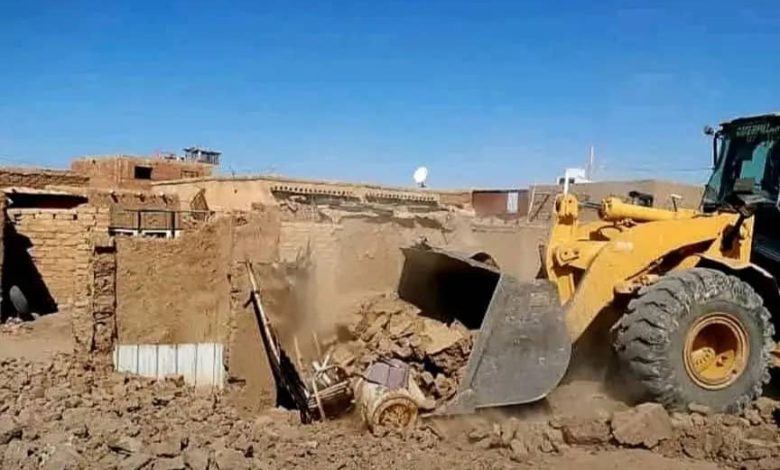
This reality necessitated, immediately after the city’s liberation, a campaign to combat informal settlements, manage the foreigners’ file, and deport them—foreigners make up a significant proportion of informal settlement residents. In recent weeks, the Land Protection Authority has stepped up efforts to halt the expansion of informal settlements, protect society, and enforce the law. It has begun dismantling informal housing that had occupied the city’s outskirts entirely, as well as parts of neighborhoods in its core, removing thousands of structures. In the area known as Mayo Quraysh, for example, the Authority removed approximately 6,667 encroachments; in Jabal Awliya, 5,581; in Bahri, Al-Jarif, Ombada 26, Nivasha, and other areas, similar actions were taken.
Major (Police) M. Abdel Nabi Al-Jabouri said the danger posed by informal settlements had been evident from the outset and did not require a war to reveal the threat they posed to the urban sector. “Informal housing produced ‘Tis’a Tawila’ gangs and ‘night visitors’ who target people in the streets for robbery. While they spread further during the war and their danger became more apparent, the threat was clear even before the war with the widespread phenomenon of street robberies, the dominance of street children over markets, and attacks on visitors and traders,” he said.
He added that some even imposed extortion fees on shopkeepers under the pretext of protecting their stores from theft—while they themselves were the thieves. “There are countless indicators of the threat these groups pose to people’s lives, security, and property. These are communities that live off theft and do not seek to learn trades or pursue legitimate work; instead, they practice theft, the production and sale of alcohol, prostitution, and other illicit activities. As a result, they generate chaos wherever they can reach,” he said.
Al-Jabouri noted that most homes in Khartoum were looted by individuals from these informal clusters, a fact confirmed by recent seizures that uncovered vast quantities of stolen goods inside these areas, including spare parts and entire commercial shops stored within homes. He added, “Thieves are not all from these informal settlements—that is true—but it is also true that dismantling these settlements is extremely important, alongside arresting foreigners who violate residency laws, prosecuting them and deporting them, and prosecuting those proven to have looted homes, vandalized public facilities, and established markets to sell stolen goods.”
He concluded that the current efforts require strong backing from the state and society, stressing that removing these تجمعات would preserve security and protect citizens’ lives, and that over time people would feel the difference between their presence and absence.
Meanwhile, Sami Abdelaziz, a resident of Al-Kalakla, said that upon returning home he found nothing left and that the house had been destroyed. “Even the doors and windows were stolen from my home, as well as from most houses in the neighborhood,” he said. He added that he was advised to search for his stolen property in a market in Mayo where looted goods are sold, and indeed found some of his home’s doors and windows there. “Can you believe that I bought them back for a very small price? Yes, I bought my own stolen property. This is what is happening in Sudan now—we have reached the stage of purchasing our own belongings from the market,” he said.
He concluded by saying that those who looted Khartoum are known and present, and that most of the stolen goods—aside from what the militia transported to Darfur—remain in informal settlement areas and in hideouts they established in certain locations. “Everything is known and is now beginning to come to light,” he said.