Despite Destruction and Power Outages, Universities Bring Life Back to Central Khartoum
Report – Sudan Events
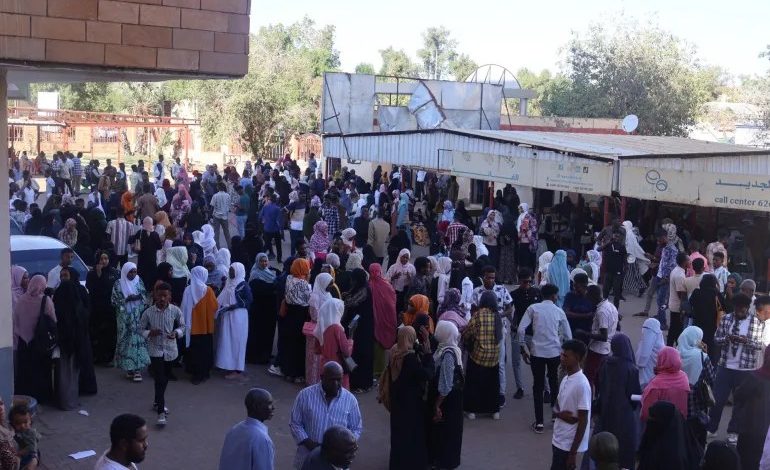
The sound of artillery is no longer the only defining feature of the Al-Mogran area in central Khartoum. Amid war-scarred buildings, the voices of students heading to examination halls have returned, cutting through the heavy silence of a city that has grown accustomed to ruin and emptiness since the war began.
The return of Nilein University to Al-Mogran was not merely the resumption of a suspended academic activity. It was a symbolic declaration of education’s ability to restore life to devastated places—and a stern test of resilience in a country where the war between the Sudanese Armed Forces and the Rapid Support Forces has yet to end.
For the first time in nearly a year, thousands of students have gathered in university buildings to sit for exams, bringing movement and vitality back to an area that had been occupied almost exclusively by police officers at the headquarters of the Khartoum State Police.
Amid the Rubble
Nilein University Vice Chancellor Prof. Al-Hadi Adam told Al Jazeera Net that the return began immediately after Khartoum was retaken in April 2025, when an administrative delegation from the university arrived to find extensive destruction and devastation across its facilities. The damage was documented, and three months later—specifically in July—the university administration decided to reopen the campus as an examination center. Around 1,200 male and female students sat exams at the center.
Since the outbreak of the war nearly three years ago, instruction at the university had shifted to online learning. Examinations were held at 18 centers—eight inside Sudan and ten abroad. Before the war, Nilein University had more than 105,000 students, making it the largest university in Sudan by enrollment, according to Adam.
He noted that reopening the examination center at the Al-Mogran campus triggered wide activity in an area that had been a theater of operations and suffered severe damage, leaving it completely devoid of movement. The university’s return brought life back, prompting visits by senior officials, most notably the Chairman of Sudan’s Sovereignty Council and Commander-in-Chief of the Armed Forces, Lt. Gen. Abdel Fattah al-Burhan, along with many other officials.
Adam added that the number of students currently sitting exams has risen to more than 3,000, prompting the university to open two additional centers at the Faculties of Commerce and Economics to accommodate them.
Challenges and Losses
Higher education institutions in central Khartoum face major challenges, Adam said, most notably:
- The absence of electricity in central Khartoum, particularly in the Al-Mogran area
- Incomplete maintenance of student housing
- Transportation and mobility constraints
- Destruction beyond the universities’ financial and logistical capacity
- The destruction of three teaching hospitals affiliated with the university
Nilein University’s war-related losses are estimated at $200 million, including the destruction of the administrative complex, laboratories, the looting of its vehicle fleet, and the devastation of three affiliated hospitals: Bashair, Jabra Ophthalmology, and Al-Mogran.
Prof. Adam stressed that the scale of destruction suffered by the university exceeds its capacity and resources. He also pointed to another challenge facing higher education institutions in central Khartoum: the country remains at war, and targeting continues. “There may be pockets of militia members and collaborators,” he said. “We are in full coordination with security agencies to address this challenge.”
Hosting and Presence
Adam noted that Nilein University successfully hosted equivalency examinations for the legal profession in Sudan and is preparing to host equivalency exams for the accounting profession. The university is also hosting universities and colleges from war-affected areas, including South Sahara College in El Fasher, North Darfur, and the University of Nyala in South Darfur State, which enrolls about 4,000 students.
“The university is ready to host any government or private entity for examinations or assessments,” he said. “Our goal is to revitalize the Al-Mogran area, because movement there helps restore services.”
He added that the university administration met with the Minister of Higher Education to address the electricity problem. The meeting tasked the Ministries of Energy and Minerals with bearing the responsibility of restoring power to higher education institutions. Adam expects that the Cabinet’s return to operating from Khartoum will accelerate the restoration of electricity to central Khartoum.
“We began in-person instruction on December 21 for first-year medical students,” he said. “About 70% of admitted students are attending in person, while 30% are studying online. If electricity returns, the university will resume operations across all faculties. For now, we are operating on a solar power system.”
University of Khartoum
Meanwhile, the University of Khartoum—the country’s oldest university—has turned to its extensive facilities spread across the capital’s cities. It consolidated all first-year students admitted this year across its 22 faculties at the Faculty of Education in Omdurman, after all its central Khartoum buildings were damaged.
Prof. Al-Sadiq Sharafi, Dean of the First Year at the University of Khartoum, told Al Jazeera Net that the administration decided to utilize faculty members present in Khartoum and bring students together for a foundational first year. He explained that this system had been used previously, with shared courses across faculties such as veterinary medicine, agriculture, animal production, and medical faculties including medicine, dentistry, pharmacy, public health, laboratories, and all engineering departments.
Sharafi said the aim was to conserve resources and optimize their use. Twenty-one laboratories were prepared for first-year students at the Faculty of Education, whose large facilities accommodated more than 4,000 students—the total number of first-year students across the 22 faculties.
Lecture halls were also prepared and refurbished, and in-person instruction for the 2023 and 2024 cohorts began in early January. The academic year will be intensive and will not exceed seven months, to compensate students for the two years lost to the war.
Infrastructure
Sharafi said the university’s greatest challenge is that faculty and staff have lost their financial savings and are grappling with severe economic hardship. He noted that the university has managed to provide housing for some lecturers to ensure stability.
He expects students to return to their faculties in central Khartoum next year, after maintenance and rehabilitation work—expected to take about eight months—is completed. The university suffered “very massive” losses, he said, and restoring it will require substantial effort.
Beyond electricity, Sharafi added, the biggest problem is rehabilitating the sewage network in central Khartoum. Its pumping stations were destroyed and require significant state intervention to restore.