Afwerki in His Most Dangerous Interview on the Sudan War: The Future of the Army, Islamists, the Intervention of Six Countries, and His Advice to Al-Burhan
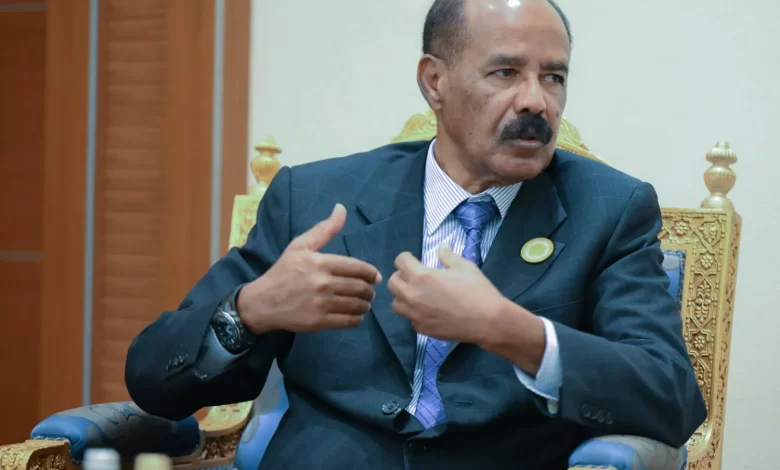
Eritrean President Isaias Afwerki said that the multiple initiatives seeking to mediate in Sudan are contributing to prolonging the war.
He explained that these initiatives come under various guises — sometimes wearing the mask of the Quad Mechanism, at other times that of the United Nations, the African Union, or the European Union, and occasionally appearing as bilateral initiatives.
In an interview with Eritrean state television on Monday evening, Afwerki called on all initiatives to distance themselves from Sudanese affairs and allow Sudan the opportunity to emerge from its crisis by having the army complete the management of the transitional period, until power is handed over to the people.
The Eritrean president said that the multiplicity of initiatives works to extend the war through repeated calls for truces and ceasefires, describing the humanitarian discourse as “crocodile tears” shed by parties he accused of bearing responsibility for what is happening.
He questioned the objectives of the Quad Mechanism, noting that there are many details related to it that he did not wish to elaborate on. He also questioned the rationale behind Saudi Arabia’s inclusion of the United States in the Jeddah initiative, and attempts to portray the war in Sudan as a civil war between two generals.
Afwerki said that the Neighboring Countries Initiative, proposed by Egypt, contained sound visions for addressing the situation in Sudan but eventually faded away, questioning why Saudi Arabia was not invited to participate in that initiative.
According to Radio Dabanga, Afwerki stated that what is taking place in Sudan is not a war between two generals nor an internal conflict within the army, but rather external intervention led by the United Arab Emirates through funding and support, along with the participation of several neighboring countries in the scheme, including Libya, Chad, the Central African Republic, South Sudan, and Ethiopia.
He said the plan began with supporting the Rapid Support Forces to ignite the war, smuggling weapons through Libya, bringing in equipment and mercenaries from Chad, in addition to preparing forces in the Central African Republic and South Sudan, ultimately aiming to target the Blue Nile via Ethiopia.
Afwerki stressed that the war that erupted in Sudan is unjustified and unacceptable, aimed at destabilizing the Red Sea region, and has led to the collapse of the country.
He said Eritrea had submitted written papers to Sudan’s Transitional Sovereignty Council calling for political forces not to participate in the transitional period until the constitution is finalized and power is handed over to the people.
Addressing Sudanese political forces, he said: “The presence of the army is temporary, and there is no meaning to conflict with the military institution.”
He called for avoiding a repetition of past mistakes, foremost among them the secession of South Sudan, stressing that the collapse of Sudan is unacceptable and that the current war is rejected. He accused external powers of seeking to turn Sudan into a launchpad toward the Red Sea, the Horn of Africa, and neighboring countries.
He emphasized that peace and stability in Sudan have a major impact on all countries in the region.
Afwerki stressed the need for Sudan to emerge from this predicament and reach safety, calling for an end to political bickering until power is handed over to the people, adding: “Sudan’s stability is a gain for everyone.”
The Eritrean president said his country’s position on Sudan stems from the belief that it is “an internal issue that primarily concerns the Sudanese people,” but he asserted that the entity capable of managing the transitional phase is “the army.”
According to Asharq Al-Awsat, Afwerki said the army’s mission to govern during the transition would end with the completion of that period, stating: “The army will not be a party to political competition or conflict in the future. Its task is to lead Sudan to safety by laying out a roadmap lasting two, three, or four years, during which broad consultations will take place on the nature of the political system, followed by a referendum so that the people choose their government, at which point the military institution exits the political scene.” He added: “We believe this is the best solution, and there is no more logical alternative.”
Afwerki described the situation in Sudan as marked by “sophistry and political farce,” saying it has not benefited from the richness of political culture that characterized the country during the 1950s, 1960s, and 1970s. He said: “For Sudan to reach this level is deeply saddening and almost unbelievable — closer to children’s play.”
He sharply criticized the emergence of what he called “self-proclaimed experts,” describing their appearance as “extremely depressing,” especially given Sudan’s wealth of resources and rich political culture. He considered this phenomenon an extension of the legacy of the National Congress Party over the past thirty years, saying: “The rule of the past three decades is what led Sudan to this degraded state.”
He traced the roots of the crisis back to 1983 during the rule of former President Jaafar Nimeiri, when Nimeiri announced the implementation of what he called “Islamic Sharia laws,” with Islamists led by their late leader Hassan al-Turabi — Nimeiri’s adviser — participating in the regime and drafting those laws. Afwerki said this marked the beginning of Sudan’s transformation into a haven for Al-Qaeda and other groups, adding: “This is what brought the country to its current deplorable condition.”
He said: “This was a problem that could have been addressed within a unified Sudan… but misguided approaches led the South to where it is today.”
Afwerki described the December 2018 revolution as a “spontaneous uprising” in which the people overthrew the regime without planning, political leadership, or political programs, resulting in what he called a “political vacuum.” During that period, the crises of the former regime erupted in the form of “regional or tribal patterns,” worsened by the absence of radical solutions, turning into a “heavy legacy” that necessitates a transitional phase capable of addressing these accumulated crises.
He denounced what he termed the “conflict between civilians and the military” in Sudan, saying: “By what logic can there be a conflict between civilians and the military? How can all of Sudan’s accumulated crises be ignored in favor of focusing on a supposed conflict between civilians and military leaders as the core of the political crisis?”
Afwerki warned against foreign intervention in Sudanese affairs, saying: “The worst thing that can happen under these complex and turbulent conditions is external intervention.” He added: “Sudanese political forces — whether traditional parties, so-called liberation movements, professional associations, or trade unions — already have enough accumulated problems, then external factors come to make matters even worse.”
He described what is happening in Sudan as the harvest of thirty years of Islamist rule, saying: “The problems they claimed to solve have escalated dramatically, bringing Sudan to its current state of hunger, high prices, and currency collapse, making it an object of ridicule.” He added: “There is nothing more miserable and heartbreaking than this.”
Afwerki stressed the importance of Sudanese consensus on mechanisms and exits from the current crisis, away from foreign interference. He said: “External interventions must stop, and responsibility lies primarily with Sudanese nationalists. If they so desire, managing the transitional period is not that complicated.” He added: “Sudanese patriots must assume responsibility, learn from the mistakes of the past four decades, and define the future direction, instead of receiving lessons and lectures from abroad.” He continued: “Because of interventions, Sudanese affairs have become a playground where anyone can issue opinions at will.”
Afwerki pointed to the impact of Sudan’s situation on Eritrea, saying: “It cannot be claimed that Sudan’s affairs do not affect us. Sudan’s role during the armed struggle and after independence was deeply intertwined with ours.” He added: “There was once a hope that the peoples of Sudan, Ethiopia, Eritrea, Somalia, and Djibouti would work together, but that dream has faded.” He concluded: “There is no alternative to cooperation among these peoples. Therefore, Sudan must emerge from its current predicament through a clear vision that closes the door to external interventions.”