Supply Routes Under Threat… The Militia Confronts Shifting Dynamics
Sudan Events – Agencies
Eritrean President Isaias Afwerki has levelled explicit accusations against the United Arab Emirates, accusing it of destabilizing Sudan and the wider region. In a lengthy interview with Eritrean state television, Afwerki said that U.S. policies, alongside intensifying international competition, have contributed to the growing complexity of the political and security landscape in several regions, including Sudan, the Horn of Africa, and the Red Sea. He stressed the need for a new approach to managing international relations, asserting that global stability cannot be achieved through domination and unbalanced interventions, but rather through the establishment of an international order based on equitable partnership, justice, mutual respect, and free from systematic exploitation of weak or conflict-affected states.
Meanwhile, the European Union reaffirmed its support for Sudan’s unity and its rejection of any parallel government. The EU emphasized the importance of a humanitarian truce and a ceasefire to protect civilians and pave the way for a political process.
In a post on the EU’s official Facebook page, Aidan O’Hara, Head of the EU Delegation to Sudan, expressed his pleasure at participating—alongside the EU Special Representative Annette Weber—in the fifth consultative mechanism for peace efforts in Sudan.
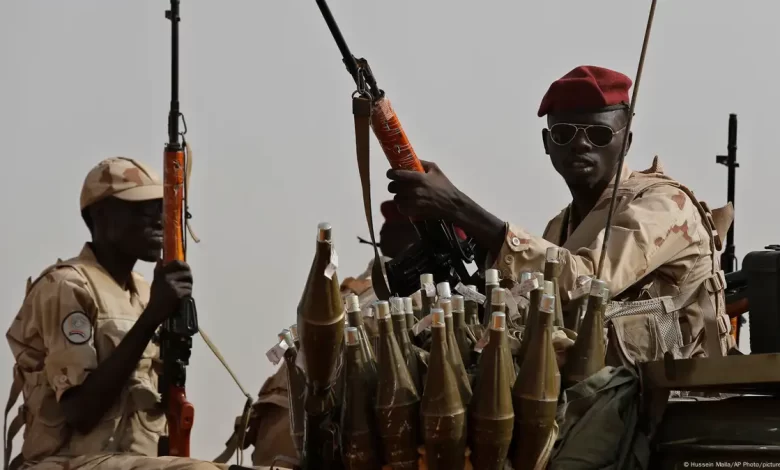
In parallel, some regional actors’ movements regarding the Sudan file have shifted from behind-the-scenes to public view, following remarks by U.S. envoy Massad Boulos, who confirmed that the United States is dealing with the government in Khartoum and will not recognize parallel entities. Leaks have also revealed sharp language used by Egypt in its communications with retired Libyan commander Khalifa Haftar, conveyed through his son Saddam Haftar, deputy commander of the so-called Libyan National Army controlling southern Libya. Egypt reportedly expects decisive measures from Haftar to halt the flow of weapons from southern Libya into Sudan and the tri-border area, where the Rapid Support Forces (RSF) militia has been active since June 2025.
Egypt is seeking guarantees to prevent military supplies from reaching the militia via Kufra Airport, which has recently become one of the most important gateways for supplies and mercenaries. Local sources indicate that supply routes from southern Libya into Darfur have grown increasingly complex due to border tensions between Sudan and Libya—exacerbated by warplanes and drones—as well as between Libya and Chad, amid repeated attacks on trucks crossing into Chadian territory in attempts to evade aerial strikes. Prior to the Egyptian warning, recent shipments had been entering Chad from Libya before heading to Darfur via Adré. These consignments came under attack by armed groups operating along the border, with some reportedly detaining and beating Libyan truck drivers. Some groups affiliated with Chadian government forces—who are fighting alongside Sudanese joint forces—are also implicated in attacks on arms-carrying trucks and the seizure of their cargo.
Observers believe that shipments originating from Kufra Airport and destined for Darfur are now on the verge of halting following Egypt’s warnings, its border movements, and renewed, firmer messages aimed at isolating the militia and cutting off Emirati support. A disruption of Libyan supply lines would likely paralyze the militia’s operations, given that most of the fuel used by its mobile units comes from Libya. The mobilization of Arab diaspora fighters and their deployment in Darfur battles is also routed through Libya, as is the arrival of most mercenaries, equipment, Emirati teams, and officers via Kufra Airport. Any shutdown of the Libyan supply line would therefore severely cripple militia fighters in Darfur and Kordofan, leaving them vulnerable to advances by the Sudanese army.
The UAE had reportedly attempted to open a new entry point for arms into Sudan through the Beni Shangul area in the east, but the army targeted and disabled it after drone strikes on the Yabous camp, causing significant disruption in a region that had not seen military operations for years and was suddenly thrust into a conflict it lacked the capacity to manage. The SPLM-North faction led by Abdelaziz al-Hilu also lacks the necessary armaments to counter the army’s aerial attacks; even if certain technologies were available, its fighters—like the militia—lack the expertise to operate them. Consequently, foreign fighters have been brought in by the militia’s backers to handle such systems. However, amid mounting supply constraints, the arrival and sustained presence of foreign fighters from technologically capable countries has become increasingly difficult, as access routes and evacuation corridors are now under sustained fire from warplanes and drones.