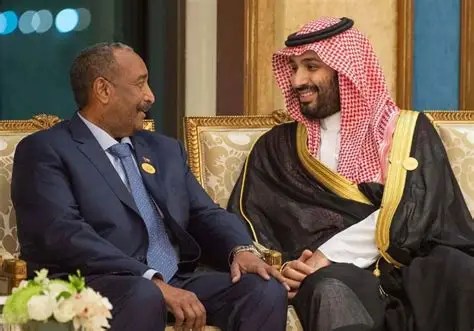
Multiple Sudanese sources have revealed to several leading international media outlets, including Reuters and Asharq News, that the Chairman of Sudan’s Transitional Sovereignty Council and Commander-in-Chief of the Sudanese Armed Forces, General Abdel Fattah al-Burhan, has officially received a new Saudi–U.S. roadmap aimed at ending the ongoing war in Sudan and pushing toward a comprehensive political settlement.
According to the sources, the initiative enjoys direct backing from Saudi Crown Prince Mohammed bin Salman and U.S. President Donald Trump, and is considered the most significant international effort in months to resolve the conflict.
Details of the New Initiative
Available information indicates that the proposed roadmap consists of three clearly defined phases:
Phase One:
The declaration of an urgent humanitarian truce to allow the delivery of humanitarian aid and the opening of safe corridors for civilians.
Phase Two:
The initiation of a cessation of hostilities between the Sudanese Armed Forces and the Rapid Support Forces (RSF), under international supervision and guarantees.
Phase Three:
The achievement of a comprehensive and final ceasefire, paving the way for the launch of a transitional political process that would set the country on a path toward stability.
Intensive Diplomatic Activity
These developments come amid notable diplomatic momentum over recent days, marked by:
Port Sudan Meetings:
A visit by Saudi Deputy Foreign Minister Waleed Al-Khuraiji to Port Sudan, where he met with al-Burhan and delivered the joint Saudi–U.S. vision.
Internal Sudanese Consultations:
Sources report that al-Burhan has already begun a series of intensive meetings with military and political leaders to shape Sudan’s official response before submitting it to the sponsoring parties.
Enhanced Coordination with Riyadh:
Simultaneously with receiving the initiative, al-Burhan issued a decision to reconstitute the Supreme Council for Strategic Cooperation and Coordination with Saudi Arabia, a clear political signal of deepening ties between Khartoum and Riyadh.
Sudan’s Official Position
Direct Welcome:
In an official post on X, al-Burhan expressed his gratitude to King Salman bin Abdulaziz, Crown Prince Mohammed bin Salman, and U.S. President Donald Trump for their efforts to end the suffering of the Sudanese people.
Conditional Openness:
Official sources said al-Burhan informed mediators of his readiness to discuss the roadmap, provided that the RSF commits to the “Jeddah Declaration” signed in May 2023, which stipulates the withdrawal of forces from civilian facilities and private homes.
Shift in Political Rhetoric:
Observers note a marked shift in the Sudanese leadership’s discourse, from an emphasis on “total military victory” toward openness to a political solution, driven by the political weight of the initiative’s sponsors.
Rapid Support Forces’ Position
The RSF leadership expressed cautious welcome for the initiative, stating that any effort led by Saudi Arabia and the United States could represent an opportunity to end the war.
However, it criticized certain statements by U.S. officials—particularly Secretary of State Marco Rubio—describing them as biased in favor of the Sudanese army.
The RSF stressed that its acceptance of any ceasefire must be linked to:
- The opening of comprehensive humanitarian corridors
- The presence of international guarantees
- Preventing the exploitation of the truce for military gains
Regional and International Support
Saudi Arabia:
Continues to play the role of the “primary facilitator” of the initiative and is working to prepare the ground for a new round of direct negotiations in Jeddah in the coming period.
United States (Trump Administration):
President Donald Trump has publicly stated that ending the Sudan conflict has become a priority, confirming that the Saudi Crown Prince personally requested his intervention—giving the initiative unprecedented political momentum.
Political Context
Analysts believe the initiative comes at a sensitive regional moment marked by efforts to close major conflict files, and that the political weight of Riyadh and Washington gives it a real chance to alter the trajectory of Sudan’s crisis—provided there is domestic political will and credible implementation guarantees.