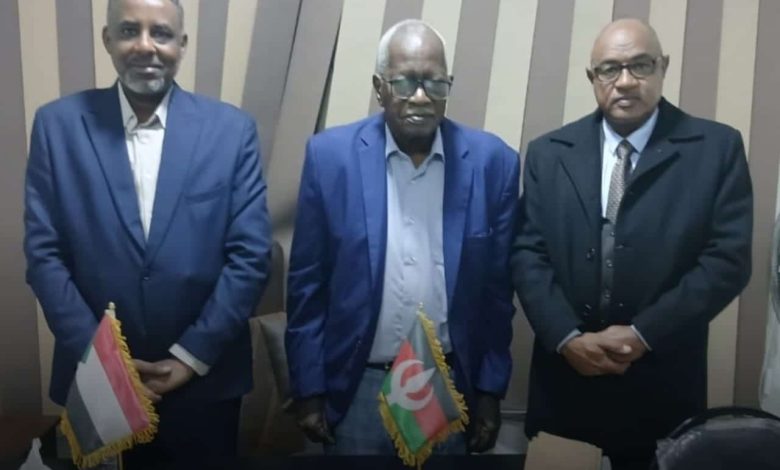
Coordination efforts have intensified among political entities that have chosen to part ways with anti-military forces and operate from within Sudan, paving the way for the announcement of a broad political alliance.
According to a statement, the National Umma Party, led by Mohamed Abdullah Al-Douma, and the National Current—comprising dissidents from the Sudanese Congress Party—held a joint meeting attended by Al-Douma, Chairman of the National Umma Party, and Nour El-Din Salah El-Din, Head of the Executive Bureau of the National Current, along with several leaders from both groups.
The meeting discussed developments in the country’s political landscape, foremost among them ending the war in favor of a state based on institutions and the rule of law, building a broad national consensus leading to a transitional path toward full civilian rule, as well as issues of social peace and ways to confront hate speech and its threats to social cohesion and national unity.
The statement noted a significant convergence of views and positions between the two sides, particularly regarding the need to unify and organize civilian efforts in confronting the war and its political and social repercussions.
Both parties agreed to coordinate and work jointly, expand communication channels with other political and civil forces, and build a broad civilian front guided by a clear national agenda focused on achieving comprehensive and just peace, and supporting Sudanese–Sudanese dialogue as the true gateway to ending the crisis.
The two sides reaffirmed their full commitment to safeguarding Sudan’s unity and sovereignty, and their categorical rejection of attempts to establish parallel governing structures under what the statement described as the Rapid Support Forces militia, citing the serious threat such attempts pose to the unity and future of the state.
They also stressed the necessity of reaching consensus on a transitional arrangement led by an agreed-upon civilian government with national legitimacy, while underscoring the armed forces’ commitment to their constitutional and legal duties and their disengagement from politics and governance, in order to ensure the building of a professional state founded on the rule of law and institutions.
The statement added that the meeting comes as part of ongoing efforts to bridge differences among civilian forces and overcome fragmentation, contributing to the formulation of a unified national position capable of addressing the root causes of the crisis and placing Sudan on a path toward peace, stability, and democratic civilian transformation.