Dissolving the Militia and Disarming It: What’s New in Sudan’s War
Report – Sudan Events
Egyptian President Abdel Fattah El-Sisi has reiterated his country’s firm and unequivocal rejection of any efforts aimed at dividing states in the region, carving out parts of their territories, or creating militias and parallel entities to national armies and legitimate institutions.
Speaking during celebrations marking Egypt’s Police Day, El-Sisi said Cairo considers such practices in neighboring countries a red line that will not be crossed, as they pose a direct threat to Egypt’s national security. He stressed that state institutions are a pillar of stability, noting that militias do not protect states. On the contrary, countries that created militias for protection have since discovered that they are instruments of destruction rather than safeguards of statehood.
These remarks came as Port Sudan, the temporary administrative capital, received Egypt’s intelligence chief, in what appeared to signal a decisive Egyptian stance on the war in Sudan. Regional states, in cooperation with the United States, Saudi Arabia, and Egypt, are reportedly working to halt the conflict through initiatives currently being discussed behind the scenes, according to leaks from various sources.
Meanwhile, the Chairman of Sudan’s Sovereignty Council and Commander-in-Chief of the Armed Forces, General Abdel Fattah al-Burhan, has stated that any return to negotiations is contingent on armed formations withdrawing and handing over heavy weapons. In an article published in a Turkish newspaper, al-Burhan said the core conditions for a ceasefire remain unchanged: withdrawal from occupied areas, removal of heavy weapons from the equation, and the dismantling of any independent power centers operating outside the state’s chain of command.
He emphasized that without these conditions, any ceasefire would amount to no more than a temporary truce that renews the conflict rather than resolving it. “Our goal is not to manage the conflict but to return the Sudanese state to its institutional path,” he said—an assertion echoed by Information Minister Khalid al-Ayeser. The minister stated that if the militia truly seeks to end the war, it must return to camps, surrender its weapons, and comply with the Sudanese government’s initiative. He added that the decision to stop the war lies with the Sudanese people, who have suffered looting, killings, and violence, and who reject the resilience of the militia and its supporters.
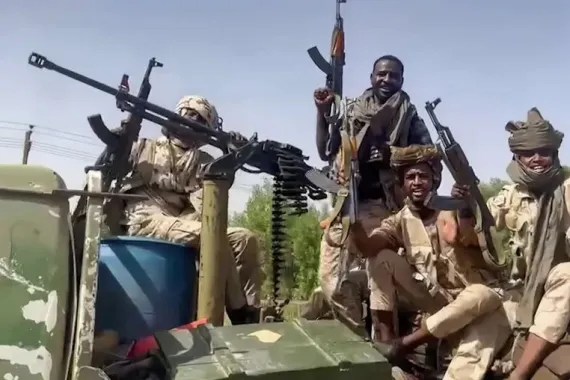
The government’s statements, alongside those of the Egyptian president, reflect a clear orientation toward decisively confronting militias. As El-Sisi noted, militias do not protect states but threaten their security—a conclusion reached by those who previously created them. The Rapid Support Forces (RSF), for example, do not appear receptive to this approach, given Sudan’s historical experience with militias.
Historically, no militia in Sudan has been fully subdued, disarmed, and demobilized. Other armed groups that fought the state were not required to do so; instead, through the militarization of political reality, they secured positions and privileges for their regions at the expense of other marginalized regions that did not take up arms and historically received little development. In most cases, advantages and preferential treatment went to regions with militias that fought the state. This raises a central question: why would any militia lay down its arms when Sudanese history shows that militia leaders were often elevated to state leadership, granted power, and lavishly funded?
Abdel Nabi Musa, a researcher specializing in the history of conflicts in Sudan who maintains an extensive archive on the subject, argues that this issue lies at the heart of the complex challenge of addressing the militarization that has taken root in the country. “Rebellion against the state has come to bring positions, power, and wealth,” he said. “Every time a faction rebelled, it eventually returned to find a reward waiting—its leader becoming a minister, its commanders receiving senior posts, and even military ranks that ordinary citizens earn only after entering military academies.”
He added that instead of being punished for rebelling against the state, these groups were rewarded—prompting a dangerous precedent. “Why wouldn’t anyone rebel against the state?” he asked. Historically, Musa said, the approach was disastrous: negotiating with militias and striking settlements that turned them into the country’s rulers. “No responsible state makes rebellion a reward and then asks what went wrong,” he noted.
Musa argued that the current militia’s situation may appear different because it was originally part of the state. However, once it became a militia funded and sustained externally, it followed a familiar trajectory, convinced that the Sudanese state would eventually negotiate and restore it to power if its plans failed. This belief, he said, is rooted in Sudan’s long history of settlements with militias that brought them to power rather than holding them accountable.
As a result, the state’s current insistence on a new approach—dissolving militias, returning them to camps, and stripping them of weapons—appears alien to militias accustomed to impunity. Sudan, too, is unaccustomed to the unprecedented actions carried out by the Janjaweed militia in the country’s history.