What Is the Humanitarian Situation Like in the Cities of Dalang and Kadugli?
Report – Sudan Events
Only one week has passed since the Sudanese army announced the lifting of the siege on the city of Dalang after a blockade that lasted two years, before issuing another statement declaring the lifting of the siege on Kadugli, the largest city in South Kordofan State.
With this, the army has regained control of the two largest cities in the state after years of siege during which humanitarian conditions deteriorated to their worst levels. News from these areas had remained scarce due to the prolonged disruption of communication networks.
On January 26, a statement by the official spokesperson of the Sudanese Armed Forces announced the reopening of the Dalang road after more than two years of siege, “following the execution of a successful military operation that resulted in the defeat of the Rapid Support Forces and allied groups, which had been attempting to obstruct the movement of citizens and supplies and to undermine security and stability in the area.”
Enormous Needs
According to sources who spoke to Al Jazeera Net from Dalang, humanitarian needs in the city remain immense. They warned that “unless the national White Nile–Dalang road is reopened, the city will enter its fourth consecutive season of siege by the holy month of Ramadan.”
Several residents described the humanitarian situation prior to the lifting of the siege as extremely dire, particularly along the eastern Habila–Dalang road, where people lost all means of survival. “There was no food, no clothing, no medicine, no education, and no salaries,” they said, amid a complete shortage of food commodities and a sharp rise in prices. At times, the price of one kilogram of sugar reached 65,000 Sudanese pounds (approximately $108).
Sources added that onions were completely unavailable in the city throughout the two years of siege, and that there remains a severe shortage of medicines and treatments. “The vast majority of residents do not have money to purchase treatment even if it is available,” they said, noting that people rely on initiatives attempting to provide care to the wounded. However, volunteers are unable to reach most residents inside their homes.
According to the same sources, most victims of shelling have resorted to alternative treatments such as herbs due to lack of funds, leading to the amputation of limbs in some cases. Others suffer from direct drone injuries, as the city was repeatedly targeted throughout the past period.
One Dalang resident, who requested anonymity, said that despite the lifting of the siege, the volume of goods entering the city remains limited compared to what is still absent, as the city continues to be subjected to repeated drone attacks. He noted that prices have seen only a slight decline, far less than expected, while the humanitarian situation remains complex due to ongoing bombardment.
Ongoing Shelling
On February 3, Transitional Sovereignty Council Chairman Abdel Fattah al-Burhan announced the reopening of the road to Kadugli, the capital of South Kordofan State, and the lifting of the siege on the city, in a televised speech broadcast by the official Sudan News Agency.
Residents who spoke to Al Jazeera Net from Kadugli said the city is in urgent need of food supplies, which have been scarce for more than two years. Prices remain high, life-saving medicines are unavailable, hospitals are non-operational, and medical staff are largely absent due to displacement over recent periods.
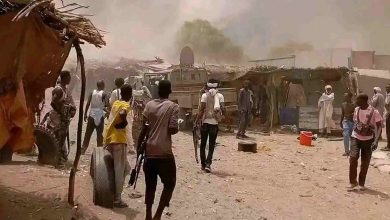
The city continues to face sustained drone attacks targeting health facilities, civilian infrastructure, and gatherings of civilians in markets, resulting in the killing of approximately 28 civilians inside health centers.
Citizen Asim Ahmed said that the pace of attacks intensified after the siege was lifted, with drones attempting to strike health and civilian institutions and gatherings of residents. He added that food and medicine remain unavailable and that movement outside the city is still nearly impossible.
For his part, the Director of the Administrative Unit of Dalang locality, Mohi El-Din Abdullah Younis, told Al Jazeera Net that the siege imposed by the Rapid Support Forces and the Sudan People’s Liberation Movement–North was “one of the harshest forms of unjust siege from all directions,” forcing children, women, and the elderly to eat tree leaves, which led to deaths due to toxic substances contained in them.
The government official confirmed that prices before the lifting of the siege had reached “insane levels,” with the price of a kilogram of sugar exceeding 40,000 Sudanese pounds, flour surpassing 30,000, and a pound of cooking oil reaching 25,000. “Less than two days after the siege was lifted and goods entered the city, prices dropped significantly and the market witnessed a major breakthrough,” he said.
Aid Convoy
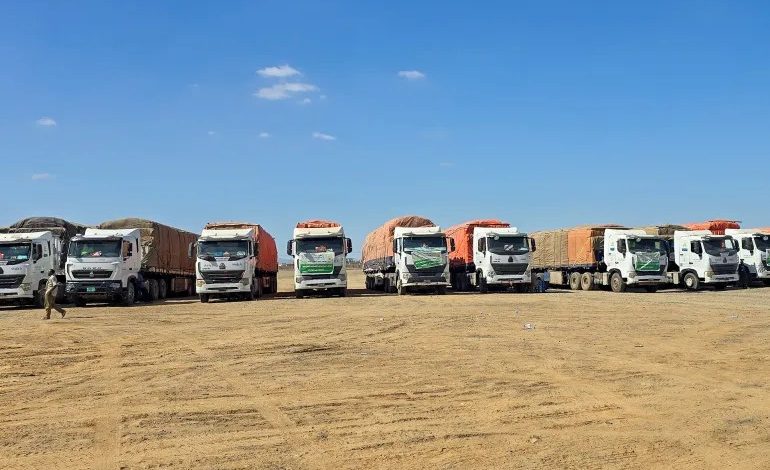
It is worth noting that Sudan’s Humanitarian Aid Commission dispatched a humanitarian aid convoy on Thursday to the city of Dalang, consisting of 2,250 tons of food and shelter assistance carried on 45 trucks, each loaded with 50 tons of flour, rice, clothing, and other essential supplies.
Sudan’s Humanitarian Aid Commissioner, Salwa Adam Buniya, told the media today during a brief press conference in Port Sudan that support for Dalang’s residents will continue. She said the convoy came as an urgent response to deliver assistance to the people of the area and pledged continued aid, stressing that it is “a purely Sudanese effort by the Government of Sudan and the Ministry of Finance, initiated by the Chairman of the Sovereignty Council.” She also called on donors to continue their efforts to support those in need across different regions of the country.