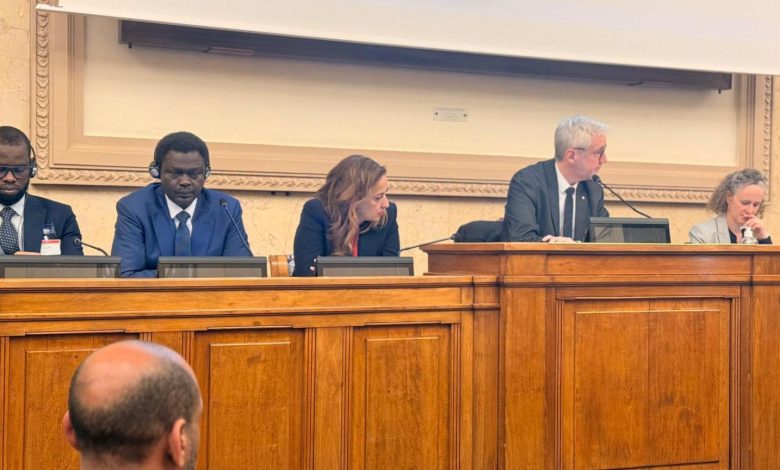
Commander Minni Arko Minnawi Addressing the French Parliament
Report – Sudan Events
In the presence of a large number of members of the French Parliament, representatives of international organizations, and members of the Sudanese community in France, Commander Minni Arko Minnawi addressed the audience on Tuesday evening. Below is the full text of his speech:
Ladies and Gentlemen, Members of the French Parliament,
Mr. President,
Distinguished Guests,
Allow me first to express my deep appreciation for the role of the French government and French humanitarian organizations operating under extremely difficult conditions in Sudan. Their efforts have provided vital support to our suffering people. It is a great honor to be here today to thank the French people for their solidarity.
I am honored to speak to you about the grave political and humanitarian situation in Sudan, with particular focus on the Darfur region.
The Sudanese crisis did not emerge overnight. It is the result of a long-standing structural imbalance, as successive ruling elites have failed to establish a just social contract based on equal citizenship and the fair distribution of power and wealth. This failure has entrenched exclusion and institutionalized violence, making the absence of equal citizenship the root cause of Sudan’s recurring conflicts.
In Darfur, the conflict has taken on a clear ethnic dimension, tragically manifested in the massacres we have witnessed over decades, including those in El Fasher. Ethnic identity has been deliberately weaponized to justify genocide and ethnic cleansing. Since 2003, the same instruments of violence have been employed: the Janjaweed militias, later reconstituted as the Rapid Support Forces (RSF).
For more than three decades, the Masalit people in West Darfur—particularly in the city of El Geneina—have endured genocidal violence. They have been confined to refugee camps under harsh conditions marked by severe suffering and international neglect. Similar crimes have been committed against other indigenous communities since 2003. More recently, the world has witnessed horrific atrocities in Zamzam camp and in El Fasher, including mass killings, forced displacement, the destruction of institutions, and the deliberate use of starvation as a weapon of war.
This reflects a systematic ideology embraced by the Janjaweed militias/Rapid Support Forces. A fundamental question therefore remains: why have the Rapid Support Forces not been designated as a terrorist organization?
The current war did not erupt in isolation. It is fueled by direct external support provided by the United Arab Emirates to the RSF—financially, militarily, and through mercenaries—in flagrant violation of international humanitarian law. This support advances an ideology that promotes forced demographic change and threatens Sudan’s unity.
I would like to express my sincere appreciation to MP Mr. Christopher for his responsible briefing to Parliament regarding the situation in El Fasher. His solidarity with the victims, along with that of other French parliamentarians, has contributed to awakening the international community and restoring confidence in humanitarian values.
The inaction of the international community—particularly the failure of the United Nations Security Council to implement Resolution 2736, which was adopted to halt atrocities and lift the siege on El Fasher—constitutes a grave moral and legal failure in the protection of civilians. Despite repeated warnings, decisive measures have regrettably not been taken.
We call for peace, but we reject any political process that is non-inclusive, that rewards warlords, that ignores the root causes of the crisis, or that disregards the rights of victims, as has occurred in the past. Genuine peace must be built on justice, accountability, and the free will of the Sudanese people, within the broad framework we continue to describe as a Sudanese–Sudanese dialogue.
Sudan’s stability is essential to regional stability. The ongoing conflict fuels displacement and irregular migration. Sudan’s strategic location on the Red Sea, along with its regional ties, positions it as a key partner in building stability and generating sustainable economic opportunities extending to West Africa. Moreover, Sudan possesses significant potential to contribute to global food security and to addressing climate challenges.
From this platform, I extend an official invitation to a French parliamentary delegation to visit Sudan, witness the impact of the war firsthand, and assess the humanitarian situation. We will provide all necessary support to ensure the success of such a mission.
Peace cannot be bought; it must be built upon justice and equal citizenship.
Finally, we have prepared a detailed humanitarian report, which is being distributed to members of Parliament.
Thank you for your kind attention.