UAE Deploys Hamdok to Thwart Egyptian–Algerian Push as Battle Erupts at African Union Over Sudan’s Membership
Report – Sudan Events
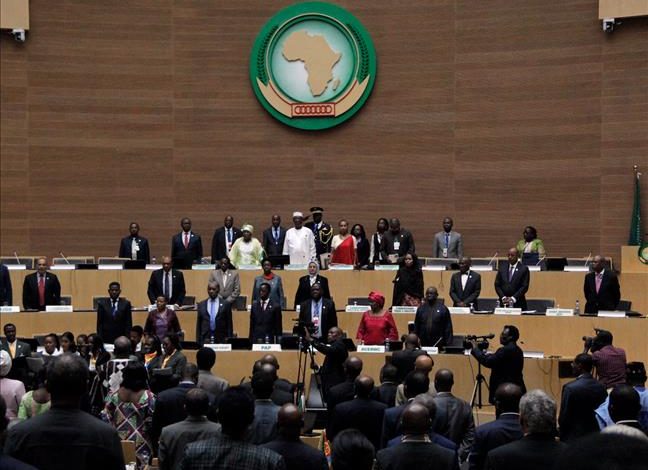
The headquarters of the African Union in Addis Ababa witnessed intense diplomatic confrontations over Sudan’s reinstatement and the lifting of its suspended membership. The venue also became a stage for broader regional and international rivalries surrounding Sudan’s file and efforts to end the suspension.
Sudan’s Foreign Minister, addressing the session, prefaced his participation with statements asserting that the country is engaged in a war against forces supplying militias with weapons and mercenaries. He stressed that the conflict involves foreign interference, advanced weaponry, and foreign fighters.
“We are fighting a war against direct foreign intervention that daily supplies mercenaries and sophisticated weapons,” he said. “As the continent’s foremost institution, the African Union must join hands with the Sudanese government to reach fundamental solutions that ensure security and stability—not only in Sudan, but across the entire continent.”
He added: “We are currently protecting Africa’s rear flank. The flow of mercenaries and advanced weapons into the continent is substantial, backed by supporters mobilizing fighters from across Africa and beyond.” He further described the AU’s decision to suspend Sudan’s membership as flawed, arguing that Khartoum’s return would be a gain for the Union as a whole. “The Union is taking a positive step by hearing the Sudanese government’s perspective and consulting with it to reach realistic understandings,” he said.
Sources within the African Union confirmed that the Foreign Minister’s address was met with significant understanding from member states, producing rare consensus toward issuing a closing communiqué expressing solidarity with the Sudanese people and government. The statement called for a ceasefire, preservation of Sudan’s unity and sovereignty, and rejection of any move to establish a parallel government. It further stressed that the solution must be Sudanese-led and not imposed from abroad.
Ahead of the session, AU corridors saw continuous meetings, as Egypt and Algeria held consultations with representatives of several states and AU officials to press for lifting Sudan’s suspension. The two countries reportedly achieved a significant breakthrough in barriers that the United Arab Emirates had erected around Sudan’s membership. Several states expressed understanding of the Egyptian and Algerian position, backed by Saudi Arabia, which exerted considerable weight in support of reinstating Sudan.
In contrast, the UAE dispatched a delegation from the “Sumoud Coordination,” headed by former Sudanese Prime Minister Abdalla Hamdok. According to sources, the delegation sought to undermine Egypt’s efforts to lift the suspension, arguing that any attempt to reinstate Sudan would run counter to the will of the Sudanese people.
Hamdok and his delegation, operating under Emirati backing, reportedly made intensive efforts to block any move toward reinstatement, advancing a narrative that the war in Sudan is a conflict between two factions and that no legitimate government currently exists in the country. Sources said the delegation held closed-door meetings in Addis Ababa with the AU Peace and Security Council aimed at preventing reinstatement and pushing the Council toward measures that could open the door to foreign military intervention under Chapter VII of the United Nations Charter.
The delegation explicitly called for the deployment of an international monitoring force led by the United States and headquartered in Ethiopia. However, Hamdok’s proposals reportedly failed to gain traction among African states or European representatives, who viewed them as inconsistent with the U.S. President’s initiative and out of step with the current administration’s approach.
Meanwhile, informed diplomatic sources indicated that momentum within the African Union is shifting toward lifting the suspension, particularly after Sudan regained its membership in the Intergovernmental Authority on Development (IGAD)—a step that some influential AU member states had reportedly set as a prerequisite for restoring Sudan’s AU membership.
For his part, Egyptian Foreign Minister Badr Abdelatty reaffirmed Cairo’s commitment to achieving peace and stability in Sudan, noting that Egypt is actively engaged in various regional and international initiatives and remains open to all efforts aimed at assisting the Sudanese people.
Speaking at the AU Peace and Security Council session held in Addis Ababa on Thursday regarding Sudan and Somalia, Abdelatty—whose country holds the Council’s presidency for February—condemned violations committed by the Rapid Support Forces militia and its continued attempts to divide the country. He called on the African Union to maintain engagement with Sudan’s legitimate leadership, represented by the Sovereignty Council and the government of Kamil Idris, in order to play a constructive role in resolving the crisis.