Community Safety Nets: Grassroots Initiatives Ease the Economic Strain on Low-Income Families
Report – Hafiya Nouraldeim
Amid escalating economic challenges and rising living costs, a range of community-led initiatives has emerged in Khartoum State to support low-income families. These efforts have effectively formed what resembles “informal social safety nets,” aimed at containing the repercussions of inflation and declining purchasing power.
The initiatives come at a time when local economic estimates point to continued inflationary pressures on essential goods—particularly food, fuel, and basic services. The impact has been direct, reshaping household consumption patterns and weakening families’ ability to meet daily needs.
Initiatives with Tangible Financial Impact
Local Efforts… Significant Figures
In Khartoum State, individual community-driven initiatives have taken on dimensions that extend beyond charitable giving, amounting to direct financial contributions that bolster the purchasing power of low-income households.
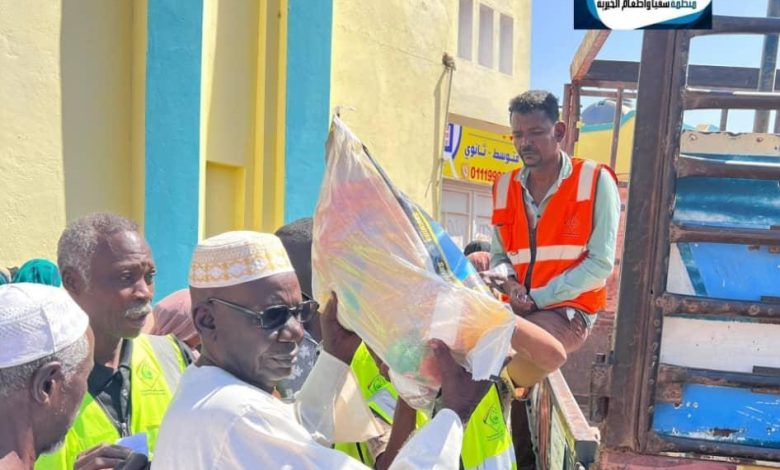
Recently, community activist Hala Al-Shafie distributed 500 food baskets, each valued at more than 200,000 Sudanese pounds, bringing the total support to approximately 100 million Sudanese pounds.
In a broader initiative, businessman Omar Al-Nimeir distributed 5,000 food baskets at an average value exceeding 200,000 Sudanese pounds per basket, raising the estimated total to nearly one billion Sudanese pounds.
Combined, the two initiatives injected an estimated 1.1 billion Sudanese pounds into local communities—a figure that underscores the capacity of civil society actors to mobilize swiftly and deliver interventions with immediate market impact.
A Cross-Border Initiative: Diaspora Support
In a parallel effort, SAPA – Sudanese American Physicians Association announced the launch of a humanitarian initiative for the month of Ramadan aimed at supporting 137,000 Sudanese citizens through multiple food and relief channels, emphasizing standards of quality, efficiency, and transparency.
The project seeks to protect 137,500 individuals across 27,500 families by providing 480,000 hot meals daily through community-based central kitchens operating in Khartoum State, North Darfur, and South Kordofan.
It also includes the distribution of 5,500 fully equipped food baskets across five key states. Each basket contains 13 staple food items tailored to local dietary culture, including flour, cooking oil, dates, hibiscus, and legumes.
The selection of states is based on recorded rates of displacement and malnutrition. Implementation involves 120 trained young volunteers to ensure compliance with humanitarian protection and accountability standards throughout packaging and distribution.
According to the organization, the average cost of supporting one family throughout the project period stands at $83.43—reflecting efficient resource management and strong value for money.
From Relief to Solidarity Economy
Dr. Ahmed Al-Tayeb Abdelqader, Professor of Economics at the University of Khartoum, notes:
“When grassroots initiatives or civil society organizations inject resources of this scale in the form of food goods and services, they constitute a direct intervention in the local consumption cycle, contributing—albeit temporarily—to mitigating the inflationary shock.”
In-kind assistance, he explains, not only alleviates household pressure but also stimulates supply chains, strengthens demand, and effectively injects implicit liquidity into local markets.
Between Emergency Response and Sustainability
Despite the scale and financial value of these initiatives, experts caution that their impact will remain short-term unless integrated into a broader vision addressing:
- Structural inflation
- Weak domestic production
- Fragile supply chains
- Erosion of real incomes
Nevertheless, the figures—both domestically and from the diaspora—highlight the emergence of a nascent solidarity economy, built on community mobilization and diaspora resources to fill urgent gaps in the social protection system.
The question remains open:
Will these initiatives evolve into an institutionalized and sustainable model of organized social safety nets, or will they remain seasonal interventions that ease hardship without tackling its structural roots?