Looted Cars in Khartoum: Government Moves to Curb “Extortion” Phenomenon
Report – Sudan Events
Police in State announced this week a package of measures aimed at regulating the handover of recovered vehicles and pursuing cases of extortion targeting owners of missing cars.
The move follows a surge in reports of vehicles stolen by the militia and criminal networks, alongside documented cases of exploitation by individuals claiming they could recover stolen cars in exchange for large sums of money.
The Anti-Vehicle Theft Unit held a joint meeting with civic initiatives that track looted vehicles through social media platforms. The meeting established a number of regulations, most notably: prohibiting the handover of any vehicle to any party or individual without prior coordination with the Anti-Vehicle Theft Department at the Criminal Investigations Directorate; requiring initiative organizers to submit lists of clients’ names and contact numbers, as well as inventories of vehicles in their possession; providing official registration certificates for the initiatives along with the names of supervisors; and barring citizens from receiving their vehicles directly through initiatives or any unofficial entity. Instead, owners must coordinate with the Anti-Vehicle Theft Unit.
These procedures are expected to limit extortion cases faced by owners of missing vehicles. In many instances, individuals who locate a car demand payment before returning it to its owner. The requested sums—depending on the vehicle’s value—have ranged between 2 and 18 billion Sudanese pounds. Victims often face protracted bargaining and pressure before reaching the payment stage, only to retrieve a vehicle reduced to a mere “skeleton”—a local term describing a car stripped of its engine, doors, and all major components.
Typically, members of the Rapid Support Forces (RSF) transport stolen vehicles outside State to neighboring regions and countries, including , , and . Some vehicles were taken to Darfur, while others were abandoned in streets and homes before the militia’s withdrawal. Organized groups then dismantled many of these vehicles to sell the parts as spare components, fully aware that the cars could not be resold intact. Thousands of vehicles have been reduced to stripped frames, commonly referred to as “skeletons.”
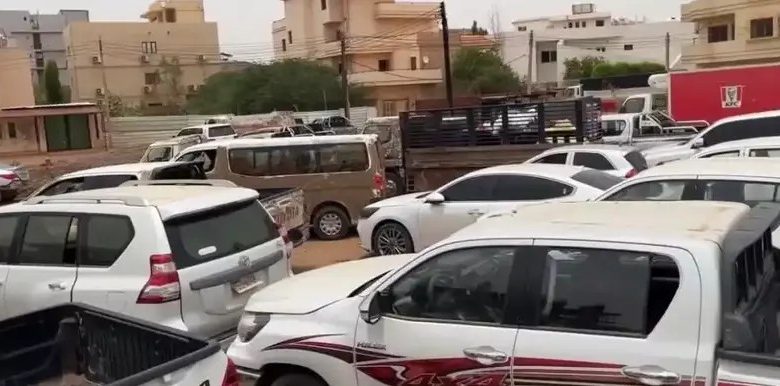
According to police spokesperson Brigadier General , a total of 89,621 reports of missing vehicles have been filed through the official police platform. Authorities have retrieved 6,968 small vehicles and nearly 300 large trucks from the streets of State. The recovered vehicles were assembled at 16 locations in and five sites in . Of these, 3,122 vehicles have been identified and matched to their rightful owners.
These figures remain small compared to the true scale of theft in the capital, where vehicles were looted on a massive scale. Some were stripped down entirely, others transported to Darfur—particularly to cities such as and —or smuggled abroad to , , , southern , and .
As joint forces advance on the ground, the scale of systematic looting in the capital has become increasingly evident. Given that operating or re-registering these vehicles after the war would likely expose their stolen status, many perpetrators opted to dismantle them entirely and sell the parts. A thriving black market has emerged, catering largely to owners whose cars were themselves stripped; they purchase spare parts—cheap in some locations, expensive in others—despite knowing the components were stolen from vehicles left abandoned on roadsides.
Reports also indicate that thieves are attempting to transplant parts onto other vehicles with legitimate registration documents, often in repair workshops. This prompted the Khartoum State government to issue a specific decision after joint forces raided several workshops and seized fully intact stolen vehicles concealed within them.
Meanwhile, groups are reportedly buying stripped car frames and restoring them to operational condition. This suggests that certain actors possessing looted spare parts are seeking to reassemble the vehicles entirely by purchasing both the stripped frames and the original ownership documents. Specialized teams are then tasked with reinstalling stolen components and returning the vehicles to the market as fully operational units for resale—a practice that has become increasingly widespread.
Owners left with little more than a stripped chassis often prefer to sell what remains, along with the vehicle’s registration papers, for modest sums, given that the car has been completely dismantled.
Notably, some of the groups currently operating claim to possess “Boko” cars—a local term for vehicles imported without official documentation or customs clearance—and aim to transfer their parts to legally registered vehicles of the same model, effectively legitimizing the stolen components.