Five-Party Mechanism Moves Toward “Declaration of Principles” to Resolve Sudan Crisis
Sudan Events – Agencies
The five-party mechanism concerned with the Sudanese crisis is moving toward issuing a “Declaration of Principles” aimed at establishing a framework for resolving the country’s political crisis, following the completion of consultations with political blocs and forces in the coming days.
The mechanism includes the United Nations, the African Union, the Arab League, the European Union, and the Intergovernmental Authority on Development (IGAD). Over the past two days, it has intensified its activities through a series of meetings with Sudanese political actors in several capitals.
An official within the mechanism told Al Jazeera Net that these efforts are proceeding in parallel with the activities of the Quad group—comprising the United States, Saudi Arabia, Egypt, and the United Arab Emirates—which proposed a roadmap in September aimed at ending the war in Sudan through a ceasefire.
The official, who requested anonymity, explained that efforts to secure a humanitarian truce, which could evolve into a comprehensive ceasefire, will still require a broad political vision formulated by Sudanese actors. He noted that the five-party mechanism is working toward this goal by organizing a political process that includes the country’s key stakeholders.
He added that the mechanism opted—rather than immediately calling for a meeting to arrange a Sudanese-Sudanese dialogue conference—to begin with consultation rounds with different political forces to gauge their views and identify common ground that could later be developed into a framework document and eventually transformed into a Declaration of Principles addressing the crisis.
The approach, he said, followed the failure of several previous meetings hosted in capitals such as Addis Ababa, Switzerland, and Cairo, which faltered due to political polarization and divisions among Sudanese forces amid the ongoing war.
Questions Ahead of Dialogue
The official revealed that the mechanism distributed a document to political blocs containing a set of questions regarding their vision for the agenda of a Sudanese-Sudanese dialogue, its general framework, and the key issues that should be discussed. The document also sought views on steps needed to create a conducive environment for a political process and the timeframe required to complete it.
According to the official, the paper also included questions about mechanisms to ensure the participation of key actors—including youth, regions, and marginalized communities—in order to guarantee the success of the dialogue, sustainable stability, and Sudan’s democratic civilian transition.
In this context, representatives of the mechanism held a virtual meeting with political forces in Port Sudan, including the National Movement Alliance led by former Darfur Regional Authority head Tijani Sisi Atim, and the National Forces Coordination, headed by Mohamed Sayed Ahmed “Al-Jakoumi.”
The mechanism is also expected to meet in the coming days with representatives of the Founding Sudan Alliance (“Tasees”), led by Rapid Support Forces commander Mohamed Hamdan Dagalo, known as “Hemedti.”
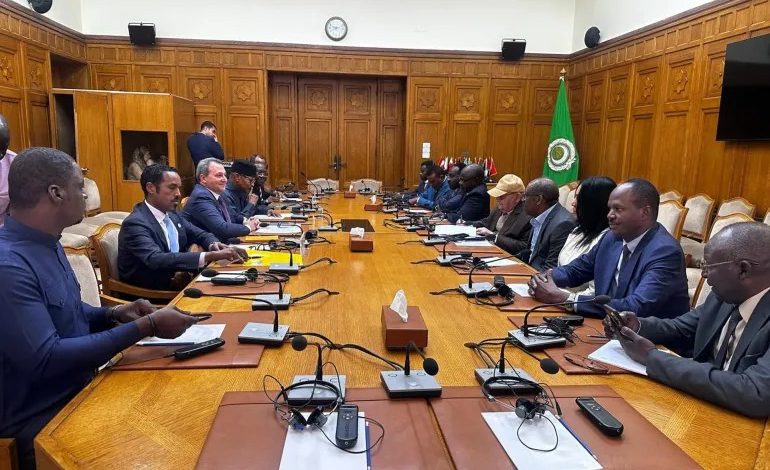
Over the past two days, the mechanism also held meetings in Cairo with several Sudanese political groups, including the Democratic Bloc, which is close to the army, the Umma Party, and the Civil Democratic Alliance of Revolutionary Forces (“Sumoud”).
The delegation of the five-party mechanism included its head Mohamed Ibn Chambas, representing the African Union; Ambassador Zaid Al-Saban for the Arab League; Adolfa Dredge for the European Union; Ambassador Lawrence Korbandy representing IGAD; and Mohamed Goumehya, representing the UN Secretary-General’s Special Envoy.
Proposals for National Reconciliation
Meanwhile, Mubarak Al-Fadil Al-Mahdi, leader of the Umma Party, told Al Jazeera Net that the meeting with the five-party mechanism was productive. He said the party submitted its responses to the questions posed and presented proposals related to national and societal reconciliation and ensuring broad participation in the political process.
Al-Mahdi stressed the importance of reaching a Declaration of Principles that would lead to sustainable peace in Sudan and pave the way for the adoption of a constitution governing the country’s affairs, as well as agreement on a mechanism for selecting a government to manage the state during the next phase.
He also emphasized the need for security and military reforms to address the status of various armed formations, ultimately leading to the establishment of a unified professional national army.
Regarding the impact of the U.S.–Israeli war on Sudan’s situation, Al-Mahdi said regional developments do not render Sudan’s war a forgotten issue, as some believe. On the contrary, he said, they increase the importance of achieving stability in Sudan, the Red Sea, and the Horn of Africa.
He added that the tense regional environment could prompt some actors to exploit the fragile security situation, potentially threatening the security of the Red Sea, a vital route for global trade and oil transport.
This reality, he said, calls for greater regional and international engagement to support peace efforts in Sudan, press for an end to the war, and prevent any parties from exploiting the conflict to threaten regional security.
Democratic Bloc’s Vision
For his part, Mohamed Zakaria, spokesperson for the Democratic Bloc alliance, said the coalition presented its vision for the political process in Sudan during its meeting with the five-party mechanism.
In a statement, Zakaria said the bloc’s vision calls for launching a Sudanese-led political process based on the principles of Sudan’s unity, respect for its sovereignty, and the legitimacy of its institutions.
He explained that the proposal includes two parallel tracks: a political track involving civilians to address governance and transitional issues, and a security track involving the armed forces based on the Jeddah Declaration, ultimately leading to the dismantling of the Rapid Support Forces.
Zakaria added that the Democratic Bloc insists the political process must include all Sudanese forces, except those implicated in war crimes, genocide, or ethnic cleansing.
The alliance also called for limiting the role of international actors to facilitating political dialogue, while coordinating with Egypt and other international stakeholders. It stressed the principle of Sudanese ownership of the political process through the formation of a national committee to lead dialogue among Sudanese political forces.