Exclusive: Ethiopian Military Base Secretly Supports Sudan’s RSF
Sudan Events – Agencies
Middle East Eye has revealed that Ethiopia is providing covert support to Sudan’s paramilitary Rapid Support Forces from a military base located in the Benishangul-Gumuz region.
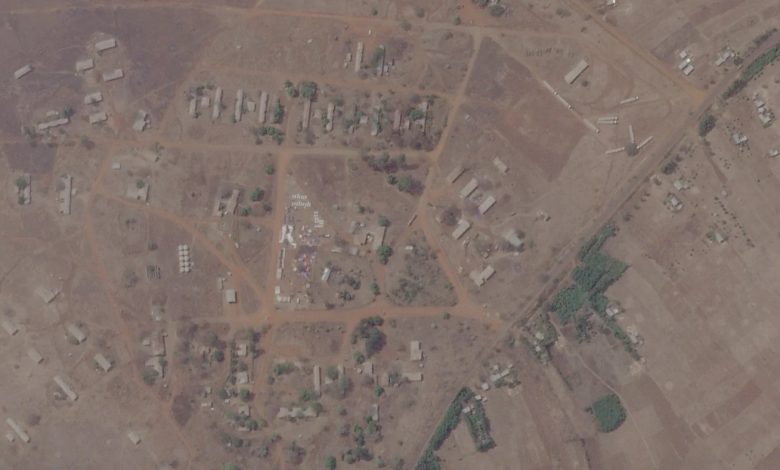
Satellite imagery analyzed by the Humanitarian Research Lab at the Yale School of Public Health, and reviewed exclusively by Middle East Eye over several months, shows extensive activity consistent with alleged military support for the RSF at a base belonging to the Ethiopian National Defense Force on the outskirts of the city of Assosa in western Ethiopia.
From December through the end of March, as RSF forces carried out intensified cross-border attacks on Sudanese army positions in Blue Nile State, vehicle transporters were observed entering and exiting the Assosa base carrying technical vehicles. Tents capable of accommodating up to 150 fighters were also visible, along with the distribution of supplies.
In February, approximately 200 combat vehicles were identified within the base. Unarmed technical vehicles were modified with mounts for heavy machine guns, and similar vehicles were later observed during RSF battles in the Blue Nile region.
Satellite imagery reviewed by Middle East Eye, and set to be published in an upcoming Yale report, along with images and videos circulating online, links the vehicle transporters and other equipment seen in Assosa to the coastal city of Berbera in Somaliland, where the United Arab Emirates operates a military base. Technical vehicles matching the same color, size, and armament were also seen in footage from fighting in and around the Sudanese border town of Kurmuk, located approximately 100 kilometers from the Ethiopian base. The town was captured by RSF forces and their allies from the Sudan People’s Liberation Movement–North at the end of March following intense fighting.
Nathaniel Raymond, Executive Director of the Humanitarian Research Lab at Yale, told Middle East Eye:
“Since last autumn, there have been allegations that Ethiopia allowed RSF forces to launch attacks into Blue Nile from its territory.”
He added:
“This report provides the first visual evidence supporting those claims. In fact, the situation is worse than initially feared—the Ethiopians are not just assisting the RSF, they are doing so from an actual Ethiopian military base.”
Multiple sources—including current and former Ethiopian military officers, Sudanese military and intelligence analysts, a European diplomat, and a former adviser to Ethiopia’s Ministry of Foreign Affairs—confirmed to Middle East Eye the existence of a base used by RSF forces in the remote, conflict-affected Benishangul-Gumuz region. However, its exact location had remained a closely guarded secret.
These sources stated that the United Arab Emirates, which continues to deny supporting the RSF despite mounting evidence, has been a decisive factor in Ethiopia’s involvement in the Sudanese war, which began in April 2023 between the Sudanese Armed Forces and the RSF. The conflict has resulted in the world’s largest humanitarian crisis, with hundreds of thousands killed and more than 11 million displaced.
A recent United Nations fact-finding mission concluded that RSF forces committed acts of genocide during their takeover of the city of El Fasher, the capital of North Darfur State. Civilians who fled the city told Middle East Eye that RSF fighters carried out acts of rape, executions, and even blood extraction from men, women, and children as they attempted to escape.
A former adviser to the Ethiopian government said:
“Many within Ethiopia’s foreign ministry and beyond believe that the UAE is effectively managing the file in Ethiopia concerning the Sudanese government, the RSF, and Eritrea—particularly with regard to the port of Assab—for at least the past two years.”
Neither the RSF, the office of Ethiopian Prime Minister Abiy Ahmed, nor Ethiopia’s Ministry of Foreign Affairs responded to requests for comment from Middle East Eye.
For his part, Emirati academic Abdulkhaleq Abdulla, a former adviser to UAE President Mohammed bin Zayed, criticized what he described as “the singling out of the UAE” over alleged support for the RSF, noting that the group also “receives support from Uganda, Ethiopia, and Chad.” In contrast, the Sudanese Armed Forces receive most of their military support from Turkey and Egypt.
Attacks from Ethiopia into Sudan
According to the Yale research unit, support from the Assosa base to the RSF dates back at least to November 8 of last year, when satellite imagery showed 15 cargo trucks arriving at two different locations.
Subsequently, commercial vehicle transporters not affiliated with the Ethiopian military were observed frequently visiting the base, unloading up to 200 technical vehicles in February—vehicles not used by the Ethiopian army. The research unit monitored 14 other bases in the region and found no comparable activity, suggesting that Assosa is an exceptional case.
Videos published in early November show vehicle transporters allegedly moving white and sand-colored technical vehicles from the port of Berbera in Somaliland—where a UAE base is located—to RSF fighters operating from bases inside Ethiopia.
Satellite images from February 18 and March 29 show vehicle transporters inside the Assosa base matching those seen in the videos, along with additional footage showing these transporters heading east toward Assosa carrying similar vehicles.
The same vehicles appear to have later been seen in images and videos from fighting in and around Kurmuk, approximately 100 kilometers from the base.
During the same period, flight tracking data showed multiple IL-76 cargo aircraft linked to the UAE flying from Abu Dhabi to various Ethiopian airports, including Bahir Dar in the Amhara region, about 300 kilometers from Assosa.
At Assosa airport, transport aircraft were observed in February and March, including a helicopter approximately 20 meters in length—likely an Mi-17—and a cargo plane believed to be a C-130, a model used by the UAE.
While vehicles were moving from Assosa toward Kurmuk, the Ethiopian military was simultaneously deploying large numbers of troops northward toward the Tigray region, more than 1,500 kilometers away.
Expanding Emirati Role
As vehicles were observed moving from Berbera to Ethiopia, tensions were rising between the Somali government in Mogadishu and Abu Dhabi over UAE support for Somaliland and Puntland.
Berbera and Bosaso form part of a network of UAE-operated bases developed in cooperation with Israel and the United States, creating a strategic arc of influence around the Red Sea and the Gulf of Aden. These bases are also reportedly used as supply lines for RSF forces in Sudan.
On December 26, Israel became the first country to officially recognize Somaliland’s sovereignty, and discussions began regarding the establishment of an Israeli base in Berbera.
On January 12, Somalia canceled all agreements with the UAE, including those related to the ports of Berbera and Bosaso, increasing the importance of Ethiopia as a partner for the UAE.
Since Abiy Ahmed assumed office in 2018, economic and military ties between Ethiopia and the UAE have significantly strengthened.
Analysts noted that geopolitical interests, along with tensions between Addis Ababa and Abdel Fattah al-Burhan since the Tigray war, are key drivers behind Ethiopia’s involvement in the Sudanese conflict.
On March 3, the Sudanese government publicly accused Ethiopia of involvement in the war, while RSF forces launched a major offensive on January 25 against Sudanese army positions in Blue Nile State.
Intensive Logistical Activity
Between late December and late March, the base witnessed intensive activity, including the construction of tents, movement of vehicles, and distribution of supplies—described by the Yale research unit as consistent with high-tempo military support operations.
Multiple shipping containers were brought in, supplies were distributed, and between five and fifteen tents were erected, accommodating up to 150 personnel. No similar activity was observed at other Ethiopian bases in the region.
Commercial transport vehicles not resembling those used by the Ethiopian military were seen repeatedly entering and leaving the base.
Satellite imagery from March 27, 2026, shows a white vehicle transporter carrying light vehicles along a main road east of the town of Mendi, approximately 95 kilometers southeast of Assosa, a key junction connecting routes toward Berbera.
March imagery also shows around 40 possible armored personnel carriers, and technical vehicles modified to mount .50-caliber machine guns.
The base includes multiple fuel storage tanks, enabling large-scale refueling operations, unlike smaller nearby sites.
The vehicles observed in satellite imagery match those used by RSF forces in combat operations in Blue Nile.
The Yale report concluded:
“Assosa represents a major logistical hub for activities consistent with the provision of military support by Ethiopian defense forces to the Rapid Support Forces, offering an ideal location for supplying fuel, shelter, maintenance, and operational support.”