Between Denial and Confirmation: War-Ending Negotiations Enter a Grey Zone
Report — Sudan Events
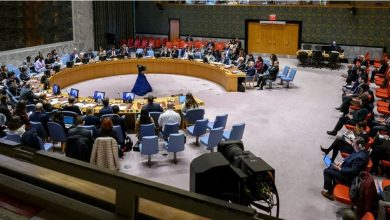
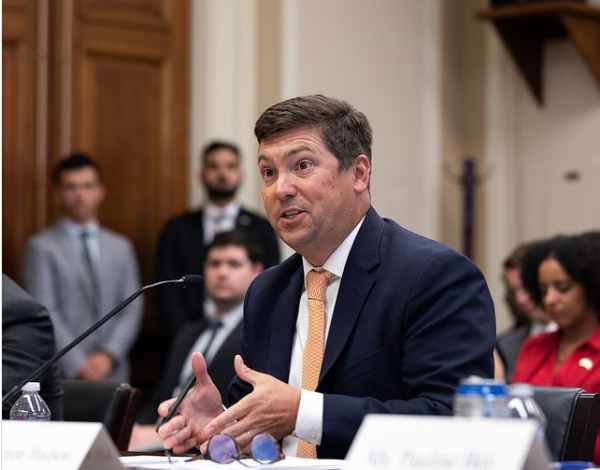
Cameron Hudson, a former U.S. diplomat and expert on African affairs, and senior fellow with the Africa Program at the Center for Strategic and International Studies (CSIS), said the Washington Conference to Support Sudan was nothing more than an attempt to whitewash the United Arab Emirates’ crimes in Sudan.
Hudson added that the conference, held in Washington, was part of what he described as an “aid-laundering” process practiced by the UAE to cover up its actions, rather than a genuine effort to raise new funds or open new humanitarian access routes—something he said remains currently impossible. He continued: “Washington’s participation appears particularly distasteful and may even undermine efforts to reach a ceasefire agreement, all because the U.S. administration wants to keep the UAE on its side.”
He explained that evidence the event was merely an attempt to launder Emirati aid lay in the fact that no countries sent senior officials—except, of course, the UAE—and that no new financial pledges were announced. “Pledging and donor conferences are not held this way,” Hudson said. “Aid budgets are set in advance, and countries with functioning parliamentary systems—unlike the UAE—do not make sudden financial commitments. Such funds are either pre-allocated in budgets or reprogrammed when political priority is high, which does not appear to be the case for Sudan.”
Hudson further noted that no Sudanese parties were invited, not even officials from the Humanitarian Aid Commission, whose presence would have been crucial as the body responsible for aid delivery. “In other words,” he said, “this conference was not interested in taking practical steps to break the humanitarian aid deadlock, nor was it concerned with raising new funds. Governments were given only one week to submit pledges, and there was no attempt to gather the world’s most powerful political leaders to focus, even briefly, on Sudan. This clearly was not important to them, as evidenced by the fact that invitations were extended only to embassies accredited in Washington.”
He went on to describe the event as “a multi-episode public relations show in which the United States issues grand promises to end the war, build international consensus, and achieve diplomatic breakthroughs, without any serious effort to effect change on the ground.” Hudson concluded: “Despite my understanding of attempts to create momentum amid near-total absence, the continued issuance of false alarms by the United States about reaching an agreement—while simultaneously deepening its alignment with the UAE—remains a poor approach.”
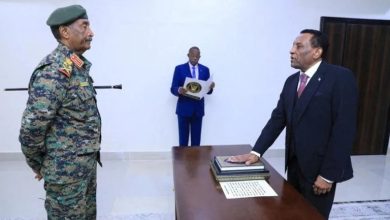
Meanwhile, Vice President of Sudan’s Sovereignty Council Malik Agar responded to claims made by U.S. presidential adviser Massad Boulos, who said that the International Quartet had reached a final text for a peace agreement in Sudan. Agar denied the claim, stating there were no understandings regarding the war. He added: “We have repeatedly stated that there are no negotiations as long as the militia remains in residential areas and civilian property.”
Despite Boulos’s insistence and leaks suggesting an imminent announcement by U.S. President Donald Trump of the initiative, the Sudanese government—represented by the Chairman of the Sovereignty Council—has continued to affirm that it will not accept any agreement that leaves the militia in its current positions, allows it to expand, or enables it to acquire weapons.
This stance, according to political science researcher Al-Badawi Mohamed Al-Haj, reflects what he calls a “finger-biting” strategy. He explained: “We will see who forces the other side to pull their hand away first.” He added: “I do not believe that Burhan has given the green light to any agreement that would withdraw his forces from cities and leave them exposed. I do not think he would accept equating the Sudanese army with a tribal militia. Such a move would open many fronts against him domestically and internationally.”
Al-Haj continued: “He is a man who knows how to manage his battles and deal with pressure. Had he been willing to accept such agreements, he would have done so at the outset, when his military position was shaky and the militia controlled the capital and Al-Jazira, threatened the Nile State, and sought to expand eastward.”
He concluded that the current “grey line,” which has become more prominent than other trajectories, stems directly from the ongoing finger-biting contest between Sudan and the UAE, as well as between both parties and other regional and international capitals. “The war in Sudan is not only being fought on the ground,” he said. “There is a vast arena of ambitions, conspiracies, and behind-the-scenes maneuvering that shapes the entire scene.” He concluded by saying: “What is happening now, in my view, is closer to the end of the war than at any time before.”