A Dialogue with Mubarak Al-Fadil
As I See
Adel El-Baz
1
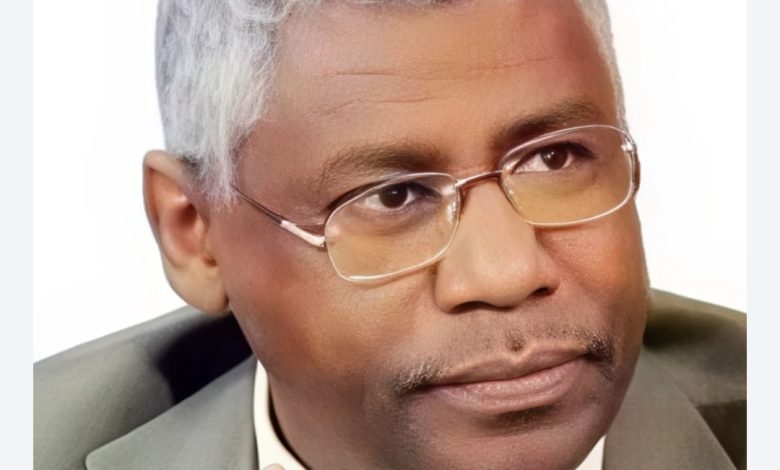
Yesterday, Mr. Mubarak Al-Fadil posted a statement answering two questions he had posed himself: Why can’t a Sudanese dialogue be held inside Sudan? And why do we support the external dialogue organized by the International Quintet?
His answer to the first question was that “there are communities under militia control that cannot participate in the dialogue.” The second reason, he argued, is the existence of “the majority of political forces that reject the war and oppose the continuation of military rule.”
In his assessment, the result would be that “an internal dialogue would, first, entrench Sudan’s division; second, support and encourage the continuation of the war; and third, reinforce continued authoritarian military rule based on the October 2021 coup.”
These, then, are the reasons Mr. Mubarak gives for rejecting the Sudanese-Sudanese dialogue announced by the government, which is to be held inside Sudan, while preferring the Quintet dialogue that will take place abroad.
Before examining the motives behind his preference for the Quintet dialogue, let us take a closer look at the reasons he has put forward against holding the dialogue at home.
2
I could not understand his argument that communities in areas controlled by the Rapid Support Forces would not be able to participate. Darfuri tribes are spread across every part of Sudan, so what would prevent their members from participating in a national dialogue held inside the country?
Unless Mr. Mubarak believes that members of those tribes residing in RSF-controlled areas possess an exclusive right to represent their communities, while anyone—for example, belonging to the Rizigat tribe and residing in areas controlled by the army—would have no right to represent the Rizigat community, even if he were the tribe’s own leader.
Can it really be the case, for example, that the Masalit should not participate because some of their members live in areas controlled by the RSF?
This is truly a perplexing line of reasoning.
3
As for the political forces Mr. Mubarak describes as “opposed to the war,” they are, in reality, the forces that contributed to causing the conflict and prolonging it after abandoning the Sudanese people and maintaining their suspicious silence toward the militia that rejected the Jeddah Declaration—the declaration that could have paved the way for peace during the first weeks of the war.
But after realizing that the militia’s attempted coup had failed, they adopted the slogan “No to War” as nothing more than a political cover.
Those forces were opposed to the defeat of the militia, not to the war itself. Otherwise, they would have supported the Jeddah Declaration and unequivocally condemned the militia’s violations.
Isn’t that the reality, Mr. Mubarak?
Despite these positions, the state is currently making strenuous efforts to create conditions that would allow “Sumoud” and others who aligned themselves with the militia to return and participate, while providing them with all the necessary guarantees.
If we compare this experience with international examples, this is hardly a political novelty. South Africa provides perhaps the most prominent example.
Before the negotiations that brought an end to apartheid between 1990 and 1994, the government of F. W. de Klerk took courageous confidence-building measures: it released Nelson Mandela, lifted the ban on the African National Congress, and provided guarantees for the return of exiles without persecution.
Indeed, Oliver Tambo and thousands of other exiles returned, and the dialogue took place inside South Africa, rather than in foreign capitals.
4
Mr. Mubarak has not disclosed the real reasons preventing those “opposed to the war” from returning. He surely knows that the primary obstacle is the position of their external sponsors.
An internal dialogue would deprive those sponsors of the ability to control the agenda or dictate the outcomes.
This raises an obvious question: How can Mr. Mubarak and his opposition allies call for a “Sudanese-Sudanese” dialogue with a national agenda, yet hold it on foreign soil under external tutelage?
That is a remarkable contradiction, Mr. Mubarak.
5
Turning to the consequences that Mr. Mubarak fears would result from an internal dialogue, he summarized them in his post as follows: “entrenching Sudan’s division, supporting the continuation of the war, and consolidating authoritarian military rule.”
In my view, this is nothing more than a political scarecrow.
The division within Sudan has already occurred. Those aligned with the army and the state remain firmly committed to their positions, while those who support the militia and its backers remain trapped in their choices because there is no avenue for them to break away—and Mr. Mubarak knows the reasons very well.
On the contrary, dialogue inside the country could help narrow the differences and make the parties more open to one another, while fully recognizing that neither internal nor external dialogue will produce complete agreement among all sides.
That would be an illusion even if the dialogue were held on Mars!
6
As for Mr. Mubarak’s claim that internal dialogue would encourage the continuation of the war, what is the logical connection between the two?
The war is already underway and continuing. It will continue until the rebellion is defeated or surrenders; under the state’s current position, there is no third option.
Here, it is essential to clearly distinguish between different tracks.
Civil and political dialogue is fundamentally different from military negotiations. If there is anything capable of stopping the war, it is direct dialogue between the warring parties or negotiations with the United Arab Emirates as the party backing the RSF.
That is the practical path.
Political dialogue, by contrast, is intended to reach agreement on broader national issues and establish a roadmap for the transitional period. Such dialogue may help create a conducive environment and bring viewpoints closer together.
But to claim that it will stop the war is a distant prospect indeed, Mr. Mubarak!
7
As for the pretext of “supporting authoritarian military rule,” one cannot help but ask: Since when has Mr. Mubarak Al-Fadil been an opponent of military rule?
Was it before the National Salvation regime, during it, or after General Burhan’s coup?
Indeed, the Umma Party itself has a long history of dealing with military coups. Who, after all, inaugurated the era of coups in Sudan in the first place?
Does Mr. Mubarak now classify himself among the forces opposed to military rule?
What a remarkable claim—and what a story!
8
For all these flimsy reasons, Mr. Mubarak prefers the Quintet dialogue, claiming that it will be “neutral and held on neutral ground” in order to achieve national reconciliation and consensus on democratic transition.
But Mr. Mubarak has not told us where this “neutral ground” actually is.
On which continent or in which country?
Has he forgotten that all the conferences held during this war have taken place on soil belonging to states with their own agendas?
London, Berlin, Washington, Geneva, Nairobi, or Addis Ababa?
Where, exactly, is this supposedly neutral ground?
Some leaders may even regard the United Arab Emirates as neutral territory!
As for the promises that dialogue abroad will stop the war, they are nothing more than a political falsehood. Genuine solutions are not prevented by holding dialogue on Sudanese soil when intentions are sincere and everyone recognizes their historic responsibility.
9
Mr. Mubarak Al-Fadil’s current opposition to the authorities in power—which he strongly supported in their early days and at the beginning of the war—appears to have led him toward strange visions that effectively hand the solution over to external actors and treat the slogan “Sudan for the Sudanese” as nothing more than an illusion from the past.
Sudan, in his view, has now become an open arena for the agendas of the Quartet and the Quintet.
May God have mercy on Imam al-Mahdi, who died dreaming of conquering the world, while today we see his descendants aligning themselves with the conquerors.
What a strange world indeed!