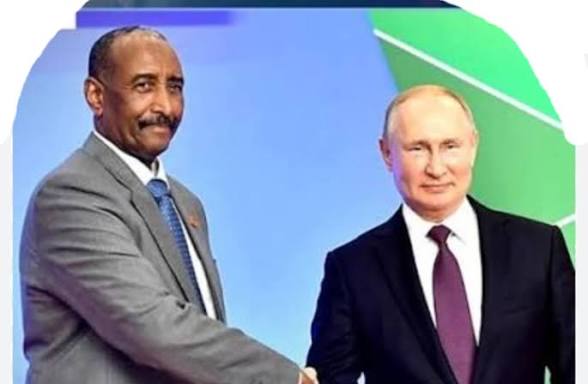
Sudan’s Sovereignty Council Chairman, General Abdel Fattah al-Burhan, is leading Sudan’s delegation to the third Russia–Africa Summit, scheduled to take place in Moscow on October 28–29.
The Sudanese delegation includes the ministers of foreign affairs and finance, the director general of the General Intelligence Service, and the director general of the Defense Industries System. The Sovereignty Council chairman is scheduled to address the summit, hold bilateral talks with his Russian counterpart, and visit the Russian State University for the Humanities.
Sudan’s ambassador to Russia, Mohamed al-Ghazali al-Tijani Siraj, told the Sudan News Agency (SUNA) that Sudan’s high-level participation comes at a time when bilateral relations between the two countries are developing across various fields, with close cooperation and coordination, particularly in international forums.
He said Russia had demonstrated its credibility and commitment through its recent support for Sudan, adhering to the guiding principles of its foreign policy, which include non-interference in the internal affairs of other countries, building relations on the basis of mutual interests without exploitation or conditionality, and respecting the sovereignty and territorial integrity of states.
The ambassador added that Russian support for Sudan had consistently been based on these principles. He said Russia was among the first countries to affirm the sovereignty of Sudan and its legitimate institutions, particularly the Sudanese Armed Forces, as they wage a war of attrition amid what he described as evident regional and international support for their adversaries.
He also noted that Russia had defended Sudan in international forums, particularly at the United Nations Security Council, by exercising its veto power and opposing attempts to undermine Sudan’s sovereignty and unity.
“The latest Russian position against attempts to expand the scope of Resolution 1591 to include sanctions across the entirety of Sudanese territory is further evidence of this. These are commendable positions that have remained consistent throughout the crisis facing Sudan,” he said.
Al-Ghazali added that Sudan’s participation in the summit was important in light of the role Russia could play in Sudan’s postwar reconstruction. He noted that the Joint Intergovernmental Committee for Economic and Trade Cooperation had continued to meet regularly and that Russia was the first country with which Sudan held a ministerial committee meeting after the outbreak of the war, in September 2025.
He said the protocol adopted at the committee’s eighth session provided a clear roadmap for a constructive Russian role in reconstruction projects across several sectors, including energy, oil, mining, agriculture, infrastructure, higher education, and other fields.
He added that the occasion carried particular significance as the two countries celebrate the 70th anniversary of the establishment of diplomatic relations this year. He described those relations as having generally been characterized by shared political will, strength, and resilience, with the leadership of both countries working to deepen ties and advance their partnership across various sectors.
Al-Ghazali said Al-Burhan’s participation was particularly significant as Sudan moved forward with determination, supported by the resolve of its people and armed forces to consolidate state institutions, preserve national unity, safeguard its institutions, and resist foreign interference in its internal affairs. He pointed to what he described as successive victories by Sudan against the “terrorist militia” and its regional and international supporters.
He added that Sudan had demonstrated that the will of peoples could not be defeated and that injustice would eventually disappear, regardless of how long it persisted. He said these were important messages to convey at an international gathering that offered an opportunity to highlight Sudan’s unity and solidarity in the face of those it considers its adversaries.
He also noted that Sudan’s address to be delivered by the president would carry profound messages for international and regional leaders and organizations, presenting Sudan’s vision for achieving peace and stability, while preserving its sovereignty and unity.
Regarding the significance of the summit, Sudan’s ambassador to Russia said the third Russia–Africa Summit was taking place amid intense regional and international polarization. He argued that, as the international order moves away from the principles and foundations of the United Nations Charter, Russia is seeking to position itself as a leading advocate of a multipolar international system.
He said Russia’s vision for its relations with Africa could be understood in this context, adding that African countries viewed engagement with Russia as an opportunity to build equitable partnerships free from political pressure and to advance development, progress, and prosperity through cooperation on Russian proposals for stability and development.
He highlighted growing African interest in mechanisms for partnership with Russia and confirmed that, according to available information, more than 36 heads of state and government were expected to participate in the summit.
Regarding the summit’s agenda, he said the leaders would discuss Russia–Africa partnership relations on the basis of three draft documents: the Russia–Africa Summit Declaration, a declaration on cooperation in the peaceful use of artificial intelligence technologies, and the Russia–Africa Partnership Action Plan for 2027–2029.
These documents address cooperation between Russia and Africa and ways to strengthen it across various sectors. The summit’s political declaration focuses on political, economic, legal, and security issues, as well as education, science, health, the environment, climate, and other areas.
The draft action plan emphasizes strengthening the partnership forum as an institutional framework and mechanism for advancing Russia–Africa cooperation. It also calls for continued dialogue, regular ministerial conferences, expanded consultations, and coordination of positions both bilaterally and in international forums.
The plan focuses on key issues such as digital economy cooperation, the development of trade and tourism, the systematic digitization of natural resources, and the importance of national capacity and economic development in Russia and African countries. It also includes providing the necessary support to African countries in their efforts to achieve balanced development in line with the continent’s Agenda 2063, “The Africa We Want.”