Sudan’s National Records Office Pays the Price of War: What Remains of Its Historical Memory?
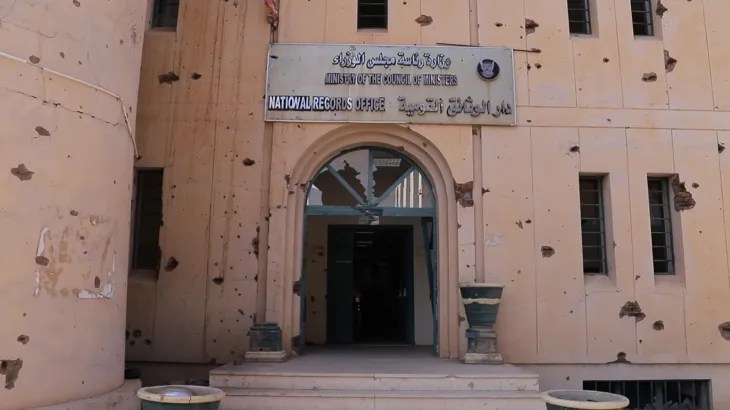
Documents do not merely preserve the history of nations; they safeguard the details of their lives and transformations, leaving future generations tangible records of what societies have experienced throughout the ages.
Hidden within manuscripts, letters, correspondence, and old registers are the stories of individuals, institutions, and events. Some of these documents may be the only surviving sources of information about particular periods in a country’s history, with no other copies or alternative records available.
In Sudan, whose history spans successive political, social, and cultural eras, the National Records Office stands as one of the most important repositories of the country’s collective memory.
The damage inflicted on the institution reveals a loss that goes far beyond the destruction of papers and buildings. The burning of original documents for which no alternative copies exist means the permanent loss of historical evidence that cannot be recovered simply by rebuilding the premises or establishing a new archiving system.
Amid efforts to rehabilitate the institution and restore its services, the fate of damaged collections and the possibility of making surviving materials accessible to researchers and academics remain a test of the future of Sudanese historical memory.
What Remains of the Archives?
Mohamed Yousif Mohamed Hussein, Deputy Secretary-General of the National Records Office, says the institution suffered extensive destruction during the war, affecting its buildings, documents, and historical collections. He explained that approximately 75% of the documents remain intact, while around 25% were burned or destroyed.
He added that the lost documents include rare historical materials dating back to earlier periods, some of which have no other surviving copies, making their replacement virtually impossible.
The damage also affected university theses, surplus newspaper archives, and electronic equipment, much of which was destroyed.
In remarks to Al Jazeera Net, Hussein explained that the destruction of electronic servers resulted in the loss of documents stored through the digital archiving system. He noted that the institution is currently no longer equipped to receive researchers and academics because suitable facilities are unavailable.
He indicated that the administration expects to resume receiving researchers in early 2027 as part of ongoing efforts to rebuild and rehabilitate the buildings.
Historical Collections
During a tour of the National Records Office, Al Jazeera Net observed the damage to the exterior buildings. Meanwhile, documents and books that had survived the destruction were seen arranged on shelves in relatively good condition. However, the institution was missing the researchers and readers who once visited to explore its pages and recover historical evidence of Sudan’s past.
The significance of the damage to the National Records Office lies in the nature of the collections it preserves. Its holdings span successive historical periods, including documents dating back to the Sultanate of Sennar, the Sultanate of Darfur, the Mahdist State, and the Anglo-Egyptian Condominium period, in addition to government institutional records and the archives of the Sudanese press.
The institution also houses historical manuscripts dating back to the sixteenth century, covering religious, scientific, and linguistic subjects, including the Holy Quran, Islamic jurisprudence, Sufism, astronomy, and genealogy.
Additional Risks
The risks are not limited to materials that were burned or destroyed. Documents that survived now face another challenge related to their storage conditions inside a building whose sections have been damaged. There are growing concerns about rainwater leakage and the effects of humidity and dust on historical collections, particularly fragile manuscripts that have deteriorated over time.
The institution’s administration had previously announced plans to rehabilitate the building, alongside initiatives to reorganize and digitize the documents in an effort to protect what remains of the archives and make them accessible to researchers once again.
One of the institution’s employees said that the manuscripts preserved in the library require suitable environmental conditions, including controlled temperatures and humidity levels, to prevent their pages from deteriorating, particularly since some date back to very early historical periods.
Speaking to Al Jazeera Net on condition of anonymity, the employee warned that the continued absence of appropriate preservation requirements could expose these collections to further deterioration.
The employee called on official bodies and relevant organizations to contribute to rehabilitating the institution and providing the resources necessary to safeguard its archives.
Researchers Shut Out
For his part, Hamza Abdullah, an academic at a Sudanese university specializing in conflict and border studies, said the National Records Office had been a primary source for his research because of its extensive collection of historical documents, manuscripts, and records, which help trace Sudan’s political and geographical transformations and examine the roots of land- and border-related conflicts.
He explained that consulting these sources had enabled him to examine original documents, compare historical accounts, and verify information.
He added that the war and the damage inflicted on the institution, coupled with the suspension of services for researchers and academics, had significantly affected his research activities. He is no longer able to access the sources on which he relied before the war and has been forced to seek alternative references and materials to continue his studies. Such alternatives, however, do not necessarily provide the same level of detail available in original documents.
In remarks to Al Jazeera Net, he pointed out that the inability to access the institution’s archives affects not only researchers’ ability to complete their studies but also limits opportunities to verify and document historical events, particularly those relating to Sudan’s border history and conflicts.
Between what the institution lost during the war and the collections that survived, restoring its role remains dependent on its ability to protect its archives and make the surviving materials accessible.
Restoring the National Records Office to its former role does not simply mean reopening its doors. It means rescuing what remains of Sudan’s historical memory and ensuring that its sources remain accessible to future generations and researchers, in a country where the war has destroyed part of the written evidence of its own history.
Source: Al Jazeera Net